- Written by: Joe Kelly
- Art by: Ed McGuinness, Cliff Rathburn, Pere Perez
- Colors by: Marcio Menyz, Erick Arciniega
- Letters by: Vc’s Joe Caramagna
- Cover art by: Ed McGuiness, Marte Gracia (cover A)
- Cover price: $4.99
- Release date: March 25, 2026
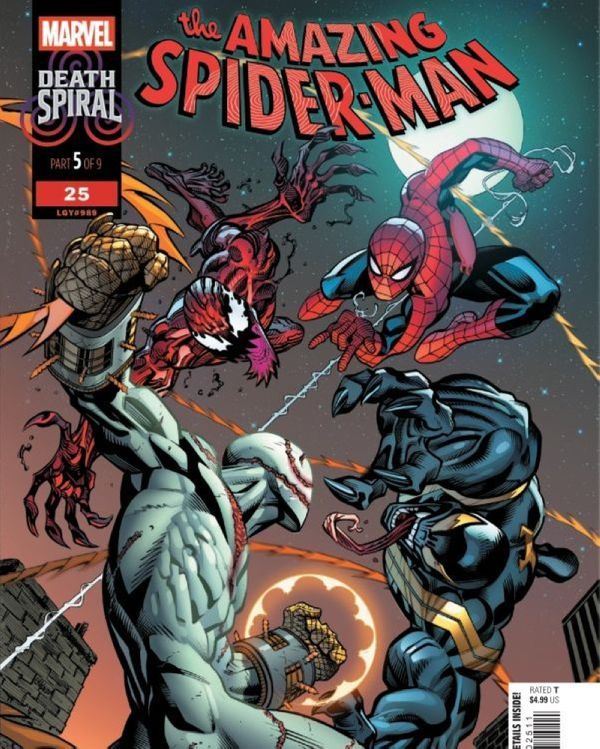
Amazing Spider-Man #25 (Marvel, 3/25/26): Writer Joe Kelly and artist Ed McGuinness smother Peter Parker, Mary Jane Watson, and Eddie Brock in a formulaic “Death Spiral” serial-killer arc where Torment and Carnage grind through family-adjacent victims while the actual leads mostly react. The result is a visually loud but creatively timid chapter that sidelines Eddie’s agency, leans on overcooked monologues, and reads more like event obligation than meaningful story, Verdict: Skip it.
First Impressions
You open Amazing Spider-Man #25 expecting a psychological pressure cooker and instead get something closer to a corporate horror sampler where every beat feels pre-approved for a variant cover line. Kelly sets up a brutal premise on paper, serial killer, Carnage kill-code, Peter and MJ on the hit list, but then keeps dodging the hard emotional collisions in favor of repetitive “Death Spiral” talk that explains more than it actually hurts. The script technically checks the boxes of a focal character, a goal, a journey, stakes, and obstacles, yet it rarely lets those pieces collide in a way that feels surprising or earned, partly because Eddie is literally knocked out of his own story. McGuinness and Menyz do what they can with heavy inks and aggressive reds, but the whole issue plays like an expensive music video for a song that never changes tempo, a lot of noise and posture without enough substance to justify the time or the price.
Recap
In the previous chapter, Eddie Brock was forced to relive his childhood rejection by his father, Carl, then woke in the Bronx to find that Torment had followed through on his “Death Spiral” philosophy by murdering Carl as part of a methodical campaign of family destruction. Torment confronted Eddie, laid out his rules about killing through families before the final victim, and delivered a brutal but strategically incomplete beating, insisting the spirals were not tight enough and walking away before anything truly resolved. That encounter ended with Eddie physically damaged, psychologically gutted, and no closer to understanding Torment’s real endgame. That unresolved tension drags into this issue, which promises escalation but mostly spins its wheels while the killer’s philosophy is repeated rather than deepened.
Plot Analysis (SPOILERS)
The recap page explains that Carnage cut a deal with Eddie to only kill serial murderers, that Torment has accepted a triune challenge to wipe out the circles around Peter, Mary Jane, and Eddie, and that Shocker and Carl Brock are already dead as opening moves. It also reminds you that Spider-Man and Venom agreed to stop Torment together, only for Carnage to betray Eddie at the key moment by putting his consciousness to sleep, turning him into a hijacked weapon with no say in what happens next. From there, the issue puts Peter and this hollowed-out “Eddie” back on Torment’s trail while the killer continues to maneuver through off-panel family targets, keeping the body count mostly conceptual instead of letting you sit with specific losses. The story type is closer to a talky horror event chapter than a grounded thriller, long on declarations about spirals and stakes, short on grounded consequences that hit the page with weight.
As the chapter unfolds, Peter tries to juggle Torment’s threats toward his and MJ’s loved ones with the increasingly erratic behavior of the Carnage-possessed Venom at his side, but the book rarely commits to meaningful conflict between those pressures. Mary Jane stays in the danger orbit, reacting, worrying, and highlighting the human cost, yet the script rarely lets her drive the plot beyond being a named target in Torment’s challenge. Torment continues to posture as a mastermind who carefully designs psychological collapses, yet the actual on-page moves feel repetitive, another speech, another ominous move, without the sense of a spiral tightening in any clever or surprising way. The issue resolves its immediate set pieces in a way that keeps the event moving, but it ducks real closure on Torment, Carnage, or Eddie, leaving you with the sense that you just paid for a long trailer reel for later issues.
Writing
Kelly’s pacing feels oddly static for a book that keeps shouting about spirals and escalation, because the chapter spends too much time re-explaining the premise and not nearly enough time pushing characters into new corners. Dialogue swings between functional and flat, with Peter’s voice losing some of its usual spark when he is forced to constantly react to exposition instead of making sharp, character-defining choices, while Torment’s speeches lean heavily on serial killer clichés dressed up as philosophy. Structurally, the book technically checks the “basics” boxes, Peter as focal character, save family as goal, hunt for Torment as journey, loved ones as stakes, Carnage and the killer as obstacles, but the execution is mechanical rather than organic, like someone assembling a story from a checklist. The biggest structural failure is Eddie’s treatment, because putting his consciousness to sleep not only undercuts a crucial character arc, it also robs the story of the internal conflict that could have turned this into a genuinely tense three-way moral collision instead of a two-hander with a prop.
Art
McGuinness and Rathburn bring their typical bombast, but here that style works against the material as often as it helps, turning what should be a psychological horror story into a parade of oversized figures hitting each other in vaguely grim environments. The layouts are clear enough, with big panels and obvious focal points, yet they rarely surprise you or mirror the emotional beats in creative ways, so the visual storytelling feels efficient but uninspired. Character acting leans heavily on wide-open mouths and exaggerated body language, which sells volume more than nuance, leaving Peter’s guilt, MJ’s fear, and Eddie’s absence feeling flatter on the page than they should in a story about targeted family annihilation.
On the color side, Menyz bathes everything in aggressive reds and murky shadows to reinforce the horror tone, but the lack of contrast starts to blur scenes together into a monotonous soup of anger and darkness. There are occasional attempts at mood shifts, cooler tones or lighter spaces, yet they arrive too infrequently and too briefly to reset your eye or carve out distinct emotional phases. The result is technically competent art that is sharply inked and easy to parse on a surface level, but it rarely deepens the storytelling or sells the psychological stakes, functioning more like slick event packaging than an integral part of the narrative.
Character Development
Peter’s motivation is familiar and solid, protect family, stop the killer, but the script rarely gives him new angles or interesting failures, so he feels like a veteran hero trapped in a rerun, consistent but not especially compelling. Mary Jane remains emotionally grounded and reasonably written, yet she is mostly used as a barometer for how bad things are rather than an active participant shaping outcomes, which makes her feel underutilized in a story that explicitly puts her in the crosshairs. Eddie’s development is where the issue truly stumbles, because stripping him of consciousness for an extended stretch turns a morally conflicted protagonist into set dressing, effectively pausing his journey so the plot can move pieces around him. Torment’s motivations are loudly declared but thin, so instead of a chillingly specific killer with personal ties or twisted logic that reflects the leads, he comes off as a concept more than a character, a mouthpiece for the “Death Spiral” brand.
Originality & Concept Execution
The Death Spiral setup sounds fresh on the recap page, a serial killer who dismantles family networks while a rule-bound Carnage is forced to engage, but on the actual page this chapter mostly repackages familiar symbiote and serial killer beats without pushing them into new territory. Torment’s triune challenge to Peter, MJ, and Eddie could have been a tightly wound, character-specific nightmare, yet here it plays like a generic “everyone you love is in danger” threat that never digs deep into what makes each target unique beyond their proximity to the brand. The choice to knock Eddie’s consciousness out is the clearest example of the concept undercutting itself, because it removes the one truly original tension, Carnage bound by Eddie’s rules, in favor of a simpler, less interesting “Carnage off the leash again” dynamic that we have seen many times before. As a result, the issue reads like a safe, committee-approved middle chapter that protects future event twists at the expense of delivering anything bold or memorable right now.
Pros and Cons
What We Loved
- Clear panel-to-panel storytelling keeps action readable despite dense symbiote detail.
- The Death Spiral idea hints at a more focused, structured horror concept than usual Carnage fare.
- Peter and MJ still sound like themselves, maintaining baseline character consistency.
Room for Improvement
- Eddie’s unconscious status guts his arc and drains the central moral conflict.
- Torment’s dialogue leans on cliché serial killer speeches instead of distinct personality.
- Overbearing reds and bombastic layouts flatten mood into a single loud emotional note.
The Scorecard
Writing Quality (Clarity & Pacing): 2/4
Art Quality (Execution & Synergy): 2/4
Value (Originality & Entertainment): 1/2
Final Verdict
Amazing Spider-Man #25 looks like a big deal on the surface, with loud art, a brutal premise, and plenty of talk about spirals and stakes, but once you get past the packaging you are left with a hollow middle chapter that refuses to let its best characters actually drive the story. The pros, clear visual storytelling and a premise that could support a sharper, more personal horror arc, are outweighed by cons like Eddie’s benched agency, Torment’s generic villain voice, and a suffocating reliance on recap and setup over real progression. If you are already locked into Death Spiral and collecting every issue, this chapter will keep your binder complete, but if you are working with a limited comics budget and hunting for issues that respect your time with strong standalone value, Amazing Spider-Man #25 is a miss you can safely leave on the shelf.
5/10
We hope you found this article interesting. Come back for more reviews, previews, and opinions on comics, and don’t forget to follow us on social media:
Connect With Us Here: Weird Science DC Comics / Weird Science Marvel Comics
If you’re interested in this creator’s works, remember to let your Local Comic Shop know to find more of their work for you. They would appreciate the call, and so would we.
Click here to find your Local Comic Shop: www.ComicShopLocator.com
As an Amazon Associate, we earn revenue from qualifying purchases to help fund this site. Links to Blu-Rays, DVDs, Books, Movies, and more contained in this article are affiliate links. Please consider purchasing if you find something interesting, and thank you for your support.
 Weird Science Marvel Comics