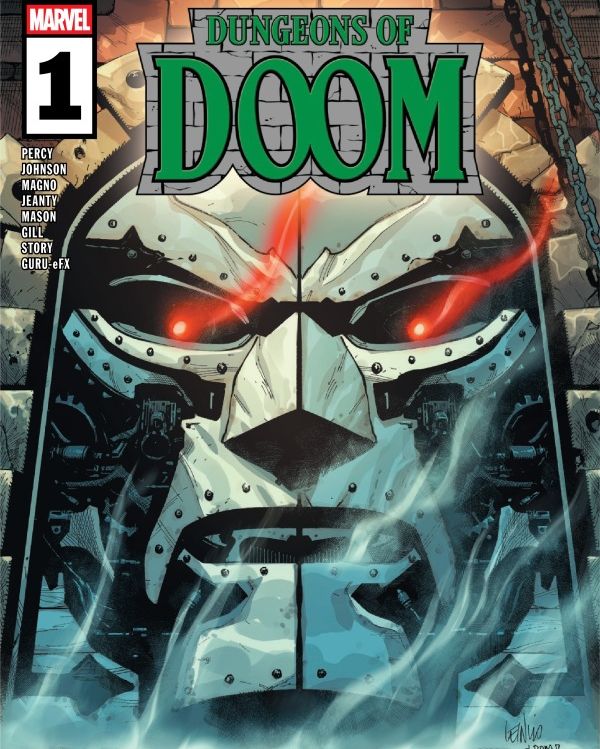
- Written by: Benjamin Percy, Phillip Kennedy Johnson
- Art by: Justin Mason, Robert Gill, Carlos Magno, Georges Jeanty, Karl Story
- Colors by: GURU-eFX
- Letters by: VC’s Travis Lanham
- Cover art by: Leinil Francis Yu, Romulo Fajardo Jr.
- Cover price: $5.99
- Release date: January 14, 2026
Dungeons of Doom #1, by Marvel on 1/14/26, drops readers into a race through Doom’s underground fortress where multiple factions scramble for power, secrets, and survival after the tyrant’s death.
First Impressions
The opening immediately hooks you with Latveria’s descent into chaos following Victor Von Doom’s demise, establishing that this isn’t just another superhero comic but a desperate scramble for resources and power. The tone feels grounded and militaristic, grounding the premise in consequence rather than spectacle. You can sense the weight of what’s been left behind in those dungeons before you even know what it is.
Plot Analysis
The issue opens with competing military forces battling for control of Latveria’s capital stronghold. Thunderbolt Ross and his team get caught in an explosion and are knocked deep underground into Doom’s hidden facility. The soldiers discover a proximity alarm triggered by Professor Charles Xavier’s recorded voice, warning of a dangerous organism that should never have been opened. This is our first hint that something genuinely horrifying lurks below.
Meanwhile, Latverian freedom fighters led by a determined group called the Latverian Resistance find themselves in the tunnels as well. The team includes Sofia, Alexander, and Boris, each scarred by Doom’s regime in ways that run deep. Their leader reveals they’ve got the advantage of knowing the facility’s layout through leaked information and are heading for Doom’s deepest secrets. Their mission is clear: find and weaponize whatever Doom was hiding to liberate their nation.
The narrative cuts between the American soldiers and the Latverian fighters as both groups navigate the facility’s dangers. A mysterious figure named Umbra appears, sent by Wakanda to retrieve something specific from the dungeons. The soldiers encounter a gruesome scene involving one of their team members with a broken back, trapped in some kind of machinery. As they struggle to free him and search for an exit, they discover an impossibly heavy hammer on an anvil.
The issue crescendos with both groups converging deeper into the facility while Xavier’s voice echoes warnings about what waits below. A mysterious figure, described as Umbra, descends through the darkness on Wakanda’s behalf, seeking treasure while serving another master entirely. The final beats suggest that multiple factions are about to collide in dungeons designed to test survival itself, with hints that something far more dangerous than any weapon awaits discovery.
Writing
The pacing moves briskly through the opening sections but occasionally stumbles when juggling multiple storylines simultaneously. Dialogue feels serviceable and character-specific; the military speak works for the soldiers while the Latverian fighters sound appropriately determined and haunted. The structure of cutting between three separate narratives (American soldiers, Latverian fighters, and Umbra) creates momentum but stretches the issue thin. Each group gets just enough space to establish stakes, but none get the breathing room needed for genuine depth.
The cliffhanger lands because of escalating stakes rather than particularly sharp writing.
Art
The rotating art team handles the heavy lifting of showing destruction and confined spaces without sacrificing clarity. The underground sequences read well with good use of shadows and environmental storytelling; you always understand where characters are positioned. Composition shines during action beats, particularly the opening battle where explosions create visual momentum across panels. Color work by Guru-eFX establishes a dark, oppressive mood that matches the premise.
However, the rapid transitions between artists creates slight inconsistencies in character rendering, and some of the quieter character moments lack the visual punch they deserve.
Character Development
The issue establishes clear motivations for each faction: American soldiers following orders, Latverian freedom fighters seeking liberation, and Umbra pursuing something specific. The Latverian group gets the most development through their shared trauma and determination, though it’s surface-level at best. The soldiers feel generic, functioning more as point-of-view characters than distinct individuals. Umbra remains enigmatic, which works for mystery but prevents any real character connection.
The emotional beats land primarily through shared suffering rather than complex character arcs, which is appropriate for an introductory issue but leaves room for deeper connection.
Originality & Concept Execution
The concept of a treasure hunt through a fallen tyrant’s dungeons is solid superhero storytelling, but it’s not groundbreaking. The execution works because it leverages existing Marvel mythology; having Doom’s fall create chaos and expose his secrets feels earned. The horror element introduced by Xavier’s warning provides freshness, suggesting something beyond standard treasure hunting. The Wakandan involvement adds complexity that extends beyond simple national conflict.
The promise of multiple factions converging creates genuine narrative potential, though the first issue itself doesn’t break new conceptual ground beyond establishing that promise effectively.
Positives
The issue’s strongest asset is its commitment to clear stakes and immediate consequence. Every faction has genuine motivation grounded in real suffering or strategic advantage, which makes their collision feel inevitable rather than arbitrary. The environmental design of the dungeons works beautifully, conveying claustrophobia and danger through careful panel composition and shadowing. The rotation of art teams, while occasionally inconsistent, brings fresh visual approaches to each scene.
The opening battle has kinetic energy, the underground tunnels feel trapped and ominous, and Umbra’s sequences carry a sleek, tactical quality. The pacing moves fast enough that you never feel bored and establish enough intrigue that you’ll wonder what Xavier’s warning actually means. The dialogue for the Latverian fighters specifically captures genuine character through their trauma and determination.
Negatives
The biggest problem is that the issue tries to do too much at once. Three separate storylines means none get the development needed for real emotional investment. The American soldiers remain interchangeable, and you won’t care about any of them specifically. Umbra exists as pure mystery without any personality or hint of what makes him distinctive beyond his role as a player in the larger game.
The rapid artist changes, while visually competent, create a choppy reading experience that pulls you out of immersion. Xavier’s ominous recording feels like setup rather than genuine storytelling, which is fine for a hook but doesn’t deliver the narrative weight it’s reaching for. The dialogue often tells rather than shows; characters explain their motivations and backstories rather than letting actions and reactions develop them naturally. For a $5.99 investment, the issue delivers plot mechanics but skimps on the character moments that make you actually care whether these people survive.
About The Reviewer: Gabriel Hernandez is the Publisher & EIC of ComicalOpinions.com, a comics review site dedicated to indie, small, and mid-sized publishers.
Follow @ComicalOpinions on YouTube, Facebook, Instagram, and Twitter
The Scorecard
Writing Quality (Clarity & Pacing): [2.5/4]
Art Quality (Execution & Synergy): [2.5/4]
Value (Originality & Entertainment): [1.5/2]
Final Verdict
Dungeons of Doom #1 is a competent setup that knows what it’s doing but doesn’t do anything particularly memorable with it. You’re getting a functional first issue that establishes multiple storylines, creates intrigue through Xavier’s warning, and promises chaos when three factions collide underground. The art handles action and atmosphere well, and the pacing moves fast enough that you won’t feel cheated of content. However, this is a book trading character connection for plot mechanics, and for the price you’re paying, that’s a compromise worth questioning.
6.5/10
We hope you found this article interesting. Come back for more reviews, previews, and opinions on comics, and don’t forget to follow us on social media:
Connect With Us Here: Weird Science DC Comics / Weird Science Marvel Comics
If you’re interested in this creator’s works, remember to let your Local Comic Shop know to find more of their work for you. They would appreciate the call, and so would we.
Click here to find your Local Comic Shop: www.ComicShopLocator.com
As an Amazon Associate, we earn revenue from qualifying purchases to help fund this site. Links to Blu-Rays, DVDs, Books, Movies, and more contained in this article are affiliate links. Please consider purchasing if you find something interesting, and thank you for your support.
 Weird Science Marvel Comics