- Written by: Joe Kelly
- Art by: John Romita Jr., Todd Nauck, Scott Hanna
- Colors by: Marcio Menyz, Marte Gracia, Erick Arciniega
- Letters by: VC’s Joe Caramagna
- Cover art by: John Romita Jr., Todd Nauck, Marcio Menyz
- Cover price: $4.99
- Release date: February 4, 2026
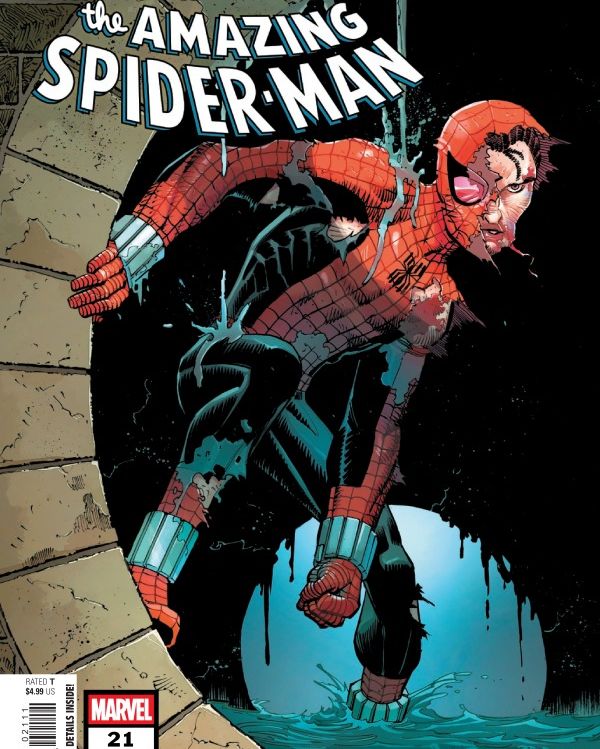
Amazing Spider-Man #21, by Marvel on 2/4/26, is an energetic Norman Osborn action vehicle wrapped in a Goblin family crisis that looks great in motion and falls apart the second you start asking basic questions.
First Impressions
This issue left me entertained but annoyed, like watching a cool stunt reel where nobody bothered to film the actual movie. The pacing and action sequences are tight, clear, and punchy, and Norman-as-Spider-Man is a strong hook that carries most of the pages. The problem is that the script keeps dropping big, important ideas like “murmuration,” the ethics of goblin genocide, and Emily’s mastermind turn without enough explanation, so the emotional weight never lands as hard as the explosions.
Recap
Last issue, Aunt May rushed to Oscorp to warn Norman that Peter was in danger, only to run into Spider-Slayer robots that arrived with the corpses of Phil Urich, Ashley Kafka, and Ned Leeds as a brutal calling card. Norman wrestled with his own guilt and inner demons as a coalition of goblin victims, led by Roderick Kingsley, launched a coordinated assault to wipe out Norman and his whole bloodline while debating whether killing his grandchildren was a necessary “preventive measure” or a moral line they should not cross. Spider-Man and Norman tried to hold Oscorp together during a three-front crisis that balanced physical combat, civilian rescue, and Norman’s internal redemption struggle until the goblin coalition separated the heroes, drove Norman into a corner, and left the story on a cliffhanger with Norman critically compromised and his allies isolated.
Plot Analysis (SPOILERS)
The issue opens with Norman in the Spider-Man suit bloodied and barely standing as the Goblin-Slayers close in and the goblin-victim coalition watches from a control room, convinced they have finally cornered their monster. Alecto confronts Norman about the innocent deaths on his conscience, while other coalition members coldly discuss pulling the entire Oscorp building down on Norman’s head so he can die watching his “tainted” family get erased with him. At the same time, Roderick Kingsley as Hobgoblin coordinates remotely, treating the whole thing like a spectacle as he rockets toward the suburbs, moving the battle from corporate war zone to family home invasion.
Miles Morales arrives in the middle of the chaos and teams up with Norman, who is still suited up as Spider-Man, to deal with a seemingly endless wave of Goblin-Slayers. Norman presses Miles on how much bioelectric energy he can generate, then uses an Oscorp security override to trigger something called “murmuration,” a command that links the Slayers to Oscorp systems in a way the comic does not bother to clearly define. Together they execute a risky plan where Miles dumps all his bioelectric “Max Power” at once to short out the Slayers while Norman programs the security network to ride that power, yet the script never clarifies what “murmuration” actually is beyond a vaguely cool-sounding flocking metaphor that conveniently solves most of the robot problem.
Miles collapses from the energy dump and Norman hauls him to safety, then pivots immediately to his family when he realizes the Goblin-Slayers are now in autopilot and targeting him directly. Norman orders Oscorp security to find any surviving units from “murmuration” and use them as transportation, casually hitching a ride on one of the same murder machines that were just trying to erase his bloodline. Meanwhile, the comic cuts to McCarthy Medical Center where a woman pleads with her teenage son Ken to call her back after a “terrible accident at the lab,” and then to Liz Allan’s Westchester home where Liz and Normie enjoy an oblivious day together under guard, completely unaware that Hobgoblin is streaking toward them.
Norman arrives in Westchester in full Spider-Man gear riding a Goblin-Slayer, which looks visually striking and terrifies Liz, then confronts Hobgoblin in a brutal showdown framed as a referendum on who gets to write the Osborn legacy. The internal narration shows Norman finally rejecting both the self-pitying “I can never be forgiven” script and the pure Goblin sadism script, choosing instead to call himself “a bad man who chooses to be better than I was yesterday,” which is the closest the issue gets to a clear thematic statement. He beats Hobgoblin decisively, threatens anyone who comes after his family with zero mercy, and is shocked when the goblin coalition points him to the real mastermind: Emily, his ex-wife, who quietly claims responsibility for orchestrating the attack on their own grandchildren before Norman “forgives” her in a moment that the comic never bothers to unpack. In the aftermath, Norman spins the entire disaster as “corporate terrorism” in the press, keeps Peter and the public in the dark about Kingsley and Emily, and finally gets a brief call with Peter Parker, who returns in a new black and yellow suit on the last page to tell Norman he “did great,” just in time for Marvel to slap a “Next Homecoming” tag on the story.
Writing
The pacing is the star here, with the issue moving cleanly from Oscorp siege to Westchester showdown and never dragging, even when Norman shifts from battlefield to hospital to suburban street. The dialogue is snappy and readable, especially between Norman and Miles, and Norman’s internal narration sells his physical pain and self-loathing with short, punchy lines that fit the tone. Structurally though, the script leans on big, unearned pivots, like “murmuration” suddenly being the magic Oscorp command that can weaponize Miles’s power against the Slayers without any prior setup, which makes the solution feel like a cheat instead of a clever payoff. On top of that, Norman simply “knowing” Hobgoblin is going for his grandkids and the Emily twist landing with almost zero context leaves huge holes where motivations should be.
Art
The art team delivers clear, readable action with strong figure work and panel layouts that make the chaos easy to follow, even when the page is packed with robots, webs, and lightning. Miles’s “Max Power” blast looks great, with electric yellows flooding the building and selling the scale of the risk, while the later Goblin-Slayer ride into Westchester gives Norman a dramatic, almost metal album-cover entrance. The colors lean into hot oranges, sickly greens, and harsh yellows that reflect Norman’s mental state and the Goblin legacy, especially in the Westchester fight where the burning surroundings frame him in morally ambiguous light. Even quieter sequences at the hospital and Liz’s home maintain strong composition, and the shift to Peter’s new black and yellow suit at the end lands visually as a clean, modern contrast to Norman’s ragged look.
Character Development
Norman’s arc is the most developed part of the book, as he moves from self-loathing and pain to a more grounded acceptance that he is a “bad man” who can still make better choices today than yesterday. His focus on protecting his family and his willingness to risk Miles and himself feel consistent with the redemption crawl the series has been building, and the narration gives us enough of his inner voice to understand why this fight matters to him. Miles gets a fairly straightforward role as the heroic partner who is willing to sacrifice himself, but beyond some quips and the “Max Power” gag, he does not get much emotional space. The real failure is on the antagonist side, where Kingsley’s moral crusade and Emily’s betrayal of her own grandchildren are left thinly sketched, so their choices read more like plot assignments than believable character decisions.
Originality & Concept Execution
On paper, “Norman Osborn as Spider-Man defending his grandkids from a goblin-victim death cult while wrestling with whether redemption is even possible” is a strong and fresh angle on old Spider-Man lore. In practice, the issue executes the spectacle half of that premise very well, with distinctive set pieces like the murmuration gamble and the Goblin-Slayer surf into suburbia, but it only half-commits to exploring the moral questions behind them. The revenge coalition’s debate over whether to kill Norman’s grandchildren should be a major ethical engine for the story, yet it mostly exists to justify a big fight and a last-minute Emily twist instead of truly interrogating cycles of abuse and inherited guilt. The result is a comic that feels original in pitch and imagery but incomplete in follow-through, especially when major concepts like murmuration remain unexplained techno-flavor text.
Positives
The biggest strength is the pacing, which keeps the issue moving from scene to scene without dead air and makes it very easy to read in one satisfying gulp. The action sequences are clean, visually distinct, and escalate well, with the Miles “Max Power” storm and Norman’s Goblin-Slayer ride standing out as clear high points where art and script actually sync. Norman’s internal monologue and final declaration that he is “a bad man who chooses to be better than I was yesterday” provide just enough character meat to give the punches some emotional texture instead of pure noise. As a disposable thrill ride that shows Norman trying, failing, and trying again to live up to the Spider-Man ideal while the art team goes big, this comic does deliver immediate entertainment value.
Negatives
The script is riddled with unexamined choices that erode trust in the story the moment you look past the cool panels. “Murmuration” is treated like a major strategic trump card without any explanation of what it actually is, how it works, or why Norman had this get-out-of-robot-jail-free button in his pocket the whole time, which makes the victory feel arbitrary instead of earned. Norman inexplicably guessing that Hobgoblin is going after his grandchildren without on-page reasoning, and Emily being exposed as the mastermind behind an attack that explicitly threatened her own grandkids, both land as baffling twists that raise more questions than they answer. When your villains’ motivations and your hero’s big plan all hinge on “just go with it,” the writing quality takes a hit, because the book starts to feel like it is reverse-engineering scenes it wanted to draw rather than building a coherent narrative.
About The Reviewer: Gabriel Hernandez is the Publisher & EIC of ComicalOpinions.com, a comics review site dedicated to indie, small, and mid-sized publishers.Follow @ComicalOpinions on YouTube, Facebook, Instagram, and Twitter
The Scorecard
Writing Quality (Clarity & Pacing): [2/4]
Art Quality (Execution & Synergy): [3/4]
Value (Originality & Entertainment): [1/2]
Final Verdict
Amazing Spider-Man #21 is the kind of issue that will not make you angry you read it, but it might make you wonder why no one in the room asked a few follow-up questions before going to print. If you are invested in Norman’s redemption experiment or you are a sucker for big, well-drawn superhero action, this is worth picking up, but only if you are comfortable accepting “because the plot says so” as the answer to several key problems. If your budget is tight and you need both spectacle and rock-solid storytelling, this feels more like optional viewing before Peter’s proper return in that sleek black and yellow suit than a must-own chapter.
6/10
We hope you found this article interesting. Come back for more reviews, previews, and opinions on comics, and don’t forget to follow us on social media:
Connect With Us Here: Weird Science DC Comics / Weird Science Marvel Comics
If you’re interested in this creator’s works, remember to let your Local Comic Shop know to find more of their work for you. They would appreciate the call, and so would we.
Click here to find your Local Comic Shop: www.ComicShopLocator.com
As an Amazon Associate, we earn revenue from qualifying purchases to help fund this site. Links to Blu-Rays, DVDs, Books, Movies, and more contained in this article are affiliate links. Please consider purchasing if you find something interesting, and thank you for your support.
 Weird Science Marvel Comics