
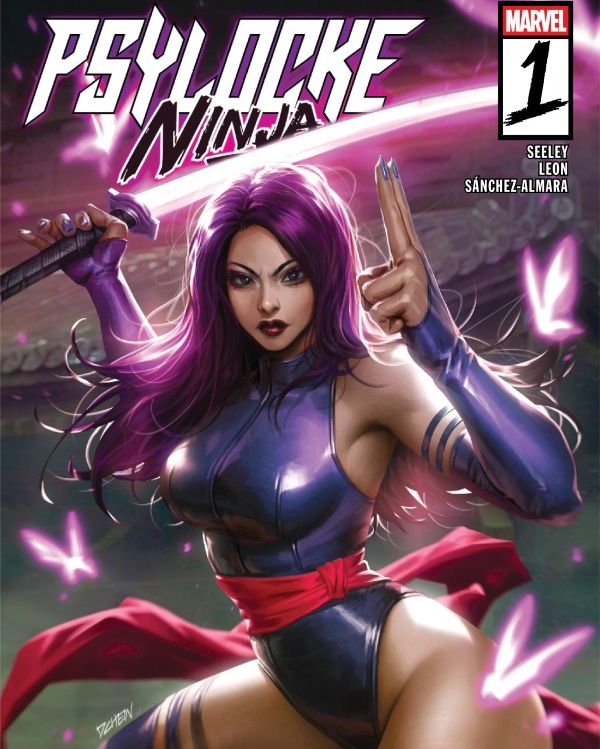
- Written by: Tim Seeley
- Art by: Nico Leon
- Colors by: Dono Sanchez-Almara
- Letters by: VC’s Ariana Maher
- Cover art by: Derrick Chew (cover A)
- Cover price: $4.99
- Release date: January 21, 2026
Psylocke: Ninja #1, by Marvel on 1/21/26, is a sleek looking origin patch that reads more like a history lesson than a thrill ride, delivering psychic guilt, ninja politics, and a whole lot of talking.
First Impressions
The opening pages drop you into Betsy Braddock’s head while she recaps her life, her powers, and the Siege Perilous, and it feels like the comic is giving you homework before class even starts. The core idea, watching her choose a dangerous magical reset while killer cyborgs close in, is strong but buried under captions that explain every beat instead of letting the moment breathe. As a first taste, it feels like someone turned a classic X Men recap page into an entire scene and then forgot to stop writing.
Recap
In Uncanny X Men #251, Betsy and the X Men stumble out of the Savage Land into the Australian Outback, only for Betsy to see a psychic vision of the team being hunted and killed by the Reavers. She carries the Siege Perilous, a mystical gateway that can send a person into a new life with their past wiped clean. Faced with what she believes is certain death for her friends, she pushes the team to step through that portal for a chance at rebirth instead of a brutal end. The recap makes it clear that this choice shatters Betsy’s faith in herself even as it saves the X Men in a twisted way.
Plot Analysis
Betsy narrates as she teleports herself, Colossus, Havok, and Dazzler back to the X Men base in Australia after their Savage Land war, and she runs through her long list of roles and powers to remind you how complicated her life already is. The team is exhausted and shaken, and Havok frets about the people they left behind while everyone quietly doubts whether Xavier’s dream of peace for mutants still means anything. Betsy feels that doubt too, especially after her vision of the Reavers slaughtering them, and when her amulet the Siege Perilous promises a clean slate she considers using it to escape that fate. When the Reavers arrive to finish the job, she ignores her usual rule against deep mental pushes and shoves her teammates toward the portal, forcing them into new lives while she stays behind to stall the killers.
As Betsy confronts the Reavers, she thinks about how her telepathy made her tune out her own instincts and focus on other peoples fear, and she wonders if she should have trusted her gut instead. Holding them off only buys moments, so she decides that rebirth is better than death and finally lets herself fall into the Siege Perilous as well. The next scene jumps to fishers off the coast of Okinawa who see a strange light and hear a woman’s voice in their heads that shifts from English to Japanese to the almost forgotten tongue of Uchinaaguchi. They realize the voice belongs to a mutant girl on a nearby island and, instead of helping her, they agree to hand her over to the cruel crime clan that rules the area, since the island lies in the palm of the Hand.
From there the story cuts to the South China Sea where Matsu’o Tsurayaba, a high ranking member of the Hand, is honored for expanding the group while he tells junior members about his most painful assignment. He was ordered to kill a rival crime boss named Nyoirin Henecha, but Nyoirin’s assassin Kwannon captured his heart even as they clashed, and their final fight ended with her slipping from a cliff and smashing her head on the rocks below. Matsu’o begged the Hand’s leader Jonin and their dark patron the Beast for a way to save her, only to be denied at first and forced to finish his contract anyway. After watching Matsu’o carve through enemy ninjas and remembering past Hand legends like Kirigi and Elektra Natchios, Jonin rethinks the matter when the clan captures an incredibly powerful telepathic mutant who fell from a tear in the sky, and he proposes binding Psylocke’s mind to Kwannon’s body, with whatever fragments of Kwannon remain pushed into Psylocke’s vacant shell as leverage.
Sometime later in snowy northern Japan, Psylocke now serves the Hand as their loyal psychic assassin and readies herself outside a mountaintop monastery that houses the Chaste, the Hand’s sworn enemies. She scouts paths and firing lines, centers her breathing, and shoves aside intrusive flashes of another life, such as a laughing blond British boy and a newborn pressed to her chest under Tokyo neon, that she refuses to claim as her own. Inside, Chaste warriors with call signs like Stone, Palm, Wing, Shaft, Claw, and Star talk about how close the Beast came to plunging the world into darkness and how their healer Palm has dedicated himself to saving a mysterious woman who fought that godlike threat with only her mind. Psylocke’s assault crashes their quiet night as she cuts through the defenders while Palm begs his brothers to hold the line so his patient, Elektra Natchios, does not slip back into oblivion, and the issue ends on the promise that the Hand’s next move is to force Psylocke to kill Elektra.
Writing
The writing leans hard on narration and exposition, and that word count crushes the pacing for a story that is already locked to past events. Betsy’s opening monologue stacks recap on top of recap, so key emotional beats, like pushing her friends into the Siege Perilous against their will, feel explained rather than felt. The middle section with Matsu’o is built on campfire style storytelling where characters literally sit and listen to his tale, so even the big romance and tragedy moments are described in long speeches instead of shown through sharp, quick scenes. By the time Psylocke storms the Chaste, the script has spent so many panels on dialogue and captions that the action reads like an afterthought, which makes the whole issue feel like homework you have to finish before the real story can ever begin.
Art
This issue jumps from the burning deserts of Australia to rainy coasts, smoky Hand gatherings on the water, and a cold mountain fortress, and the art keeps each location visually distinct so you always know where the scene has moved. The snowy assault on the Chaste sells the isolation and harshness of the setting, with Psylocke’s bare skin and the heavy drifts making her look both exposed and dangerous at the same time. Psychic moments, like Betsy’s visions and the disembodied voice over the ocean, are given clear visual cues that match the script’s focus on language and mind games, which helps keep all the talky scenes from feeling completely static. The layouts favor readability over wild experimentation, which fits the retro vibe of the script but also means the visuals rarely fight back against how dense the dialogue balloons are.
Character Development
Psylocke’s inner voice is the glue holding the issue together, and her guilt about forcing her friends through the Siege Perilous and her choice to stop trusting her own body give her a clear, if heavy, motivation. The problem is that the script keeps telling you how she feels instead of letting small reactions or silent panels do that work, so her struggle comes off as distant rather than intimate. Matsu’o gets a simple but effective arc as the man who chose duty over love and now tries to game his own cult in order to keep a piece of that love alive, and his bitterness at the Beast and Jonin tracks cleanly from scene to scene. The Chaste members are mostly thin archetypes with fun code names and one or two personality notes, and Elektra spends the issue as a symbol on a cot, so readers looking for someone new to latch onto beyond Betsy may feel shortchanged.
Originality & Concept Execution
The stated premise here is the secret history of how Betsy Braddock ended up as a Hand trained ninja assassin, and using the Siege Perilous as the engine for that body swap is a clever way to line the pieces up. Structurally, the issue tries to braid three strands, Betsy’s fall, Matsu’o and Kwannon’s doomed romance, and the present day Hand assault on the Chaste, which is ambitious for a single chapter. In practice, all three threads are delivered mostly as explanations of decisions you already know must have happened, so the comic rarely feels like it is discovering anything new about this corner of X Men lore. The concept is strong enough that a leaner script could have felt sharp and dangerous, but here the execution is like reading a very pretty manual for a machine you already see running.
Positives
There is real value in finally lining up all the wild pieces of Betsy’s transformation, from the Siege Perilous choice to the Hand’s creepy brain swap plan, in one clear sequence that newer readers can follow. The book also gives Matsu’o and Kwannon more space than they usually get, framing their tragedy as a key driver rather than a throwaway footnote, which helps the old continuity beats feel a bit more human. Visually, the mix of mystical ninjas, psychic storms, and stark snowy battlefields gives the artist a lot of chances to sell mood and location, and the scenes set with the Chaste in their mountain home feel especially atmospheric. If you care a lot about how the puzzle pieces fit, this issue does lay them out on the table in a way that makes internal sense.
Negatives
The biggest problem is that the script is so in love with its own explanations that it forgets to let the story move, turning what could have been a tense ninja thriller into a slow, talk heavy flashback. Every major beat, from Betsy sending her friends through the Siege Perilous to Matsu’o losing Kwannon to the Hand deciding to weaponize Psylocke, is narrated in long speeches and captions, which makes reading the issue feel like slogging through a novelization of events you would rather see. Because the entire plot is framed as a known slice of backstory, there is almost no suspense about outcomes inside this chapter, only the question of how much text it will take to reach the next expected moment. For readers who picked up a book called Psylocke, Ninja looking for sharp, kinetic fights and quiet visual storytelling, the imbalance between dense dialogue and relatively brief action is going to feel like a poor trade for both time and money.
About The Reviewer: Gabriel Hernandez is the Publisher & EIC of ComicalOpinions.com, a comics review site dedicated to indie, small, and mid-sized publishers.Follow @ComicalOpinions on YouTube, Facebook, Instagram, and Twitter
The Scorecard
Writing Quality (Clarity & Pacing): [1/4]
Art Quality (Execution & Synergy): [3/4]
Value (Originality & Entertainment): [1/2]
Final Verdict
Psylocke: Ninja #1 is the kind of issue that will satisfy continuity hounds who want every corner of Betsy Braddock’s history pinned down, but everyone else will feel the weight of the captions long before the last page. The core idea, that a bad choice with the Siege Perilous leads straight into a morally rotten deal with the Hand and puts Betsy’s mind on a collision course with Elektra, is solid but smothered in explanation. If your comic stack is tight and you are choosing between fresh stories and deep cut origin repair jobs, this one only really earns a slot if you are a devoted Psylocke or Hand fan.
5/10
We hope you found this article interesting. Come back for more reviews, previews, and opinions on comics, and don’t forget to follow us on social media:
Connect With Us Here: Weird Science DC Comics / Weird Science Marvel Comics
If you’re interested in this creator’s works, remember to let your Local Comic Shop know to find more of their work for you. They would appreciate the call, and so would we.
Click here to find your Local Comic Shop: www.ComicShopLocator.com
As an Amazon Associate, we earn revenue from qualifying purchases to help fund this site. Links to Blu-Rays, DVDs, Books, Movies, and more contained in this article are affiliate links. Please consider purchasing if you find something interesting, and thank you for your support.
 Weird Science Marvel Comics