- Written by: Joe Kelly
- Art by: John Romita Jr., Paco Diaz, Todd Nauck, Scott Hanna
- Colors by: Marcio Menyz, Erick Arciniega, Marte Gracia
- Letters by: VC’s Joe Caramagna
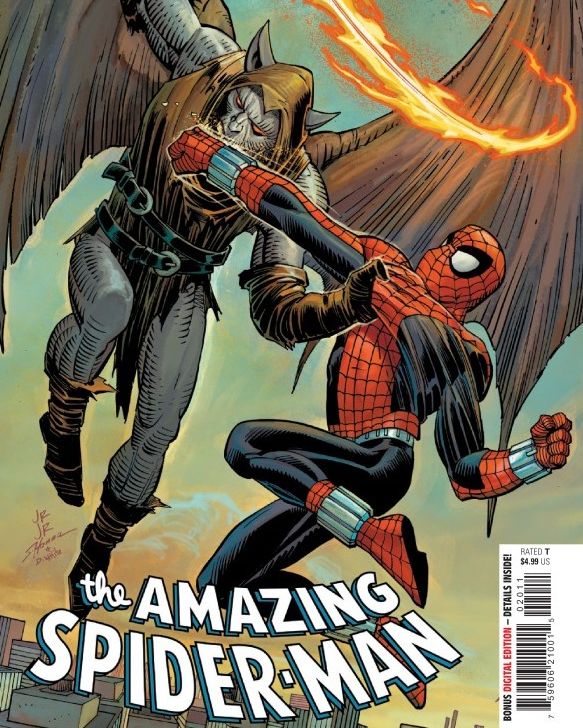
- Cover art by: John Romita Jr., Dean White, Scott Hanna (cover A)
- Cover price: $4.99
- Release date: January 21, 2026
Amazing Spider-Man #20, by Marvel on 1/21/26, finds Norman Osborn facing an extinction-level event when every goblin victim he’s ever wronged comes to collect on centuries-worth of debts.
First Impressions
The opening scramble to reach Norman before Spider-Slayers tear through Oscorp hits with immediate dread. There’s genuine tension in watching Aunt May crash the security desk and Norman’s fractured internal monologue introduce you to a character drowning in his own screams, and that combination lands because the comic trusts readers to care about a former villain’s attempt at heroism without being condescending about it.
Recap
In Amazing Spider-Man #19, Peter Parker’s space journey reaches its climax when he confronts Hellgate across multiple planetary surfaces and dimensional rifts. After eighteen issues of separation, Peter manages a final strike that sends Hellgate back toward his own dimension while Rocket sacrifices the beacon ship to clear an escape route. The stargate activates successfully, Peter detects Earth’s atmosphere, and the issue closes with Peter returning home, his promise to Raelith and the thought of ice cream flavors anchoring him to what matters. Norman Osborn, meanwhile, remains on Earth where Spider-Slayers have been collecting the bodies of other goblins, and the stakes have escalated beyond anything Norman anticipated when he decided to keep the mask.
Plot Analysis
Aunt May arrives at Oscorp desperate to warn Norman about his nephew Peter, only to witness Spider-Slayer robots announce their presence with the bodies of Phil Urich, Ashley Kafka, and Ned Leeds draped across the facility. Norman’s internal monologue establishes him as a man at war with himself, imagining his heart as a cave that oscillates between quiet and screaming, a metaphor that will drive every decision he makes throughout this issue. Roderick Kingsley emerges as the orchestrator, collaborating with surviving goblin victims who’ve formed a coalition to systematically erase Norman and his bloodline from existence, treating the operation like a moral crusade against a man who’s repeatedly destroyed their lives. The assassins debate whether eliminating Norman’s grandchildren is necessary to prevent future goblin iterations, with most voting yes, though Alecto the coalition’s voice of conscience argues against it, creating fracture lines within the hunter team.
When Spider-Man emerges to defend the building, the issue pivots between three simultaneous battles: Norman fighting his internal demons and the assassins attacking him physically, Spider-Man protecting civilians while confronting people whose trauma is genuine and justified, and Ben Reilly at Rand dealing with the knowledge that Peter’s return will displace his newfound sense of purpose and agency. Ben’s frustration boils over into sabotage, hiding a preserved tuna fish in Oscorp’s ventilation system before departing, an act that plays funny on the surface but communicates something darker about resentment festering beneath gratitude. The Spider-Slayers mount repeated assaults, forcing Norman and Spider-Man to coordinate against overwhelming numbers while the coalition leader Kingsley manipulates the violence from a distance, revealing that he’s invested in destroying Norman’s legacy across multiple dimensions of existence, not just his life.
The issue builds toward escalating chaos as the assassins separate Spider-Man/Norman deliberately from the arriving Spider-Heroes, attempting to isolate the target and exploit his emotional vulnerabilities. Norman accesses his mantra, asking himself repeatedly what Peter would do, using the absent hero as an internal compass even as his father’s voice echoes in his head, warning him that empathy is weakness and only family matters. Civilian casualties mount as Spider-Man juggles rescue operations with combat, and the comic makes clear that Spider-Man’s moral code directly prevents him from winning decisively because he won’t sacrifice innocents to eliminate threats; he has to split his attention infinitely. By the issue’s final page, Spider-Man is seemingly taken down, Norman’s leverage is neutralized, and Kingsley’s coalition has successfully driven a wedge between the the villain-turned-hero and his allies, ending on a literal cliffhanger that transforms Norman’s attempt at redemption into a deadly catastrophe.
Writing
Joe Kelly splits the issue’s narrative across three locations and three simultaneous crises, and the pacing demonstrates real craft; each location gets enough panel time to breathe but never enough to let momentum stall. The dialogue between Alecto and Kingsley cuts to moral differences without becoming a lecture, and Norman’s internal monologue provides emotional context without drowning out the action sequences. Aunt May’s voice carries specific inflection that distinguishes her from younger characters; she’s direct, no-nonsense, and uses colloquial language that communicates her desperation without feeling performative.
The exchange between Ben and Janine communicates resentment through minimalist dialogue, letting the hidden tuna fish metaphor do heavy lifting while Ben himself barely articulates his bitterness. Structure places vulnerability alongside violence intentionally, forcing Norman to process his father’s voice while fighting for his life, which creates thematic alignment between internal and external conflict. Spider-Man’s quips land without undermining the stakes because they’re grounded in his character rather than inserted to lighten tone; he cracks jokes while carrying genuine dread about civilian casualties. The one structural weakness is that the coalition’s internal disagreement doesn’t escalate into open conflict; Alecto voices objections but doesn’t act on them, which means a potential subplot gets abandoned without payoff.
Art
John Romita Jr. handles the pencil work alongside Scott Hanna and Paco Diaz, creating compositions that distinguish between the cramped, claustrophobic interiors of Oscorp and the more open chaos of the larger battle. The Spider-Slayers are rendered with crystalline clarity despite their mechanical complexity, and their designs convey threat through sharp angles and purposeful construction. Panel flow guides your eye through complicated action sequences without losing spatial orientation, which is especially important when multiple characters occupy the same frame fighting distinct opponents.
Marcio Menyz and Erick Arciniega color the issue with deliberate mood shifts; civilian sections of the building are rendered in harsh fluorescent whites that amplify dread, while Norman’s sections shift to darker golds and reds that communicate his internal heat. The Spider-Slayers themselves are rendered in silvers and mechanical blues that make them feel distinct from organic threats, which subtly communicates that this is a coordinated, intelligent assault rather than random violence. Composition during the Ben Reilly sequence becomes noticeably tighter and smaller, using negative space to isolate him emotionally even as he stands in a functional laboratory, which visually communicates his sense of displacement. Action sequences maintain clarity even during multi-character confrontations; your eye can track each combatant’s position because the art trusts linework and color separation to do that work without resorting to speed lines or visual confusion.
Character Development
Norman’s character arc in this issue emphasizes the fragility of redemption narratives. He’s actively trying to hold his moral compass despite overwhelming pressure to revert to the goblin persona that his father’s voice continuously promotes in his head. His repeated invocation of Peter’s example demonstrates that his heroism isn’t innate but learned, borrowed from someone he respects, which creates vulnerability that makes him sympathetic even as readers recognize his past actions justify the coalition’s grievances.
Norman/Spider-Man’s consistent refusal to compromise civilian safety for tactical advantage demonstrates his character without needing explicit explanation; his choices communicate his values reliably throughout. The coalition members are individually motivated by specific losses; the woman who lost her family to Norman’s pumpkin bombs is fighting for justified revenge, which complicates the moral landscape significantly. Alecto’s internal conflict between wanting to destroy Norman and recognizing that murdering his grandchildren crosses into villainy demonstrates character depth that works even if the subplot doesn’t fully develop. Ben Reilly’s resentment reads as earned and human; his frustration that Peter will inherit everything despite being absent activates genuine emotional resonance, and his decision to sabotage rather than openly confront communicates his character through action rather than exposition. Kingsley emerges as a manipulator who’s genuinely convinced himself that orchestrating genocide is justified morality, which makes him more complex than a simple villain; he’s convinced that his vision aligns with justice.
Originality and Concept Execution
The core concept of a redemption narrative under existential siege is executed with genuine stakes. The issue doesn’t ask readers to absolve Norman Osborn; instead, it asks whether his current attempts at heroism matter even if his past remains unforgiven, which is a more philosophically interesting question than simple redemption arcs typically explore. The inclusion of victims whose grievances are legitimate and specific adds texture to what could be a simple “good guy versus assassins” scenario. Kingsley’s involvement introduces a layer of manipulation; he’s not just supporting the coalition, he’s instrumentalizing their trauma for his own vendetta against Norman’s legacy across multiple dimensions, which makes the villain more complex than a simple revenge antagonist.
The visual metaphor of Norman’s heart as a cave, oscillating between quiet and screaming, communicates his internal struggle without becoming maudlin. The decision to have NOrman/Spider-Man struggle because his morality prevents tactical effectiveness is fresher than typical superhero narratives, where moral heroes usually win decisively through both righteousness and superior power. Ben Reilly’s hidden sabotage subplot sets up future complications that suggest the comic understands that heroic situations can create new villains rather than simply resolve existing conflicts.
Positives
The three-location narrative structure demonstrates sophisticated handling of multiple simultaneous crises without feeling fragmented or scattered. The emotional weight of Norman’s crisis of faith is genuine because the comic has spent nineteen previous issues building his character arc, and this issue forces him to confront whether Peter’s absence invalidates his entire attempt at redemption, which deepens his character significantly. Aunt May’s arrival feels earned as a character moment rather than plot convenience; her desperation to warn Norman communicates care that humanizes her and provides stakes beyond abstract morality.
The coalition’s specific grievances transform what could be a simple villain army into characters with justified motivations, which complicates audience response and increases thematic depth. Kingsley’s manipulation across dimensions hints at larger plots that suggests Kelly has genuine long-term vision rather than spinning wheels. The Ben Reilly subplot introduces a ticking time bomb that suggests future complications beyond Norman’s immediate survival, which prevents the narrative from becoming purely reactive. The art maintains remarkable clarity despite handling enormous panel density and multiple simultaneous action sequences, which demonstrates technical excellence in execution.
Negatives
The coalition’s internal disagreement fails to escalate into meaningful conflict despite Alecto’s explicit objections to murdering Norman’s grandchildren; the subplot gets introduced and then abandoned without payoff, which wastes a genuinely interesting moral complication. The Spider-Slayers separate the heroes deliberately, but the execution reads more as plot necessity than as a tactical decision that makes strategic sense, which undermines the illusion that the assassins are competent. The comic never explains why Norman is remembering this specific moment with his father during crisis unless it’s purely thematic.
Ben Reilly’s departure scene, while clever, feels disconnected from the main narrative and lacks consequences within this issue itself, which makes it read like a post-credits scene interrupting the primary story. The issue’s cliffhanger ending, while visually striking, doesn’t actually resolve any of the conflicts introduced, which means the entire issue functions as setup rather than a self-contained story with meaningful progression. Kingsley’s coordination across multiple dimensions gets referenced but never explained, which sacrifices clarity for vagueness and leaves readers uncertain about the scope of the threat beyond “universal erasure.”
About The Reviewer: Gabriel Hernandez is the Publisher & EIC of ComicalOpinions.com, a comics review site dedicated to indie, small, and mid-sized publishers.Follow @ComicalOpinions on YouTube, Facebook, Instagram, and Twitter
The Scorecard
Writing Quality (Clarity and Pacing): [3/4]
Art Quality (Execution and Synergy): [2.5/4]
Value (Originality and Entertainment): [0/2]
Final Verdict
The Amazing Spider-Man #20 crafts compelling individual sequences and character moments but fails to deliver them in service of a satisfying story; it’s a middling issue in a series where that word carries specific weight. The emotional stakes are present, the art executes cleanly, and the writing demonstrates genuine character voice, but the comic prioritizes setup over payoff so thoroughly that spending four dollars on it feels like a down payment rather than a purchase.
5.5/10
We hope you found this article interesting. Come back for more reviews, previews, and opinions on comics, and don’t forget to follow us on social media:
Connect With Us Here: Weird Science DC Comics / Weird Science Marvel Comics
If you’re interested in this creator’s works, remember to let your Local Comic Shop know to find more of their work for you. They would appreciate the call, and so would we.
Click here to find your Local Comic Shop: www.ComicShopLocator.com
As an Amazon Associate, we earn revenue from qualifying purchases to help fund this site. Links to Blu-Rays, DVDs, Books, Movies, and more contained in this article are affiliate links. Please consider purchasing if you find something interesting, and thank you for your support.
 Weird Science Marvel Comics