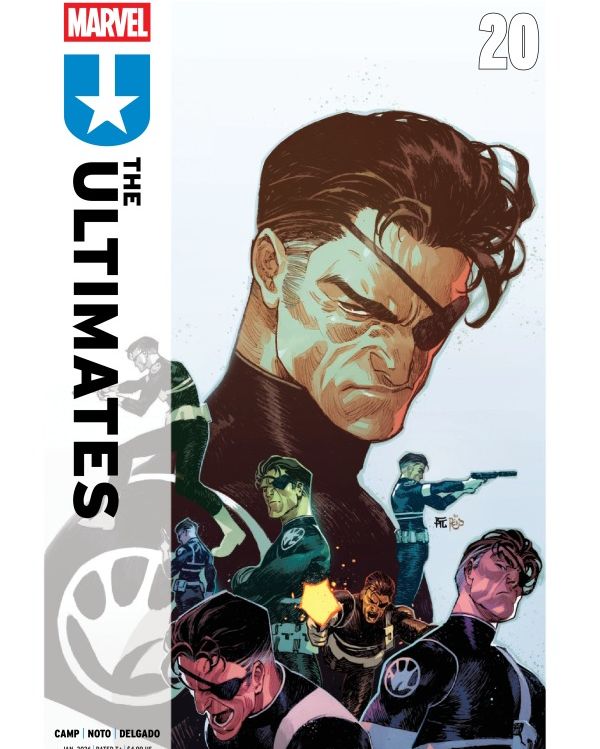
- Written by: Deniz Camp
- Art by: Phil Noto
- Colors by: Edgar Delgado
- Letters by: VC’s Travis Lanham
- Cover art by: Dike Ruan, Moreno Dinisio
- Cover price: $4.99
- Release date: January 14, 2026
The Ultimates #20, by Marvel on 1/14/26, presents a sprawling network story about Vision’s evolution and Detroit’s rebellion, but struggles with visual consistency when anatomy matters most.
First Impressions
The opening pages deliver tremendous spectacle with Vision coordinating dozens of network nodes across the resistance, creating genuine momentum through digital intrigue and scale. But the art inconsistency kicks in fast, with character proportions shifting panel to panel and body mechanics that don’t track smoothly. The core concept clicks, yet execution stumbles.
Recap
The Ultimates #19 found worldwide uprisings erupting against the Maker’s Council a month into the revolutionary war. Captain America’s group liberated the East Coast from Captain Britain’s fantasy forces, but H.A.N.D. Helicarriers destroyed the Triskelion satellite base and stranded She-Hulk. The issue climaxed with Wasp revealed as a triple agent under Vision’s command and ended on a tease: “NEXT BEHOLD THE VISION!”
Plot Analysis
Vision establishes itself as the Ultimates Network’s coordinating intelligence across multiple nodes, revealing that the Human Torch (Jim Hammond) traveled back to 1947 with future knowledge to prepare groundwork against the Maker. Over decades, Hammond invested secretly in infrastructure, resisted Namor’s execution, influenced markets, and disrupted the Maker’s plans from within the timeline. Vision functions as Hammond’s evolved consciousness, merged with the network across 2.3 million connected nodes of resistance fighters.
War Machine defends a H.A.N.D. Helicarrier fleet carrying enslaved prisoners and stolen resources while Fury, a Life-Model Decoy, commands the assault on Detroit with 1,189 active carriers. Vision alerts Captain America to the H.A.N.D. onslaught and coordinates resistance fighters across encrypted channels, while Wasp grapples with guilt over the Triskelion’s destruction and Hank’s disappearance, accusingly confronting Vision about probability and the cost of war.
Wasp broadcasts enemy attack plans to Luke Cage and rallies freed prisoners aboard the Helicarriers into coordinated combat operations. Vision reveals its secret war with Fury across fourteen timelines and locations, uploading Fury’s erased memories back into his consciousness, breaking him mentally before transferring his rage into War Machine’s destruction. The sequence shows Vision reshaping consciousness and identity through data warfare.
Detroit physically rises as an Anti-War Machine mech construct built over decades of secret labor, with thousands of skilled underground workers operating it in perfect unison while Wasp orchestrates escapee revolts aboard the Helicarrier fleet. The Helicarrier count drops from 1,189 to 935 to 653 to 389 as Vision’s coordinated assault dismantles the assault force. The issue closes with Detroit unbroken and the network celebrating victory while the Maker remains absent.
Writing
Dialogue flows with crisp efficiency in Vision’s technical exposition and emotional exchanges between Wasp and Vision regarding guilt and Hank’s fate. Deniz Camp layers philosophy through the Ship of Theseus concept, exploring what Vision became after absorbing Hammond’s consciousness and the network’s intelligence. Pacing stumbles slightly by diving deep into Vision’s internal timeline battles and personal war with Fury when climactic momentum demands forward thrust toward the Maker confrontation. Structure supports Vision’s reveal but dilutes immediate payoff.
Art
Phil Noto’s compositions shine during large-scale setpieces like the rising Detroit construct and Helicarrier formations, with clean layouts that convey scope and coordination. Color work from Edgar Delgado effectively shifts from cold digital blues in network sequences to warm reds during combat explosions. However, character anatomy inconsistencies undermine credibility; proportions shift noticeably between panels, body mechanics stretch unnaturally during action sequences, and faces flatten or elongate unexpectedly. These anatomical mishaps break immersion during crucial emotional beats between Wasp and Vision.
Character Development
Vision’s concept as evolved Hammond with network consciousness delivers genuine originality, showing evolution from individual heroism into collective intelligence. Wasp’s struggle with complicity in the Triskelion bombing and Hank’s vanishing creates relatable moral ambiguity and trauma. War Machine’s role as tool enforces tragic consistency, while Fury’s breakdown through memory restoration drives home the cost of manipulation. The Maker remains completely absent, which represents a critical narrative failure for a series building toward climactic confrontation.
Originality & Concept Execution
Transforming Jim Hammond into a time-displaced network orchestrator represents imaginative use of established characters, showing long-term strategic thinking decades in advance and questioning identity through digital consciousness merging. The concept executes brilliantly on Vision as idea and philosophical statement about what heroism becomes at scale. Execution fails on Maker engagement, however; a series nearing conclusion needs its antagonist present and threatening rather than completely sidelined. The Vision payoff feels hollow without direct confrontation looming.
Positives
Phil Noto’s large-scale compositions and dynamic action layouts create genuine visual spectacle during the Detroit construct’s rise and the Helicarrier cascade, boosting clarity and excitement significantly. Edgar Delgado’s color shifts between digital cold blues and combat warmer tones enhance pacing and emotional resonance without overtaxing the artwork. Vision’s concept as Hammond-plus-network delivers authentic originality by exploring identity evolution through collective consciousness while maintaining relatable philosophical grounding. Wasp’s guilt and Hank’s absence inject real emotional stakes into the resistance, transforming victory into complex moral ambiguity.
Negatives
Misshapen anatomical proportions and inconsistent character body mechanics throughout numerous panels severely damage credibility during critical emotional sequences, pulling focus from meaningful dialogue and creating jarring visual disconnects. The Maker’s total absence from a series designed around confronting him represents catastrophic structural failure; a climax demands the primary antagonist threatening directly rather than remaining offstage while Vision claims spotlight. Pacing drags during Fury’s memory-dump monologue when forward momentum toward series conclusion demands acceleration, diluting Victory’s impact through excessive introspection about Vision’s past wars instead of setting up the final confrontation.
About The Reviewer: Gabriel Hernandez is the Publisher & EIC of ComicalOpinions.com, a comics review site dedicated to indie, small, and mid-sized publishers.
Follow @ComicalOpinions on YouTube, Facebook, Instagram, and Twitter
The Scorecard
Writing Quality (Clarity & Pacing): [2.5/4]
Art Quality (Execution & Synergy): [2/4]
Value (Originality & Entertainment): [1/2]
Final Verdict
The Ultimates #20 builds genuinely clever architecture around Vision’s collective consciousness and Detroit’s secret rebellion, yet fails to deliver payoff when it matters most. The imaginative concept of Hammond as time-displaced foundation and Vision as evolved network delivers originality, but anatomical inconsistencies undermine visual trust while the Maker’s continued absence turns the issue into a detour rather than climax. You’d expect a penultimate chapter to accelerate tension and place antagonists directly in harm’s way, not sideline the primary threat for philosophical monologues. Strong ideas cannot overcome weak execution on fundamentals; save your money unless you’re hunting Vision lore or extremely committed to Ultimate continuity.
5.5/10
We hope you found this article interesting. Come back for more reviews, previews, and opinions on comics, and don’t forget to follow us on social media:
Connect With Us Here: Weird Science DC Comics / Weird Science Marvel Comics
If you’re interested in this creator’s works, remember to let your Local Comic Shop know to find more of their work for you. They would appreciate the call, and so would we.
Click here to find your Local Comic Shop: www.ComicShopLocator.com
As an Amazon Associate, we earn revenue from qualifying purchases to help fund this site. Links to Blu-Rays, DVDs, Books, Movies, and more contained in this article are affiliate links. Please consider purchasing if you find something interesting, and thank you for your support.
 Weird Science Marvel Comics