- Written by: Al Ewing, Tom Waltz
- Art by: Juanan Ramirez
- Colors by: Erick Arciniega
- Letters by: VC’s Clayton Cowles
- Cover art by: Ryan Stegman, Frank Martin (cover A)
- Cover price: $5.99
- Release date: January 14, 2026
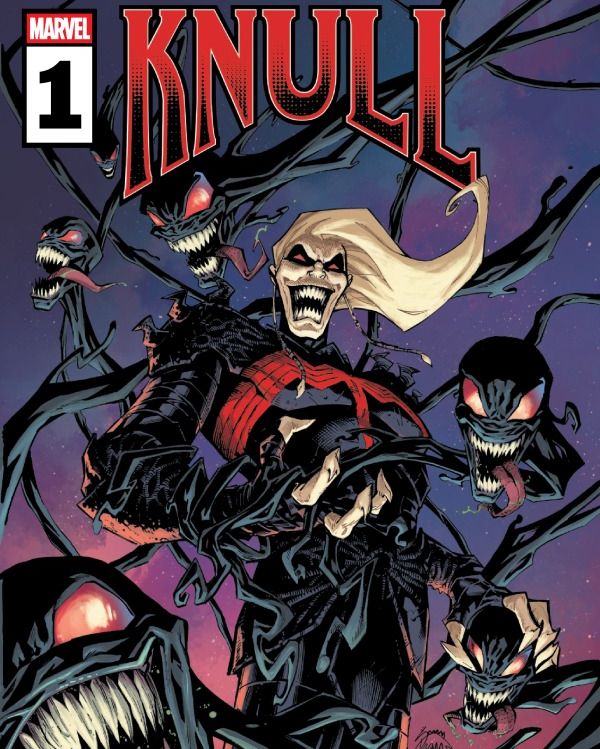
Knull #1, by Marvel on 1/14/26, is a sharp looking cosmic horror pitch that mostly talks at you instead of grabbing you. It’s a handsome, moody lore dump that treats your reading time like a classroom lecture dressed up in symbiote slime.
First Impressions
The opening pages hit hard with giant space gods, a living sword, and Knull wrapped in pure black, so the book looks like a heavy metal album come to life. At the same time, the wall of narration and captions makes that first stretch feel like reading a textbook about the void instead of watching a story unfold. The core idea, a god of nothing who hates creation, lands right away, but the way it is delivered feels stiff and over explained.
Plot Analysis
The book starts by laying out Knull’s origin in the endless dark before creation, where he is perfectly content alone in the living void. When the Celestials arrive and flood his kingdom with blinding light, they decide the emptiness is “unfinished” and start building, which Knull sees as an invasion. He forges a living sword from the blood of a fallen Celestial and sets out across the universe to slaughter gods and push back the light, earning titles like god of the symbiotes and lord of the abyss. A golden knight with a spear of pure light finally clashes with him, the sword is stolen while they lie locked in a death pose, and Knull’s living darkness spins off into the symbiote hive that spreads his influence even after it later turns on him.
The narration notes that those symbiotes and past battles eventually pulled Knull to Earth to fight its heroes, then cuts to the present where he sits trapped in a high tech cage on a station called Daedalus five. A guard wearing one of Knull’s symbiote “children” as living armor taunts him, joking about the big bad king in black while Knull calmly promises to paint the universe with the blood of his victims. Hela arrives as the ruler of this outpost, shuts the guard down for standing so close to Knull while wrapped in his own spawn, and tells Knull this cage is his new home until she says otherwise. She clears the room so she and her general can speak with their prisoner in private, treating him more like a dangerous battery than a simple monster.
Hela and her general, Tyr Odinson, talk about what Knull really is, with Tyr calling him a thing of the void and Hela comparing him to the true cosmic force named Oblivion. Through their dialogue and more captions, the issue explains that the Celestials once chose Knull to serve as the King in Black at the dawn of the cosmos, a job he lost when he attacked Earth’s champions and was burned in the sun by Eddie Brock, the Venom host of that era. That death left a gap in the machinery of reality, so whenever nobody holds the title, the universe drags Knull back as a kind of living patch to fill that space, even if he returns only as a weak shadow of his former self. Hela reveals that when he resurfaced this time, too drained to even remember Asgard existed, she gathered the threads of fate around him so that as his strength returns, it flows into her instead of back into his own dark kingdom.
While Hela keeps visiting to drain off more of his dark energy and comments that he is starting to outlive his usefulness, Knull leans into the idea that he is nothing, the void and the emptiness inside every space. He uses that concept as a weapon, becoming the “nothing” in his surroundings so that when the cage seems empty and the room seems empty, he is actually inside those gaps, waiting. A guard comes to check on him and learns this the hard way when Knull appears, kills him in a burst of symbiote horror, and calls the stolen symbiote child back to himself, feeding on the soldier’s death as a tiny universe ending. As soldiers scramble and he slips through shadows with short range teleport style tricks, Knull complains that he is reduced to hijacking a small ship instead of soaring on a dragon of living night, escapes into space to rebuild his power, and Hela ends the issue on the station by telling Tyr that an almost queen in black is not good enough and calling an old flame who can help guide stubborn Knull into making the one move that will finish handing his power over to her.
Writing
Most of this issue reads like one long exposition dump, with captions and speeches doing the heavy lifting while the actual present day plot creeps forward in small steps. The structure is very simple, cosmic history lesson up front, then a prison interview that keeps explaining the rules of the King in Black job and the difference between Knull and Oblivion, then a short escape and a tease. Dialogue is packed with big cosmic terms and sharp insults, which fits the characters, but it also makes the book feel dense and slow, since almost every page has someone explaining how the universe works. As a time investment, you get a lot of information and not much escalation, and there is no real “wow” twist or set piece at the end to make all that talking feel worth it.
Art
Juanan Ramírez’s line work sells the scale of the story clearly, from the huge Celestials cutting into the void to the cramped cages and halls of Daedalus five. The layouts stay readable even when the pages are covered in narration boxes and word balloons, which is not easy with this much text. Erick Arciniega’s colors give the book a strong mood, with cold blacks and blues for the void, burning golds and reds for the Celestials and All Light, and sickly greens and purples for the prison that make everything feel a little rotten. Even when the script drags, the pages are fun to look at, and the art team keeps Knull’s powers and movements clear whenever he finally does something in the present.
Character Development
Knull comes across as exactly what the narration says he is, a bitter god of nothing who hates light and wants to erase creation, and he does not move much beyond that. His one new angle, using his “I am nothing” identity as a clever way to slip out of the cage, is more of a neat trick than a deep character beat, since we do not see him question himself or change his outlook. Hela is very on brand as a schemer who wants to turn a cosmic monster into her personal power source, and Tyr is the loyal soldier who voices the risk, but neither gets a strong emotional moment. Because nobody here reveals a new side or has a personal choice that costs them anything, it is hard for a reader to feel connected to the stakes beyond “who gets to be the scariest goth god in the room.”
Originality & Concept Execution
On paper, the concept of Knull as a cosmic patch that reality keeps reinstalling whenever there is no King in Black, and Hela trying to hijack that glitch for herself while Midgard is cut off, is a cool twist on existing lore. The specific use of emptiness as a power, turning the “nothing” inside a cage or a room into his hiding place, is a smart visual idea that fits his theme. The problem is that these fresh ideas are buried under so much explanation about Oblivion, the Living Tribunal, the original war with the Celestials, and Eddie Brock’s past win that the issue feels more like a handbook entry than a story with its own spark. The book promises a wild new chapter for this villain, but by the last page, it mostly feels like a side document that rearranges continuity instead of delivering a standout, self contained narrative.
Positives
The big win here is the visual imagination, since the art team turns abstract ideas like the living void, god slaying blades, and fate threads into strong, readable images that could hook anyone flipping through the book. Knull’s design and the way his symbiote children flow and lash out always look sharp, and Hela’s queenly presence fills the panels even when she is mostly standing and talking. For readers who enjoy cosmic Marvel lore, the issue does a tidy job of lining up Knull, Oblivion, the King in Black title, and the fallout from Eddie Brock’s big victory into one clear timeline. When the script lets the pictures breathe, such as during the escape sequence and the small moments of horror as Knull feeds, the comic briefly feels as intense as its premise suggests.
Negatives
For anyone who is not already invested in Knull’s mythology, the pacing is likely to feel painfully slow, because the book spends most of its page count explaining history and mechanics instead of building present day tension. The escape that should be the high point is over quickly and plays out in a very expected way, with no surprise twist or giant set piece to make you sit up. By the time Hela makes her “old flame” phone call, it feels like the story has only just cleared its throat, so this issue lands more as a preface than as a rewarding chapter on its own. When you factor in how wordy the narration is, the entertainment you get per minute of reading feels low, especially if you came in hoping for a bold, jaw dropping villain showcase rather than a lore briefing.
About The Reviewer: Gabriel Hernandez is the Publisher & EIC of ComicalOpinions.com, a comics review site dedicated to indie, small, and mid-sized publishers.
Follow @ComicalOpinions on YouTube, Facebook, Instagram, and Twitter
The Scorecard
Writing Quality (Clarity & Pacing): [1/4]
Art Quality (Execution & Synergy): [4/4]
Value (Originality & Entertainment): [1/2]
Final Verdict
If you love Knull as a character and want every scrap of official backstory and cosmic fine print, Knull #1 gives you exactly that, with top tier visuals to sweeten the medicine. If you are a more casual reader who picks only a few books in a month, this reads like optional homework rather than a can’t miss chapter, since it mostly explains things you can pick up elsewhere and never really cuts loose. The art absolutely earns attention, but the script treats that art like a slideshow for a lecture, so the overall package does not justify a tight pull list spot for most people.
6/10
We hope you found this article interesting. Come back for more reviews, previews, and opinions on comics, and don’t forget to follow us on social media:
Connect With Us Here: Weird Science DC Comics / Weird Science Marvel Comics
If you’re interested in this creator’s works, remember to let your Local Comic Shop know to find more of their work for you. They would appreciate the call, and so would we.
Click here to find your Local Comic Shop: www.ComicShopLocator.com
As an Amazon Associate, we earn revenue from qualifying purchases to help fund this site. Links to Blu-Rays, DVDs, Books, Movies, and more contained in this article are affiliate links. Please consider purchasing if you find something interesting, and thank you for your support.
 Weird Science Marvel Comics