- Written by: Joe Kelly
- Art by: Pepe Larraz
- Colors by: Marte Gracia
- Letters by: VC’s Joe Caramagna
- Cover art by: Pepe Larraz, Marte Gracia (cover A)
- Cover price: $4.99
- Release date: December 10, 2025
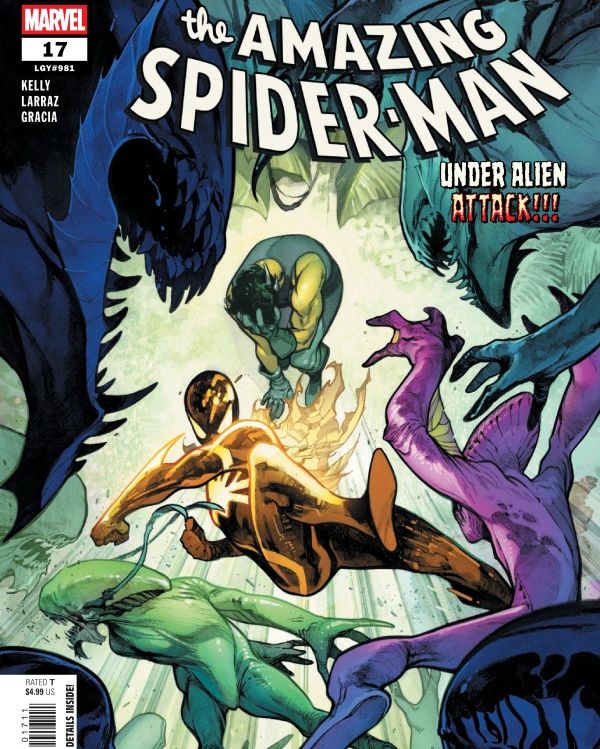
Amazing Spider-Man #17, by Marvel on 12/10/25, reads like someone asked “What if Peter Parker got accidentally swapped with Star-Lord in the Marvel database?” and Joe Kelly said, “Don’t mind if I do.”
First Impressions
The opening pages feel bright and weirdly optimistic for a comic titled “Under Alien Attack,” which sets off immediate alarms. Rocket’s profane captain’s log, the lush alien landscape, and the focus on romantic banter between Peter and Raelith instantly signal that we’ve left New York City far behind. The gut reaction is confusion mixed with grudging entertainment; this reads like a Guardians side story with Spider-Man’s name slapped on the cover.
Recap
In Amazing Spider-Man #16, Peter Parker was drowning in guilt, family drama, and the fallout from his decisions. Aunt May pressed him for answers while Norman Osborn tried on the Spider-Man suit like it was a borrowed jacket at a party he didn’t want to attend. Ben Reilly celebrated breakthroughs in revolutionary housing tech while the city’s villain roster circled like sharks. The centerpiece villain, Plague RX, arrived with a concept as twisted as it was creative: pain absorption on a cosmic scale. By issue’s end, Osborn admitted defeat and walked away from playing hero. The emotional weight was heavy. This issue? Not so much.
Plot Analysis
Peter’s space crew crashes on an uncharted planet after Nial (a character who seems designed for comedic relief through pure stupidity) sabotages the ship because he wanted them all to be “a little family.” While the crew bickers about repairs, Peter and Raelith sneak off for a romantic conversation about candy, kissing, and emotional vulnerability. She warns him that she doesn’t love him, relationships between them are fragile, and he might get hurt because he’s “a man-child.” He accepts this with surprising grace, proving that Peter Parker can adapt to basically any role the writer assigns him.
Then things get weird. A telepathic figure called “Nikodimu of the Pinnacle” arrives astral-projected from a planet called Kailo, claiming to be Raelith’s superior. This figure sends an alien horde down on the crew and psychologically dominates Raelith, calling her “wretched” and forcing her into submission. Peter, responding with genuine anger for the first time in the issue, tells this space tyrant exactly what he thinks: no apologies, no negotiation, just “no.”
Peter then spends an entire battle sequence fighting alien creatures while telling Raelith a detailed story about Mr. Grasso, a candy store owner from his childhood who abused kids. He couldn’t tell anyone as a child because adults had authority. His uncle was disappointed. The shame stuck with him. As Peter’s neural connection with Glitch destabilizes (the suit is dying under the strain), he finishes the story: you have to take big swings to get the life you want. Raelith, empowered by his defiance and his honesty, stands up to the psychic tyrant and reclaims her dignity. The crew patches things up and prepares to leave. The issue ends on a note of “so we’re staying?” suggesting the actual conflict hasn’t been resolved and neither has anything else.
Writing
Dialogue runs the gamut from sharp to clunky. Rocket’s profanity-laden captain’s log is entertaining, but watching Peter dispense folksy wisdom about candy stores while fighting aliens designed by committee feels tonally dissonant and meandering. The pacing lurches; half the issue is romantic banter and philosophical discussions about relationships, and the other half is a cosmic battle sequence interrupted by a seven-panel-long flashback delivered mid-fight. Structure follows no particular logic beyond “what if we mashed Guardians, space opera, and therapy session together?” The writing has moments of genuine wit and character depth, particularly in Raelith’s vulnerability, but it keeps getting swallowed by the cosmic scope creep.
Art
Pepe Larraz’s linework is clean and dynamic, delivering excellent action sequences where every punch and creature motion is clear and impactful. Composition balances the intimate (Peter and Raelith’s conversation) with the epic (hordes of alien creatures and telekinetic dominance). Colors by Marte Gracia paint the alien landscape with lush purples, greens, and warm tones that make the planet feel genuinely beautiful and lived-in. The synergy between art and story is strong; the visuals sell the emotional beats even when the dialogue stumbles. This is Marvel-level professional execution, full stop.
Character Development
Peter’s consistency shatters here. The guilt-ridden, morally exhausted version from issue #16 has been replaced by someone who shrugs off casual betrayal, accepts a relationship built on emotional hedging, and delivers heartfelt speeches about childhood trauma while surrounded by cosmic horrors. Raelith has genuine motivation and relatability; watching her reclaim agency is the issue’s best moment. Rocket remains Rocket. Everyone else (Glitch, Xanto, the Prince) function more as plot devices than characters with coherent arcs. The relationship between Peter and Raelith develops, but it develops into something that looks less like Spider-Man romance and more like a sci-fi slow burn.
Originality & Concept Execution
A sentient technarch suit bonding with Spider-Man offers genuine potential for exploring identity and bodily autonomy. The Kailo planet hierarchy and psychic dominance by a caste-obsessed regime is interesting sci-fi. But the comic doesn’t execute either concept with clarity; they get tangled up with romance subplots, sabotage reveals, and a climactic moment where Peter’s defiance matters more than any actual physical victory. The “original” part works fine. The “execution” part treats Spider-Man’s presence as window dressing on a Guardians story.
Positives
The art team deserves a bonus. Larraz and Gracia create visuals that are consistently excellent, from the alien landscape’s atmospheric beauty to the kinetic clarity of combat sequences. The emotional beats land when the story lets them breathe; Raelith’s character arc from submissive to empowered carries genuine weight, and watching Peter choose defiance over negotiation with an unjust authority is thematically sound. The dialogue, when it’s not drowning in cosmic lore dumps, sparkles with personality and humor. There’s real craft here, even if the story underneath occasionally creaks under its own ambitions.
Negatives
This comic feels like it was written for the Guardians of the Galaxy book and someone forgot to change Peter’s name in the file. A Spider-Man issue should, at minimum, feel like a Spider-Man story. Trading the supporting cast in New York, Peter’s actual relationships, and the street-level stakes that define the character for space romance and alien politics is a betrayal of the premise. The pacing is erratic; pivoting from relationship counseling to a seven-panel flashback mid-battle to a climax that’s about emotional courage rather than actual danger makes the stakes feel weightless. The sabotage reveal (Nial crashed the ship to keep everyone together) is treated as a joke when it’s actually a serious violation that doesn’t get addressed. By issue’s end, nothing is resolved except Peter’s emotional availability, and even that feels contingent.
About The Reviewer: Gabriel Hernandez is the Publisher & EIC of ComicalOpinions.com, a comics review site dedicated to indie, small, and mid-sized publishers.Follow @ComicalOpinions on YouTube, Facebook, Instagram, and Twitter
The Scorecard
Writing Quality (Clarity & Pacing): [1.5/4]
Art Quality (Execution & Synergy): [3.5/4]
Value (Originality & Entertainment): [1/2]
Final Verdict
If you picked up Amazing Spider-Man #16 expecting Spider-Man, you’ve been sold a Guardians of the Galaxy knockoff with a web-slinger’s face pasted on top. The art is excellent, the romantic subplot works, and there are genuine moments of character growth here. But a comic that costs five dollars and forces you to care about Kailo’s caste system, relationship ambiguity, and space sabotage while giving Peter Parker nothing to do but talk, fight, and feel out of place is a waste of a legend’s time. This issue doesn’t earn its price for readers who actually care about Spider-Man stories. It’s a pretty comic book with a hollow core, and that’s not nearly enough.
5.5/10
We hope you found this article interesting. Come back for more reviews, previews, and opinions on comics, and don’t forget to follow us on social media:
Connect With Us Here: Weird Science DC Comics / Weird Science Marvel Comics
If you’re interested in this creator’s works, remember to let your Local Comic Shop know to find more of their work for you. They would appreciate the call, and so would we.
Click here to find your Local Comic Shop: www.ComicShopLocator.com
As an Amazon Associate, we earn revenue from qualifying purchases to help fund this site. Links to Blu-Rays, DVDs, Books, Movies, and more contained in this article are affiliate links. Please consider purchasing if you find something interesting, and thank you for your support.
 Weird Science Marvel Comics