- Written by: Deniz Camp
- Art by: Terry & Rachel Dodson, Jonas Scharf
- Colors by: Terry Dodson, Edgar Delgado
- Letters by: VC’s Cory Petit
- Cover art by: Mark Brooks
- Cover price: $4.99
- Release date: March 25, 2026
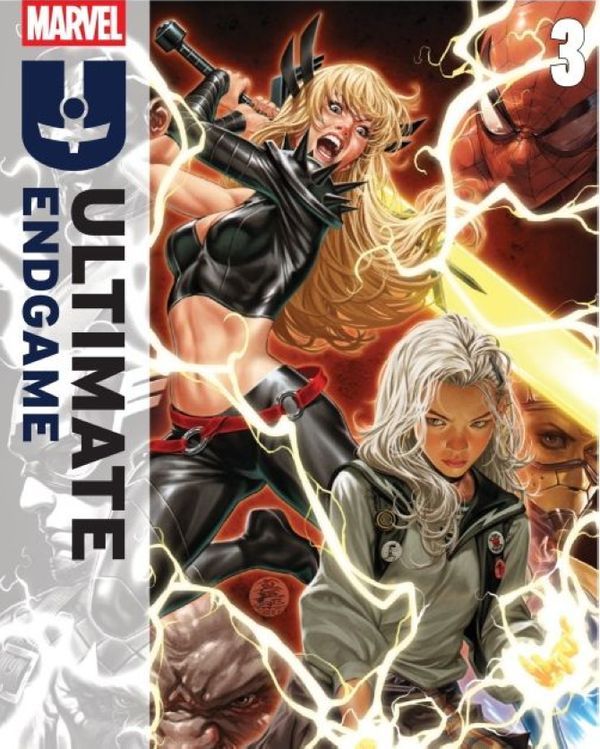
Ultimate Endgame #3 (Marvel, 3/25/26): Writer Deniz Camp and artist duo Jonas Scharf with Terry and Rachel Dodson juggle Iron Lad’s grief spiral, a global resistance briefing, mutant teens in the City, and a Kang reveal in a reality-warping crisis story. The execution feels scattered and uneven, so Verdict: For die-hard fans only.
First Impressions
You crack open Ultimate Endgame #3 and it immediately feels like Marvel trying to fake momentum by juggling four different comics at once instead of delivering one clean, escalating issue. Tony’s guilt visions, MJ’s bunker drama, Nico’s teleporting mutant squad, and Kang’s smug time lecture all compete for attention, so no single thread has room to breathe or land emotionally. The core ingredients are strong on paper, from Peter’s haunting posthumous letter to the idea of the Maker literally becoming the environment, yet the script hopscotches between scenes so quickly that big moments land like channel flips. The shifting art teams underline that fragmentation, with Dodson’s softer, lush surfaces clashing hard against Scharf and Delgado’s harsher, more horror-tinged interiors, which makes the book feel like an anthology stitched together instead of a coherent chapter. You can feel the attempt at fast-paced, end-of-the-world urgency, but what sticks is the sense of noise, not a clear dramatic build.
Recap
In the previous issue, the heroes pushed deeper into the City and into Howard Stark’s warped time-pocket, where Immortus narrated centuries of failed attempts to kill the Maker while Howard slowly lost his mind fighting a forever war. We learned the Maker’s infection turns people into receivers for his mind, Howard extended the Darwin Bubble to hold that infection in place, and only microseconds have passed outside while ages ticked by inside, which raises the stakes for every delay. Howard clung to containment over victory, and when he tried to seize Tony’s Immortus Engine, Tony killed his own father to protect the last anchor keeping the Dome intact, even as Doom reappeared at the Maker’s side like a favored son. The issue ended with Limbo collapsing, Howard and the Maker’s temporary edge dissolving, and the heroes spat back into the City with no clear win condition, right as Doom returned to the villain’s orbit and reset the board in the Maker’s favor.
Plot Analysis (SPOILERS)
The issue opens on Tony trapped in a guilt-soaked hallucination keyed to a letter “To Mary Jane,” where America Chavez and Spider-Man shout him awake while a horde of Maker-controlled zombies close in. We cut away to the bunker, where Mary Jane and Ben Parker argue with Richard about staying hidden, while J. Jonah Jameson reminds him that their underground paper is reaching millions. Vision finally steps out of the shadows to confirm he has been shielding their online work from H.A.N.D. censors, delivering a narrated rollout of global resistance hotspots like uprisings in Heaven, Hulk’s overextended forces, and mutant agitation in Hi no Kuni. That broadcast doubles as a bridge to Nico Minoru and her friends, who decide to teleport all the way to the City to find their missing comrade, even though Nico has never pushed her magic that far before.
Inside the City, the heroes confront manifestations of the Maker’s influence, where reality itself bends around their unseen enemy and the terrain behaves like his extended nervous system. America leans on Deathlok’s advice to hit the swarm with a precise band of cosmic energy, briefly hurting the enemy before the Maker’s system immediately adapts and removes that tactic from the board. Tony still moves like a shell-shocked passenger while Doom and Iron Man coordinate, only for a temporal freeze to lock everything in place as a mysterious time traveler appears, introduces himself as Kang, and casually claims to be Tony billions of years down the line. Kang delivers a meta-lecture about repeated failures to beat the Maker, then Doom decides he has heard enough, orders a shot that damages Kang’s Immortus Engine, and lets normal time surge back just as the Maker’s presence bears down and a new, grotesque Carnage sequence tears Spider-Man apart. The issue closes with a chilling smash cut back to MJ in the bunker, quietly crying under prehistoric skies as her son asks why she is upset and she admits she was “lost in the stars,” setting up the emotional fallout from Peter’s death without yet revealing his full letter to her on the page, though we see it afterward as backup text.
Writing
On the writing front, Camp leans hard into volume and scope, and that choice undermines the core basics of story that should anchor this chapter, because Tony’s grief journey never solidifies into a clear throughline you can track scene to scene. Dialogue between MJ, Ben, and Jonah crackles authentically when they argue about activism versus safety, and Vision’s exposition about global uprisings stays readable, but the script relies too heavily on narrated status updates instead of letting us sit in one character’s emotional viewpoint. The scene order feels almost scattershot, as we jump from zombie fights to newsroom debates to Japanese teen banter to Kang’s time monologue without a strong spine tying it all to Tony’s internal goal, which is allegedly to process Howard’s death and step up. Stakes are theoretically massive, given a reality-controlling Maker and the suggestion that all prior attempts have failed, yet the obstacles blur together because the issue keeps resetting focus every few pages, so tension spikes in short bursts then evaporates before it can deepen. Structurally, this reads less like a deliberate escalation and more like a highlight reel of “big developments” meant to shout urgency at you, and that keeps the plot from building a clean, dramatic progression that would justify the event branding.
Art
Visually, the book splits between Dodson on the outside-the-Dome material and Scharf on the City sequences, and the handoff is jarringly obvious every time it happens, which undercuts immersion. Dodson’s pages with Mary Jane, Richard, and the bunker crew lean into rounded faces, softer expressions, and a slightly idealized, almost classic Marvel sheen that sells domestic emotion, especially in close-ups of MJ’s worried eyes or Richard’s frustrated posture. Delgado’s color work in those scenes leans warm and grounded, with natural interiors and a subtle prehistoric palette outside that sells the weirdness of their underground refuge without tipping into full fantasy abstraction.
Once you flip back into the City, Scharf’s linework muddies, shadows deepen, and compositions lean harder into horror and cosmic distortion, but the transition feels like a hard cut between two different books rather than a controlled stylistic contrast. Panels of reality bending around the Maker’s mass look conceptually strong, and the Carnage sequence lands with genuine visual brutality, from glitching Spider-Man panels to the skin-as-razor-blades picotech effect that practically scrapes off the page. At the same time, some of the action layouts get busy, with energy effects, warped architecture, and overlapping figures fighting for space, which hurts panel-to-panel clarity when you need to understand exactly how Tony and the others are navigating this living environment. Color choices inside the City pump up neon blues, sickly reds, and warped glows that fit the horror tone, yet stacked against Dodson’s cleaner, more classic pages, the overall issue reads like a patchwork rather than a unified visual statement.
Character Development
On the character front, Tony should be the focal anchor here, a young hero wrecked by patricide who has to decide what kind of leader he will be, yet he spends most of the issue stuck in guilt fog or off-screen calculation rather than making visible choices. Doom stays consistent as the hyper-rational zealot who prioritizes mission over everything, shooting Kang’s engine in a move that fits his personality but also feels written to force the plot into chaos rather than emerging from a clear tactical progression. The Parker family scenes do a better job of grounding motivation, since Richard’s anger at hiding, MJ’s protective instinct, and Ben’s insistence on investigative work all play off each other in ways that feel recognizably human. Nico and her friends have clear, simple drives, like finding Hi-chan and stepping up as mutants, but they drop in and out so quickly that their journey feels like a teaser reel instead of a fully integrated character arc, which reinforces the sense that the book is throwing pieces on the board rather than paying off anyone’s emotional journey.
Originality & Concept Execution
Conceptually, Ultimate Endgame #3 toys with some fresh angles, especially the idea of the Maker existing as a pervasive environmental infection and a future Tony reappearing as Kang, trapped forever in the moment before death. The problem is that those big swings arrive stacked on top of each other without room to resonate, which makes the originality feel theoretical instead of viscerally exciting in the reading experience. The five basics suffer in the execution: the focal character blurs between Tony, MJ, and the wider network, the goal shifts from surviving zombies to decoding Kang’s warning to reacting to Carnage, the journey fragments across locations, and the stakes and obstacles are repeated at high volume instead of sharpening around one clean dramatic question. You can see the premise Marvel wants to sell, a ruthless, cosmic endgame where every move has history behind it, yet on the page this chapter plays like a messy transitional issue rather than a confident delivery on that pitch.
Pros and Cons
What We Loved
- Vision quietly shielding the Parker paper and using journalism as resistance.
- Carnage sequence delivers brutal, horror-leaning imagery that genuinely unsettles.
- Peter’s letter to MJ adds weight and emotional texture to the larger conflict.
Room for Improvement
- Fragmented scene-hopping weakens pacing and undercuts dramatic cohesion.
- Stark art contrast between Dodson and Scharf makes the issue feel disjointed.
- Tony’s arc lacks clear, on-page decisions, softening the emotional center.
About The Reviewer: Gabriel Hernandez is the Publisher & EIC of ComicalOpinions.com, a comics review site dedicated to indie, small, and mid-sized publishers.Follow @ComicalOpinions on YouTube, Facebook, Instagram, and Twitter
The Scorecard
Writing Quality (Clarity & Pacing): 2/4
Art Quality (Execution & Synergy): 2.5/4
Value (Originality & Entertainment): 1/2
Final Verdict
Ultimate Endgame #3 has sharp moments scattered across its pages, like Vision quietly weaponizing journalism, Peter’s aching goodbye, and some nasty Carnage horror, yet the overall reading experience feels oddly hollow because those highs never lock into a clear, escalating spine. The rotating art styles keep individual scenes visually engaging, but the clash between Dodson’s polished bunker drama and Scharf’s jagged City horror makes the book read like two different projects stapled together instead of one unified event chapter. If your pull list can only support tightly focused, dramatically coherent stories, this one will feel like a pricey sampler of developments rather than a satisfying meal, so it is hard to recommend outside readers already all-in on Marvel’s Ultimate line experiment.
5.5/10
We hope you found this article interesting. Come back for more reviews, previews, and opinions on comics, and don’t forget to follow us on social media:
Connect With Us Here: Weird Science DC Comics / Weird Science Marvel Comics
If you’re interested in this creator’s works, remember to let your Local Comic Shop know to find more of their work for you. They would appreciate the call, and so would we.
Click here to find your Local Comic Shop: www.ComicShopLocator.com
As an Amazon Associate, we earn revenue from qualifying purchases to help fund this site. Links to Blu-Rays, DVDs, Books, Movies, and more contained in this article are affiliate links. Please consider purchasing if you find something interesting, and thank you for your support.
 Weird Science Marvel Comics