- Written by: Luciano Vecchio
- Art by: Luciano Vecchio
- Colors by: Luciano Vecchio
- Letters by: VC’s Joe Sabino, Ariana Maher, Travis Lanham
- Cover art by: Luciano Vecchio
- Cover price: $6.99
- Release date: March 4, 2026
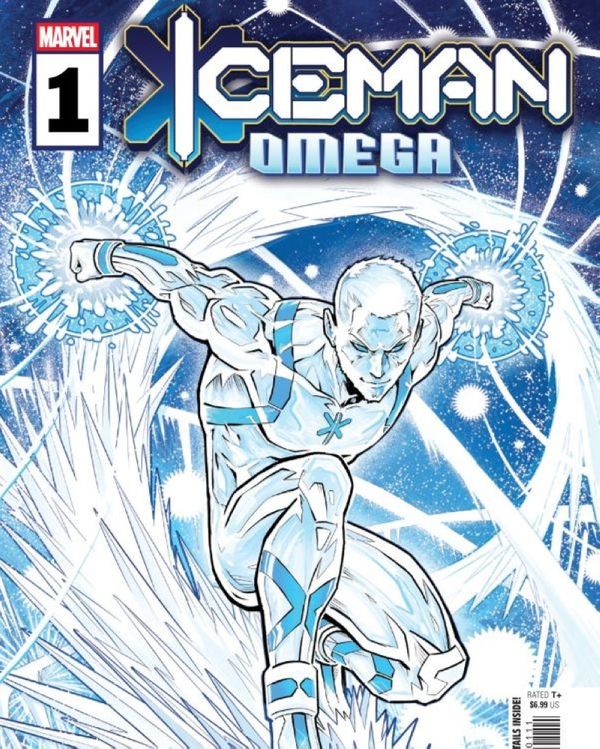
Iceman: Omega #1 (Marvel, 3/4/26): Writer and artist Luciano Vecchio delivers a meandering, low-stakes character hangout where Iceman’s grief, love life, and Omega status float through indulgent vignettes instead of a focused story, positioning Bobby Drake as the lead in a loose, slice-of-life reflection on his powers and identity. The execution is earnest but dramatically flat and structurally bloated, Verdict: Skip it.
First Impressions
The first impression is that Iceman: Omega #1 wants to be a victory lap for Bobby Drake’s Omega status and queer identity, yet reads like an overlong epilogue that forgot it needed a central conflict. You get an opening bar scene with Rictor and Northstar poking at Bobby’s “adulting,” his dating history, and his breakup baggage, and instead of building tension, the script stalls in chatty self-congratulation that feels more like a Tumblr thread than a superhero comic. The immediate emotional reaction is boredom mixed with mild irritation, because every conversation is framed as a Very Important Moment For Representation while actual stakes quietly leave the room.
By the time the kaiju attack arrives in Los Angeles, the comic has already signaled that nothing truly bad will happen, so the big monster sequence lands as a visually playful but dramatically weightless detour. The same problem haunts later chapters, where Bobby’s climate speech and his father’s death are handled with such didactic, message-first narration that you never forget you are being instructed rather than immersed. There are flickers of genuine emotion, especially around Bobby’s complicated feelings about his dad and his own self-worth, yet those sparks get smothered under a constant stream of speeches, captions, and historical shout-outs that treat every page like a podium.
Plot Analysis (SPOILERS)
Bobby Drake opens the story at the Green Lagoon on Krakoa, talking with Rictor and Northstar about his move to Los Angeles, his need to escape constant “X-Drama,” and his muddled dating life, from Christian Frost to Romeo and beyond. The banter frames him as newly single and “adulting” in a cramped LA mancave, where he wants time for self-discovery yet still craves classic romance and validation from his friends. Firestar pops in through the portal network, refuses to move to Krakoa because she will not abandon her father, and soon they join a rescue operation involving a collapsing building, which gives Bobby a brief hero beat before he unexpectedly runs into Romeo, the Inhuman empath he fell for as a time-displaced teen. The issue quickly recaps their convoluted time-travel breakup and uses the reunion to set up the idea of second chances, both romantic and personal, for Bobby as he navigates his next phase.
Later in Los Angeles, Bobby and Romeo respond to a sudden kaiju rampage triggered by telepathic panic waves that overwhelm the crowd and even Bobby’s mind. Bobby distracts the monster with swaggering taunts and an ice-giant “Ice-Zord” construct while Romeo uses his empathy to calm the creature, eventually discovering that it was prematurely awakened from hibernation when its iceberg prison melted. Bobby restrains the kaiju in a gigantic ice security blanket that the creature interprets as soothing, and Romeo coordinates with S.W.O.R.D. to take custody, all of which resolves the conflict cleanly without lasting fallout. Immediately after, Bobby rushes to a Climate Action Summit to deliver a sermon about how he cannot single-handedly fix climate change, how humans plunder the planet while heroes fight monsters, and how those in power must accept responsibility, before he bolts for Krakoa only to arrive too late to see his father alive one last time.
The comic pivots after Bobby’s father’s funeral into a mystical crisis involving Loki, now leaning into his “God of Outcasts” persona, and Daemond II, a frightened, arrogant kid dabbling in blood magic. Daemond has shackled Loki with artifacts and miscasts a spell meant to summon a powerful ice demon, which instead yanks Bobby into a nightmare pocket reality that fuses Loki’s Frost Giant father and Bobby’s own dad into a towering wraith. Loki convinces Bobby to take his crown and staff as a supposed power boost, then pushes him to confront the monstrous father figure, turning Bobby’s unresolved resentment into a literal punching bag. Bobby unleashes spikes, rage, and a torrent of truth about never feeling genuinely loved, about his father refusing mutant medicine even at the cost of his life, and about the bitter satisfaction of finally hitting back, which effectively collapses the spell and frees Loki.
In the fallout, Bobby feels like he has unlocked something new inside himself, a sense of limitless power that Loki cheekily reveals was always his own potential rather than any borrowed godhood. That hubris culminates in the “Omega” showcase where Bobby freezes space-time around a single snow crystal, creating an existential cold that exceeds normal hydrokinesis and leaves him stuck in a world that cannot move, unable to stop the spread or even feel his own body properly. Days later, at the South Pole, Northstar and Firestar combine lightspeed and star-level heat to weaken the freezing aura, while Christian Frost uses his psionic astral projection to reach Bobby, and Romeo adds empathic reassurance that Bobby is loved and safe. The intervention works, Bobby breaks down in tears like a new mutation of emotional honesty, and he reframes his views on “human” versus “mutant” identity, deciding he does not want to regard himself as a different species from his own family. The final stretch shifts to Prodigy documenting LGBTQ superhero history, from Stone Age Starbrand to Northstar’s coming out to modern queer teams and trans characters, all framed as a living archive that situates Bobby and his peers within a growing, celebratory legacy.
Writing
The pacing is indulgent and episodic, reading like four loosely stitched web chapters instead of a cohesive one-shot with a central spine. Scenes linger on conversations about dating, identity, and community while core conflicts resolve with minimal resistance and almost no lasting consequence, so tension never has a chance to build. The kaiju sequence is a perfect example, it arrives abruptly, gets wrapped up through a neat empathy trick and a cute ice gag, then is abandoned as the comic hustles Bobby off to the next speech, leaving the whole interlude feeling like a theme-park ride rather than a turning point. Structurally, the jump from climate summit and parental death, to a blood-magic daddy-issues hallucination, to an Omega power experiment gone wrong, and finally to a documentary-style history lecture is technically coherent but dramatically scattered.
Dialogue frequently sounds like Twitter threads read aloud, with characters delivering polished, activist-ready sound bites instead of messy, human conversation. Bobby, Christian, Romeo, and Prodigy all speak in similar, earnest cadences that flatten their personalities into interchangeable voices carrying the writer’s thesis statements. When Bobby confronts the Frost Giant avatar of his father, the monologue about never feeling loved and mutant medicine refusal hits real emotional territory, yet even that scene leans into on-the-nose phrasing that explains the psychology rather than trusting subtext. Thematically, the book hammers ideas of self-worth, community, and queer resilience so relentlessly that nuance and surprise evaporate, leaving you with a well-meaning sermon instead of a sharply structured narrative.
Art
Visually, Luciano Vecchio delivers clear and stylish storytelling with a bright, polished finish that fits Marvel’s house line, yet the slickness often undercuts any sense of danger. Page layouts are clean and easy to follow, with action beats communicated through large, readable panels and expressive body language that makes even static talking heads feel active enough. The kaiju rampage and the Ice-Zord construct are playful and dynamic, using scale and motion lines to create a sense of movement, but panel framing rarely pushes into inventive or experimental territory, so big moments look competent rather than breathtaking. The Loki and Daemond sequence offers more imaginative visuals, particularly in the Jotunheim-esque mirage with towering Frost Giant imagery and a tiny house evoking Bobby’s old home, yet the staging still feels safe, keeping the horror at arm’s length.
Character acting is a clear strength, with faces and poses tuned for warmth, flirtation, or anguish as needed, although the emphasis on soft, attractive features and friendly gestures makes everyone look perpetually ready for a Pride poster. That approach works beautifully for intimacy but weakens scenes that should feel harrowing, like Bobby frozen at the South Pole or trapped in apocalyptic space-time stillness, where the compositions never quite sell the existential horror the captions describe. Color choices skew bright, saturated, and celebratory, bathing Krakoa, LA, and even mystical arenas in luminous blues, pinks, and purples that reinforce the celebratory queer tone while diluting contrast between mundane and catastrophic moments. The overall mood is inviting and affirming rather than tense or foreboding, which might suit the book’s message-first priorities, but it leaves the supposed Omega-level crises looking oddly cozy.
Character Development
Bobby’s core arc revolves around accepting his own worth, confronting his father’s legacy, and recognizing that his power ceiling is emotional as much as physical, yet the book keeps spelling this out in captions instead of dramatizing it with tough choices. His motivation to move to LA and “adult” on his own terms is clear enough, but the story rarely puts that independence at odds with his responsibilities or relationships, so his stated need for space never collides with any meaningful sacrifice. The confrontation with the father-giant wraith is the strongest character beat, because it externalizes his resentment and self-loathing into a monster he can literally punch, however the resolution is too neat, as if one giant therapy session in magic snowland clears years of trauma. By the end, Bobby feels more like a mascot for Omega queer resilience than a flawed person still working through grief and insecurity.
Supporting characters mostly function as thematic mouthpieces or emotional utilities for Bobby rather than fully realized people with their own agendas. Romeo appears when empathy is convenient, disappears when the plot moves on, and reappears again for the climactic “You Are Loved” affirmation, which is sweet but also reductive, as if his role is to provide one perfectly calibrated therapy sentence on cue. Christian Frost has a stronger interiority, talking about his N.A. meetings, restraint, and living with his flaws, yet the script uses him primarily to lecture Bobby on self-acceptance and set up the final rescue, not to expose tensions in their non-relationship. Loki and Daemond offer the promise of complicated, morally messy dynamics, but Loki gets declawed into a sardonic mentor, and Daemond is shuffled off for help once he has served his function as an object lesson in reckless inheritance.
Originality & Concept Execution
On paper, the premise of an Omega-level queer hero exploring the upper limits of his power while processing grief, romantic baggage, and community legacy is fertile and genuinely fresh. In practice, the execution leans heavily on familiar Marvel beats, from time-frozen spectacle to magical daddy issues to “love and support fix the broken hero,” with little structural innovation beyond the Infinity Comic chaptering. The documentary epilogue with Prodigy cataloging LGBTQ superhero history is conceptually strong and culturally valuable, but it plays more like a Marvel Unlimited feature article in comic form than an organic part of Bobby’s story, which makes the issue feel like two different projects stapled together. The most original sensation arrives during Bobby’s quantum freeze stunt, where the narration teases a shift into “mutant magic” or something beyond hydrokinesis, yet even that avenue is quickly resolved and not deeply interrogated, leaving the supposed Omega breakthrough oddly toothless.
The comic is also aggressively on-the-nose about its themes, which undercuts any sense of discovery for the reader. Rather than weaving queerness, grief, and power into subtextual patterns, the script stops repeatedly to explain what each moment “means,” from climate speeches to psychic interventions, trusting slogans more than storytelling. As a result, the book feels less like a story asserting a bold premise and more like a corporate-approved affirmation package delivering pre-digested lessons to a presumed sympathetic audience. For a comic ostensibly about unlimited potential, the conceptual choices feel surprisingly limited, circling safety instead of pushing form or content in any risky direction.
Pros and Cons
What We Loved
- Clear, readable layouts keep action and dialogue easy to follow in every scene.
- Expressive character faces and poses communicate emotion with polished clarity.
- The Frost Giant father sequence visually externalizes Bobby’s trauma in a strong metaphor.
Room for Improvement
- Episodic pacing and loose structure sap urgency and narrative cohesion throughout.
- Dialogue leans into didactic speechifying, sacrificing naturalism and subtext.
- The queer-history epilogue feels bolted on, disrupting closure and story focus.
About The Reviewer: Gabriel Hernandez is the Publisher & EIC of ComicalOpinions.com, a comics review site dedicated to indie, small, and mid-sized publishers.Follow @ComicalOpinions on YouTube, Facebook, Instagram, and Twitter
The Scorecard
Writing Quality (Clarity & Pacing): 1/4
Art Quality (Execution & Synergy): 2/4
Value (Originality & Entertainment): 0/2
Final Verdict
Iceman: Omega #1 is the kind of comic that will be loudly praised in press releases, quoted in social threads, and quietly forgotten by readers who wanted an actual story instead of a branded affirmation packet. The writing is technically clear yet dramatically lethargic, the art is attractive yet rarely thrilling, and the whole package reads like a corporate victory lap for themes that deserve better than this flat, frictionless presentation. If your budget is tight and you measure purchases by how much narrative meat and genuine drama you get per dollar, this one-shot does not justify its price tag or your time. Verdict: Do not waste your money.
3/10
We hope you found this article interesting. Come back for more reviews, previews, and opinions on comics, and don’t forget to follow us on social media:
Connect With Us Here: Weird Science DC Comics / Weird Science Marvel Comics
If you’re interested in this creator’s works, remember to let your Local Comic Shop know to find more of their work for you. They would appreciate the call, and so would we.
Click here to find your Local Comic Shop: www.ComicShopLocator.com
As an Amazon Associate, we earn revenue from qualifying purchases to help fund this site. Links to Blu-Rays, DVDs, Books, Movies, and more contained in this article are affiliate links. Please consider purchasing if you find something interesting, and thank you for your support.
 Weird Science Marvel Comics