
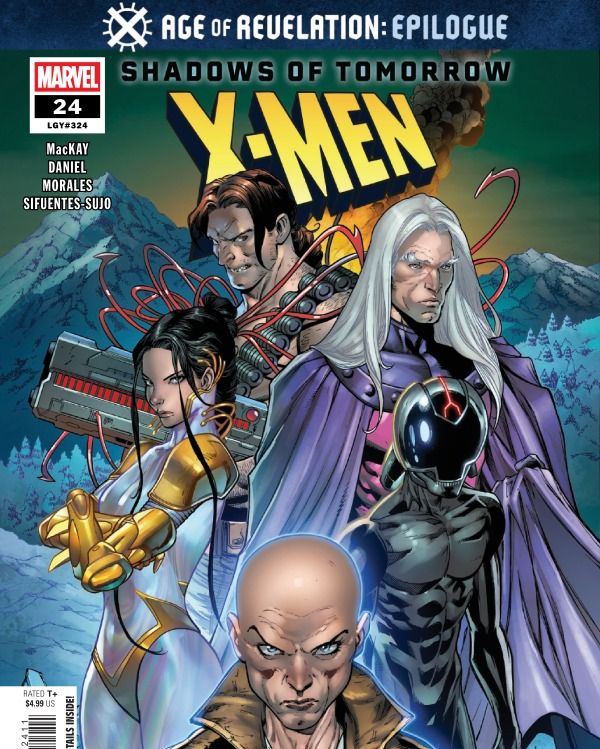
- Written by: Jed MacKay
- Art by: Tony Daniel, Mark Morales
- Colors by: Fer Sifuentes-Sujo
- Letters by: VC’s Clayton Cowles
- Cover art by: Tony Daniel, Mark Morales, Fer Sifuentes-Sujo (cover A)
- Cover price: $4.99
- Release date: January 21, 2026
X-Men #24, by Marvel on 1/21/26, finds the mysterious 3K fighting amongst themselves due to the Chairman’s absence. But the fighting ends when the Chairman returns to explain everything.
First Impressions
The opening pages promise internal conflict among 3K’s leadership, but instead of genuine drama, the issue pivots to a boardroom exposition scene where the Chairman explains everything he learned in the future. It’s the storytelling equivalent of a character walking in and reading footnotes aloud instead of letting plot developments unfold naturally.
Recap
In X-Men #23, Future-Cyclops infiltrated the team to assassinate Doug Ramsey before he becomes Revelation, an apocalyptic-level threat. The X-Men captured Future-Cyclops after Beast disrupted his carefully orchestrated attack. In the brig conversation that followed, Future-Cyclops revealed his willingness to sacrifice everyone to prevent the Age of Revelation, while Doug walked free, confident his destiny remained unchanged. The issue ended with the future becoming unstable; Magneto’s powerlessness signaled that the timeline was already shifting, making Future-Cyclops’s mission potentially obsolete.
Plot Analysis
The issue opens with 3K’s council of Cassandra Nova, Astra, Joseph (a Magneto clone), Myriad, Wyre, and the Chairman dealing with a week-long leadership vacuum after the Chairman disappeared. Cassandra Nova immediately positions herself to seize control, sparking internal tensions about who will lead the organization and manage the clones, particularly Astra’s desire to create more copies. Joseph and Cassandra Nova prepare to fight for dominance, with Wyre seemingly disinterested in power but interested in “a more interesting future.” The X-Men trained by Wyre hesitate to pledge loyalty without clear leadership, and the group teeters on the edge of mutiny.
Then the Chairman returns, changed and more confident, announcing he’s been to the future and brought back the means to secure it. He efficiently shuts down the immediate power struggle by executing Schwarzschild, a 3K operative who sided with the future X-Men instead of 3K, demonstrating that his future knowledge gives him actionable intelligence. He then reveals his true prize: knowledge of how to reliably create the X-virus, the mutagenic agent Doug Ramsey engineered in the future to transform humans into mutants.
In a brief but telling flashback, the Chairman explains his absence and his consciousness swap with the present-day Beast. He inhabited a synthetic body before the swap, having rejected organic existence to embrace pure intellect. His ten years in the future taught him that organic experience matters more than logic alone. He watched 3K fail despite their genius and their efforts, only to see Doug Ramsey and the future X-Men succeed by becoming Revelation and engineering the X-virus. Humiliated by this failure, the Chairman cloned himself a new body and transferred his consciousness into it, bringing back the data on creating the X-virus reliably. With this knowledge, 3K finally has the method to achieve their core goal of transforming humanity into mutants.
The issue ends with Wyre welcoming the Chairman back and the organization unified again, now possessing a genuine roadmap to victory. Doug Ramsey transformed half of North America into mutant-exclusive territory in the future, and the Chairman’s knowledge gives 3K the blueprint to do the same in the present, suggesting the organization’s threat level has fundamentally increased.
Writing
Jed MacKay’s pacing in this issue is distinctly uneven. The opening ten pages generate genuine tension as 3K’s factions position themselves for power, with Cassandra Nova’s cold opportunism and Joseph’s swagger creating a sense that actual conflict might erupt. Then the issue abruptly shifts to a long exposition sequence where the Chairman explains his absence, his consciousness swap, his time in the future, and his plans. This explanation spans multiple pages and kills all momentum the opening established. The dialogue during the exposition works technically, but it feels obligatory rather than organic. MacKay prioritizes explaining what happened over showing conflict or tension. The structural problem is that readers already know most of this from X-Men #23 and the recap provided. The Chairman’s revelations about seeing 3K fail and Doug Ramsey succeed are interesting in isolation, but they’re framed as explanations rather than discoveries, making the issue feel like recap material stretched into a full plot.
Art
Tony Daniel and Mark Morales deliver clean, readable panel work that excels at conveying the boardroom tension in the opening sequence. Character positioning clearly shows the hierarchy of 3K’s council, and the brief combat moment between Cassandra Nova and Myriad is rendered with kinetic precision. The flashback sequence where the Chairman describes his experience in the future is conveyed through minimal visuals; Daniel relies on close-ups and reaction shots rather than detailed action. Fer Sifuentes-Sujo’s colors maintain consistency between present-day scenes and flashback sequences, using slightly warmer tones in the flashbacks to create temporal distinction. The overall visual language is efficient but lacks visual stakes. The issue doesn’t look bad; it simply looks like characters talking in rooms, which is technically fine but narratively flat.
Character Development
The Chairman emerges as the issue’s only character with clear, compelling motivation. His shame at being outsmarted by Doug Ramsey, combined with his philosophical evolution about the value of organic existence, provides genuine character depth. The realization that his rejection of humanity was philosophically hollow makes his rebirth into a new body meaningful rather than arbitrary. Cassandra Nova, Joseph, Astra, and Wyre remain functional but largely one-dimensional. Cassandra Nova is “power-hungry,” Joseph is “arrogant,” Astra is “frustrated,” and Wyre is “detached.” None of them respond to the Chairman’s return with complexity or conflict beyond surface-level acknowledgment. Schwarzschild’s execution happens almost incidentally, which might suggest the Chairman’s ruthlessness but instead feels like plot convenience. The X-Men created by Wyre don’t even appear on more than a few panels; they’re discussed as pawns rather than characterized as individuals. For a council of formidable mutants, most register as NPCs filling a room rather than people with invested stakes in the organization’s future.
Originality & Concept Execution
The concept of 3K’s leadership vacuum creating internal conflict is solid, and the Chairman’s return with future knowledge could be genuinely threatening. However, the execution relies entirely on exposition to deliver the stakes rather than showing them. The central idea that the Chairman now possesses reliable knowledge of creating the X-virus is mechanically important but dramatically inert. Readers already understand from X-Men #23 that Doug Ramsey engineered the X-virus and that it transformed continental territories into mutant-exclusive zones. Having the Chairman repeat this information doesn’t add originality; it adds confirmation. The issue suffers from feeling like plot setup for future arcs rather than a story with its own internal momentum. The genuine thriller elements, if any exist, are buried under layers of explanation that rob them of impact.
Positives
The Chairman’s character work genuinely shines in this issue. His philosophical evolution from rejecting organic existence to understanding its value is a compelling character arc compressed into a few pages. The detail about transferring his consciousness into a cloned body gives his return tactile weight rather than feeling like simple plot convenience. Myriad’s lightning-quick incapacitation of Cassandra Nova during the brief power struggle provides a moment of genuine surprise and suggests consequences within 3K’s hierarchy. The visual clarity of the boardroom scenes makes the competing faction interests immediately readable without requiring exposition to explain who wants what. The premise that 3K now possesses reliable methodology for creating the X-virus does establish genuine future stakes, suggesting the organization’s threat level has meaningfully increased and setting up future conflicts.
Negatives
The issue’s primary failure is its reliance on exposition to deliver plot information that readers already mostly understand from previous issues and recap material. The first half promises internal conflict among 3K’s factions; the second half abandons that conflict to have the Chairman explain what happened to him in clinical detail. Schwarzschild’s execution happens so abruptly and with so little characterization that it fails to land as a power move; it reads as an arbitrary plot convenience to demonstrate the Chairman’s knowledge without genuinely raising stakes.
The flashback sequence explaining the Chairman’s consciousness swap and his time in the future is told rather than shown, making it feel like reading Wikipedia summary notes instead of experiencing drama. Cassandra Nova’s threat during the opening scene completely evaporates without resolution, suggesting the drama was performative rather than genuine. The issue assumes deep reader investment in 3K’s organizational structure and the X-virus concept; newcomers will find themselves drowning in jargon with no emotional stake in any character’s choices. The final panel shows unified acceptance of the Chairman’s return with no dissent or conflict, which deflates rather than heightens tension about 3K’s future actions.
About The Reviewer: Gabriel Hernandez is the Publisher & EIC of ComicalOpinions.com, a comics review site dedicated to indie, small, and mid-sized publishers.Follow @ComicalOpinions on YouTube, Facebook, Instagram, and Twitter
The Scorecard
Writing Quality (Clarity & Pacing): [2/4]
Art Quality (Execution & Synergy): [2.5/4]
Value (Originality & Entertainment): [0.5/2]
Final Verdict
X-Men #24 exists to move plot pieces into position for future storytelling rather than to tell a complete story of its own. The Chairman’s return would have impact if the issue showed his takeover of 3K instead of having him narrate it, but instead, readers get a boardroom scene followed by a long explanation of events that happened off-panel. The issue reads like MacKay needed to answer the question of where the Chairman went and what he learned, but answering the question consumed the entire issue without creating drama in the process. For four dollars and ninety-nine cents, you’re essentially buying a transition scene stretched into a full comic when the material might have functioned better as a brief opening sequence for a more substantive story.
5/10
We hope you found this article interesting. Come back for more reviews, previews, and opinions on comics, and don’t forget to follow us on social media:
Connect With Us Here: Weird Science DC Comics / Weird Science Marvel Comics
If you’re interested in this creator’s works, remember to let your Local Comic Shop know to find more of their work for you. They would appreciate the call, and so would we.
Click here to find your Local Comic Shop: www.ComicShopLocator.com
As an Amazon Associate, we earn revenue from qualifying purchases to help fund this site. Links to Blu-Rays, DVDs, Books, Movies, and more contained in this article are affiliate links. Please consider purchasing if you find something interesting, and thank you for your support.
 Weird Science Marvel Comics