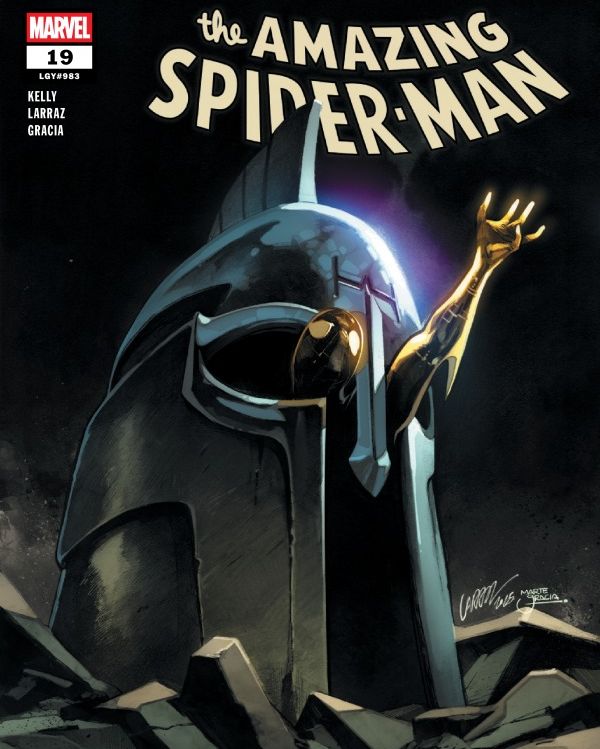
- Written by: Joe Kelly
- Art by: Pepe Larraz
- Colors by: Marte Gracia, Marcio Menyz
- Letters by: VC’s Joe Caramagna
- Cover art by: Pepe Larraz, Marte Gracia (cover A)
- Cover price: $4.99
- Release date: January 7, 2025
In Amazing Spider-Man #19, by Marvel on 1/7/26. Peter Parker’s journey home from space becomes a high-stakes power play where emotions run deeper than plot logistics, and the real threat isn’t what you see coming.
First Impressions
The opening pages on an alien planet whispering prophecy and political intrigue set a tone of cosmic destiny that immediately grounds itself in genuine character work between Peter and Raelith. The gut reaction is one of relief, honestly, because after eighteen issues of setup, this comic finally lets its characters breathe and make choices that matter. The execution lands because it trusts the emotional stakes instead of burying them under exposition.
Recap
In Amazing Spider-Man #18, Norman Osborn seeks reassurance from J. Jonah Jameson about his sanity while Norman’s impostor actions weigh on him; Jameson confesses they both care for Peter like a son. Elsewhere, researcher Brian Nehring runs a failed mycological experiment because Peter’s engineering design couldn’t support the load. Spider-Heroes stake out Norman’s location while, in the final twist, therapist Dr. Myrna Saldano is revealed to be Queen Goblin Ashley Kafka, attacked by a spider-like android. The issue ends with humanoid robots at Oscorp announcing they’re hunting goblins and “us,” creating ambiguity about the emerging threat.
Plot Analysis
On the alien planet Kailo, the governing council called the Pinnacle debates their world’s fate while Hellgate listens for instructions. Peter’s group orbits a critical stargate, the only route home, but it’s surrounded by warring factions from the larger galaxy fighting for control. Rocket Raccoon, with his usual colorful vocabulary, explains the problem to the assembled crew: Kree and Shi’ar are at war, Wakanda is off the grid, and nobody’s safe to approach the gate. Xanto Starblood claims he can operate it if the ship gets close enough, but the practical question remains whether the group can fight their way past everyone else to reach it. As the crew strategizes, Raelith confesses to Peter her fear that Hellgate will follow him back to Earth, but Peter reassures her that his heart remains strong regardless of the danger.
Peter confronts Hellgate in a brutal, multi-location fight that spans planetary surfaces and dimensional tears. Hellgate repeatedly tries to finish Peter by hurling him across planetary terrain and ripping open space itself, but Peter endures the onslaught with growing confidence. The battle is interrupted by Rocket, who launches a surprise attack to extract Peter and give him an escape route, hitting the beast with an explosive while shouting insults that are somehow both genuinely funny and completely serious. Before the final confrontation, Raelith makes Peter promise that he’ll come home to her, and the two share a moment of genuine tenderness where Raelith promises protection and Peter promises ice cream. Hellgate, fueled by a vision from his people’s elder The Seer, attacks again with even greater fury, declaring Peter a coward and himself the strongest warrior alive.
Peter manages a final, desperate strike that sends Hellgate tumbling back toward his own dimension, possibly gravely injured, while Rocket and the ship make their escape. The beacon ship detonates, sacrificing itself to clear a path for Peter’s journey home. Rocket grieves the loss of the ship with a quiet moment of respect before redirecting his focus to completing the mission: getting Peter back to Earth. As the gate begins to open and the stargate is activated successfully, Peter detects Earth’s atmosphere and the familiar smell of the wasteland where Hellgate originally dumped him. The implication lingers as Peter acknowledges the trauma of his journey while looking forward to home, ice cream flavors on his mind and a promise to keep.
Writing
Joe Kelly’s dialogue hits differently in this issue because it prioritizes character voice over exposition. Rocket’s extended rant about the celestial political situation is funny and profane, but more importantly, it establishes stakes without the reader feeling lectured. The exchange between Peter and Raelith carries genuine weight; their conversation about fear, strength, and the promise of ice cream feels earned because the story has spent eighteen issues building their relationship. The extended fight with Hellgate uses dialogue economically, letting physical action communicate most of the tension while Peter’s internal monologue provides emotional context without slowing momentum.
Pacing moves briskly through combat sequences and then deliberately slows for character moments, creating rhythm that doesn’t feel monotonous. The issue’s structure places the most vulnerable emotional beats alongside the most violent action, creating contrast that heightens both. When Peter and Raelith discuss ice cream flavors while falling into a black hole, the juxtaposition should feel tonally chaotic, but instead it feels human; this is what real people do in crisis, they anchor themselves to small promises.
Art
Pepe Larraz’s pencilwork here is dynamic and purposeful. The opening council scene on Kailo uses angular compositions and heavy shadows to communicate political dread without any dialogue explaining the mood. His rendering of the fight with Hellgate is kinetic without being incomprehensible; each panel clearly communicates spatial relationships, even as characters are being flung across planetary landscapes and dimensional tears. The composition pulls your eye naturally from one panel to the next, creating momentum that accelerates during combat and decelerates during character moments. Larraz’s design work on Hellgate is striking: a massive, angular figure with organic menace, rendered with clarity and weight that makes every impact feel consequential.
The color work by Marte Gracia and Marcio Menyz distinguishes between locations through palette shifts; Kailo’s political scenes are rendered in cool blues and silvers that communicate coldness and distance, while the combat sequences shift to warm reds and oranges that communicate heat and urgency. The space sequences use dark, negative space effectively to create isolation and scale. When Rocket’s beacon ship detonates, the explosion is rendered with genuine visual impact; it’s heartbreaking because the art makes you feel its weight. The final sequence, with Peter approaching Earth and smelling the wasteland air, uses warm atmospheric colors and light filtering to communicate arrival and closure.
Character Development
Peter’s arc in this issue is entirely about agency and survival. He arrives at the conversation with Raelith still burdened by fear of Hellgate, but her confession forces him to articulate his belief in his own capacity to endure. By the time he confronts Hellgate, he’s fighting not with desperation but with the kind of calm competence that comes from accepting his own strength. His willingness to strike the final blow, after attempting negotiation and understanding, shows growth from earlier issues where he struggled with the decision to use violence.
Raelith’s character arc completes here; her fear of standing up for herself is replaced by a fierce protectiveness over Peter that’s romantic without being dependent. She’s not saving him, but she’s choosing to fight alongside him, which is fundamentally different and more interesting. Rocket maintains his role as the pragmatist and the soul of the group, making impossible decisions while still processing grief. Even Xanto Starblood, the antagonist turned reluctant ally, gets a character moment where Peter acknowledges his crimes while still accepting his utility. These are characters with motivations that align with their actions; nobody acts out of plot necessity.
Originality & Concept Execution
The concept of Peter’s journey home being an exercise in emotional growth rather than physical survival is increasingly rare in mainstream superhero comics. The idea that Hellgate functions as both a literal threat and a metaphorical representation of Peter’s internal fear is executed with enough subtlety that it doesn’t feel preachy. The inclusion of Raelith’s character arc alongside Peter’s, where she gains confidence in her own agency while he gains confidence in his worthiness, creates thematic resonance. The decision to make the climax of a space adventure about promises and ice cream rather than one final explosive battle is genuinely fresh; it takes a risk by trusting that readers care about these characters enough to accept a resolution that prioritizes emotional closure over physical spectacle. The execution succeeds because Kelly doesn’t apologize for the tonal shift; he commits entirely to the idea that grown superheroes can promise each other ice cream and that it can matter more than the explosions surrounding them.
Positives
The Peter and Raelith scenes are the emotional core of this comic, and they work because the dialogue trusts readers to understand subtext. When Raelith says “I am not in love with you, but I love you,” it’s a moment of absolute clarity about what their relationship means and why it matters. The art makes these moments visually significant through composition and color, ensuring that emotional beats land with the same impact as action sequences. The fight with Hellgate is genuinely well-choreographed; it’s visceral without being difficult to follow, and the progressive brutality of Hellgate’s attacks creates the sense that Peter is overmatched until he finally finds his opening.
Rocket’s presence as both comic relief and genuine emotional anchor prevents the comic from becoming self-serious; his grief for the beacon ship and his commitment to the mission feel authentic because he’s not performing his emotions for anyone’s benefit. The final sequence, with Peter approaching Earth and the promise of ice cream and home, lands with earned catharsis. After eighteen issues of separation from everything he loves, the comic gives him a moment to process arrival without making it saccharine.
Negatives
The opening council scene on Kailo, while visually striking, spends time establishing political stakes that don’t actually resolve in this issue. It communicates threat, but not consequence; readers understand there are larger forces at play, but the comic doesn’t commit to showing how these forces affect the central plot. The decision to keep Hellgate’s motivation entirely internal to his own people and his elder The Seer means that readers familiar with earlier arcs will understand what’s driving him, but newcomers might find his aggression unmotivated. The resolution of the final Hellgate confrontation is somewhat ambiguous; Peter strikes what seems like a finishing blow, but it’s not entirely clear if Hellgate is defeated or simply incapacitated, which leaves a slight narrative loose end. The beacon ship’s sacrifice, while emotionally effective, doesn’t carry the weight it might if the comic had established stronger relationships between the crew and the ship itself earlier in the arc.
Overall, this half of Joe Kelly’s run still reads like a repurposed Guardians of the Galaxy story, which is about as far away from an Amazing Spider-Man comic as you can get.
About The Reviewer: Gabriel Hernandez is the Publisher & EIC of ComicalOpinions.com, a comics review site dedicated to indie, small, and mid-sized publishers.Follow @ComicalOpinions on YouTube, Facebook, Instagram, and Twitter
The Scorecard
Writing Quality (Clarity & Pacing): [3/4]
Art Quality (Execution & Synergy): [3.5/4]
Value (Originality & Entertainment): [1.5/2]
Final Verdict
Amazing Spider-Man #19 proves that a climactic issue can be just as interested in promises as it is in payoffs. This comic earns every moment of emotional catharsis by refusing to shortcut the work that gets you there, and it does so while delivering genuine action sequences that serve the character arcs rather than existing alongside them. Whether this is worth your money depends on whether you’ve entertained by Peter’s journey in a recycled Guardians of the Galaxy tale, but if you are, this is the issue that makes the entire space arc feel necessary rather than indulgent.
8/10
We hope you found this article interesting. Come back for more reviews, previews, and opinions on comics, and don’t forget to follow us on social media:
Connect With Us Here: Weird Science DC Comics / Weird Science Marvel Comics
If you’re interested in this creator’s works, remember to let your Local Comic Shop know to find more of their work for you. They would appreciate the call, and so would we.
Click here to find your Local Comic Shop: www.ComicShopLocator.com
As an Amazon Associate, we earn revenue from qualifying purchases to help fund this site. Links to Blu-Rays, DVDs, Books, Movies, and more contained in this article are affiliate links. Please consider purchasing if you find something interesting, and thank you for your support.
 Weird Science Marvel Comics