
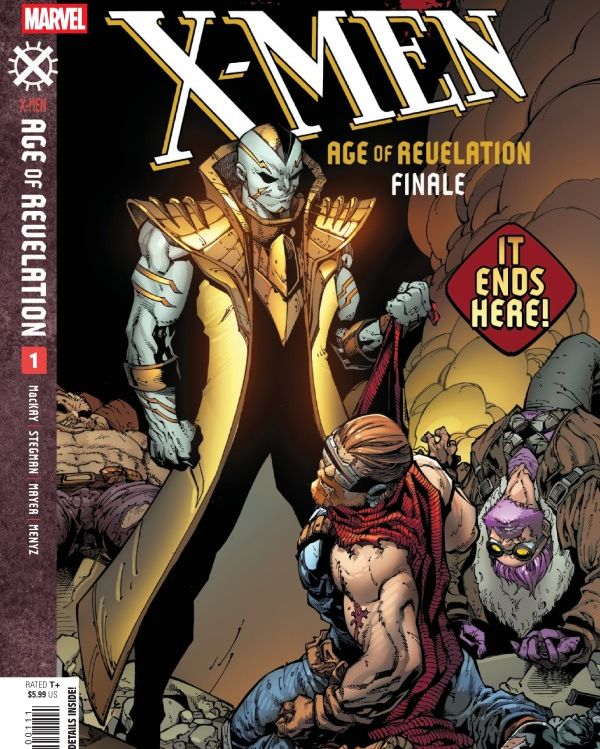
- Written by: Jed MacKay
- Art by: Ryan Stegman, Netho Diaz, JP Mayer
- Colors by: Marcio Menyz
- Letters by: VC’s Clayton Cowles
- Cover art by: Ryan Stegman, JP Mayer, Marte Gracia (cover A)
- Cover price: $5.99
- Release date: December 31, 2025
X-Men: Age of Revelation Finale #1, by Marvel on 12/31/25, dares to ask the unthinkable question: what if the hero actually loses? The answer is a finale where the only victory available is understanding exactly how catastrophically things fell apart.
First Impressions
From the opening panels, the sense of escalating dread hits hard. The dialogue between Charles Xavier and Apocalypse crackles with genuine weight; both are marching toward war knowing something has already gone wrong in ways they can’t quite articulate. When Quentin Quire’s psychic presence floods the narrative, the pacing shifts into overdrive, and suddenly you’re racing toward an ending that doesn’t feel like it’s going to resolve neatly, because it doesn’t, and that’s the whole point.
Plot Analysis
The issue unfolds with ruthless efficiency. In the future, Cyclops and Beast have orchestrated a time-swap with their past selves to prevent Revelation’s (Doug Ramsey’s) rise to power before it began. and the X-Men have infiltrated Philadelphia alongside Apocalypse and his Arakko army. The battle erupts in brutal fashion: Wolverine, transformed into Revelation’s “Angel of Death,” fights free of his control after years of manipulation. Xavier and Quentin Quire engage in a psychic duel that ends with a trick Xavier didn’t see coming, leaving the X-Men momentarily exposed. Revelation’s ultimate gambit unfolds: he never needed to defend his territory because he’s been building mutant biomass all along. Every warrior Apocalypse brought, every person affected by the X-Virus, every mutant in the Revelation Territories serves as a biological anchor point.
In the future timeline, Cyclops realizes too late what Revelation has accomplished. Schwarzschild opens a temporal lens to send data back to the past, but Revelation transforms Earth into a Living Planet, consuming all life on Earth as a gestalt organism. The future is lost. Beast and Animalia make a choice to hold back the wave long enough for Cyclops to escape, knowing it’s already over. Back in the present, past-Hank McCoy returns from his temporal expedition, but something’s wrong: the Beast who was with Cyclops in the future never made it back.
In the story’s final twist, we discover that past-Xavier’s consciousness has returned, but trapped in a synthetic body. He brought back data from a future timeline, knowledge of the X-Virus, and plans to reshape society. The Age of Revelation may have ended, but something far more dangerous has come back through time to take its place.
Writing
Mackay structures this finale like a collapsing wave. The opening establishes stakes through conversation rather than exposition dumping, letting Xavier and Apocalypse’s dialogue convey their mutual dread. The mid-section ratchets tension by jumping between three simultaneous conflicts (Wolverine’s fight, Xavier versus Quentin, and the underground bunker), giving readers no breathing room. The payoff lands with precision: Revelation’s monologue about his plan works because it recontextualizes every earlier scene. His casual comment about video game boss fights isn’t just flavor text; it’s his psychological profile made visible. The pacing falters slightly during the temporal lensing sequence where physics exposition competes with emotional climax, but the final reveal salvages it entirely, as long as you’re not completely confused by it. The dialogue rings true, especially Wolverine’s raw guilt and Cyclops’ growing horror as he pieces things together.
Art
Stegman (with assists from Netho Diaz) maintains visual clarity even during the densest action sequences. The panel layouts guide the eye exactly where it needs to go, and the composition of the psychic duel between Xavier and Quentin radiates weight and consequence. Mayer’s inks ground the artwork, preventing it from becoming too ethereal despite the heavy psychic content. Marcio Menyz’s color work deserves particular praise: the warm oranges of Arakko’s warriors contrast sharply against the cold blues of Cyclops’ bunker, making the spatial separation visceral. During the Living Planet sequence, Menyz’s color transitions from naturalistic flesh tones to writhing purples and sickly greens sell the horror of consumption without needing dialogue. The one moment where art and story misalign slightly is the synthetic body reveal at the end, which reads as more clinical than it probably should for such a devastating twist.
Character Development
Revelation’s characterization anchors this entire issue. His monologue about feeling like the player in a video game while everyone else is NPCs reveals genuine psychological fracturing without relying on easy “he’s just crazy” explanations. He owns his guilt about the X-Virus deaths; he’s not rationalizing them away, but he’s also so committed to validation that he weaponizes that guilt. Wolverine’s arc throughout provides the emotional spine: years of being used as a weapon, being forced to kill, and finally breaking free only to realize his violence enabled someone else’s apocalypse. His lines to Revelation carry earned weight. Cyclops’ journey from tactical confidence to dawning horror feels honest to his character. Beast’s sacrifice carries impact because we’ve seen enough of his personality across the issue to know what he’s choosing to lose. (One of the) Xavier’s return in the final pages is genuinely chilling because his motivation remains ambiguous, which is far more effective than spelling it out.
Originality and Concept Execution
The premise promises a finale, and instead of delivering triumphant victory, Mackay and Stegman deliver catastrophic failure. That’s bold. The Living Planet concept itself isn’t new to X-Men lore, but the way Revelation weaponizes the very solution the heroes sought (spreading mutation across the population) feels earned rather than contrived. The time-swap mechanic could’ve been a cheap plot device, but it’s deployed to maximize emotional impact: the reader watches the future team fail in real-time while the past team remains ignorant. The final reveal of Xavier’s return hints at even deeper conspiracies, suggesting that this issue is less a finale and more an endpoint that spawns new problems. That’s sophisticated storytelling, though it raises questions about whether this comic stands alone or requires future issues to resolve its implications.
Positives
The greatest strength of this comic is its refusal to give easy answers. Cyclops and Beast’s time-travel gambit doesn’t work because Revelation was always several moves ahead, and that’s compelling tragedy rather than cheap writing. The art team delivers stunning action sequences that balance superhero spectacle with emotional intimacy; the moment Wolverine recognizes Logan beneath the control is conveyed through body language and facial expression more than dialogue. Menyz’s color work during the Living Planet transformation is genuinely unsettling, using sickly organic palettes to make consumption feel violating rather than merely destructive. The dialogue consistently earns its space, with each character’s speech patterns remaining distinct and recognizable. The issue respects the reader enough to assume they’re following complex plot threads across multiple timelines and delivers payoffs that actually connect.
Negatives
The density of plot information creates pacing problems in the middle section. The psychic duel between Xavier and Quentin Quire happens so quickly that Quentin’s “Omega Kids” feel more like a narrative speedbump than a genuine threat; readers don’t have time to process what these new psychics can do before Xavier dismisses them. The temporal mechanics explanation interrupts the emotional climax of Revelation’s transformation, and the exposition about “Schwarzschild’s black hole opening an information channel” pulls focus from the immediate drama. The final page reveal of Xavier’s return (maybe) is conceptually strong but visually unclear; the difference between Xavier’s original consciousness returning and a synthetic body duplicate hosting an unknown entity should hit harder than it does. For a one-shot finale, the comic leaves significant questions unresolved about what version of Xavier has returned and what his data means, which reads less like open-ended storytelling and more like setup for series the reader may not be invested in yet.
About The Reviewer: Gabriel Hernandez is the Publisher & EIC of ComicalOpinions.com, a comics review site dedicated to indie, small, and mid-sized publishers.Follow @ComicalOpinions on YouTube, Facebook, Instagram, and Twitter
The Scorecard
Writing Quality (Clarity & Pacing): [2/4]
Art Quality (Execution & Synergy): [3.5/4]
Value (Originality & Entertainment): [1/2]
Final Verdict
X-Men: Age of Revelation Finale #1 is a comic that respects intelligence over comfort but trips over confusion. It won’t scratch the itch for heroic triumph, and it shouldn’t; it’s explicitly about the moment when heroic effort proves insufficient. Stegman’s art keeps up with Mackay’s ambition, and Menyz’s color work deserves recognition for making abstract psychic concepts visually coherent. The real question isn’t whether this comic is good, it’s whether you’re looking for a tale where the team learns something by surviving intact or one where survival costs everything.
6.5/10
We hope you found this article interesting. Come back for more reviews, previews, and opinions on comics, and don’t forget to follow us on social media:
Connect With Us Here: Weird Science DC Comics / Weird Science Marvel Comics
If you’re interested in this creator’s works, remember to let your Local Comic Shop know to find more of their work for you. They would appreciate the call, and so would we.
Click here to find your Local Comic Shop: www.ComicShopLocator.com
As an Amazon Associate, we earn revenue from qualifying purchases to help fund this site. Links to Blu-Rays, DVDs, Books, Movies, and more contained in this article are affiliate links. Please consider purchasing if you find something interesting, and thank you for your support.
 Weird Science Marvel Comics