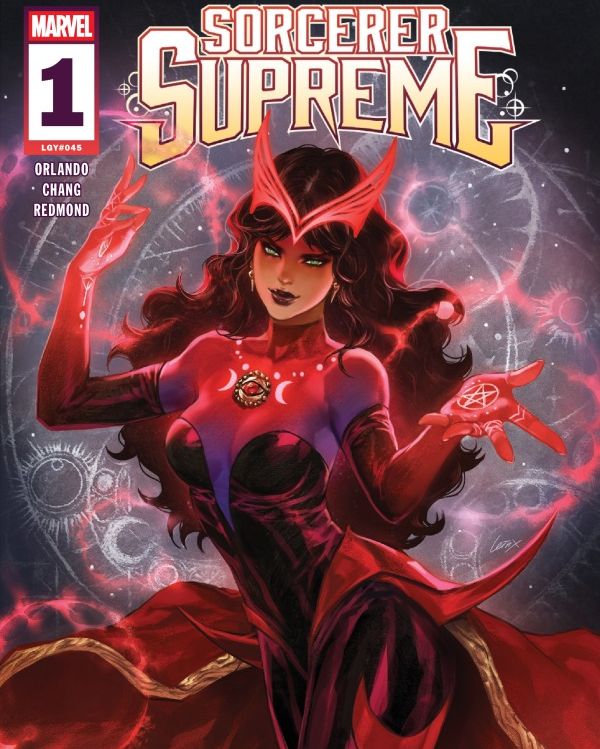
- Written by: Steve Orlando
- Art by: Bernard Chang
- Colors by: Ruth Redmond
- Letters by: VC’s Cory Petit
- Cover art by: Leirix Li (cover A)
- Cover price: $4.99
- Release date: December 31, 2025
Sorcerer Supreme #1, by Marvel on 12/31/25, wastes no time establishing Wanda Maximoff’s new title. But does a sharp aesthetic and snappy banter distract from an issue that feels more like a prologue than a story?
First Impressions
The opening pages deliver style in spades. Wanda’s confrontation with Dormammu on Roosevelt Island radiates confidence, with Bernard Chang’s kinetic linework and Ruth Redmond’s moody palette immediately setting a high bar. The dialogue crackles with personality, establishing Wanda as a sorcerer who trades quips as easily as hexes, but the stakes feel oddly absent for a dimensional tyrant threatening to devour Manhattan’s sorrow.
Plot Analysis
The issue opens with Wanda Maximoff defending Roosevelt Island from Dormammu, who seeks to feast on the city’s accumulated fear. Wanda introduces her Occultus Ab Occultis, a personal diary documenting her new role as Sorcerer Supreme, and promptly dispatches Dormammu using the Eye of Agamotto and dimensional snares. She then weaponizes the True Darkhold contained within her, forcing Dormammu to experience billions of years of anguish before he retreats. After the battle, Wanda telepathically communicates with Darcy Lewis, now running the Emporium magic shop in Brooklyn, joking about the confrontation while remaining characteristically late.
Wanda relocates to the Sanctum Sanctorum at 177A Bleecker Street, where she encounters Wong’s open hostility. Wong challenges her legitimacy as Sorcerer Supreme, accusing her of stealing the title and vestments rather than earning them through the Vishanti’s traditional selection process. Despite the tension, they agree to share custody of the Sanctum’s mystical animals: Bats the ghost dog, and the snakes Aleister and Anton. Wanda deflects Wong’s criticism and shifts focus to her first Cabinet meeting, having assembled a council of advisors to avoid repeating Doom’s mistake of ruling alone.
The Cabinet includes Somnus, a century-old King of Dreams who warns that her radical approach will scare allies and enemies alike, Speed (Tommy Maximoff), her son and a UN Sorcerous Crimes Service agent who cautions about increased scrutiny on all sorcerers, and Wiccan (Billy Maximoff), her other son, recently deposed as a cosmic wizard and future deity. Clea, Sorceress Supreme of the Dark Dimension and Doctor Strange’s wife, questions whether Wanda’s changes are too drastic and advocates for reforming the system from within rather than smashing it. The final and most unsettling advisor is Chthon, the Elder God who has tormented Wanda since birth, now imprisoned in a pocket dimension called the Sleeping Beyond but given a seat at the table as a devil’s advocate. Chthon mocks her, suggesting she stole the vestments from Doom’s corpse, but Wanda counters with a flashback sequence.
The flashback reveals how Wanda became Sorcerer Supreme after Doom’s sacrifice. When the Living Tribunal vaporized Doom and the vestments in One World Under Doom #9, Wanda heard the Cloak of Levitation and Eye of Agamotto crying out from the void. Recognizing that these artifacts possessed a higher form beyond their material existence, she used the Last Door, a portal for those with nowhere to turn, to reconstitute them, though the portal was destroyed in the process. The vestments, grateful to Wanda for rescuing them when Doom had abandoned them to annihilation, chose her as their new bearer.
However, the Vishanti, the cosmic trinity of Agamotto, Oshtur, and Hoggoth, confronted Wanda and demanded she return the vestments, insisting only they could select a Sorcerer Supreme. Wanda refused, standing her ground against the Vishanti and declaring she would defend the vestments against all threats, including them. When Oshtur attempted to intimidate her, Wanda unleashed the True Darkhold’s power and banished the Vishanti to the Crossroads, neutral ground, warning them never to stand between her and those in need again. Back in the present, the Cabinet meeting ends with acknowledgment that Wanda has already made powerful enemies. Wong remains skeptical but admits he is willing to be proven wrong, while Wanda walks Bats the ghost dog through Greenwich Village, explaining to the spectral hound that she believes magic should be more accessible and that traditions can become cages. The issue concludes abruptly as Agatha Harkness attacks Wanda with the Catastrophic Horn of Heaven, announcing herself as the Vishanti’s chosen true Sorceress Supreme.
Writing
Steve Orlando’s script delivers sharp, personality-driven dialogue that makes every character sound distinct. Wanda’s banter with Dormammu (“I put Chthon in a little box. Try to keep up.”) and her casual telepathic conversations with Darcy feel natural and entertaining. The issue juggles an ambitious amount of information, from magical lore to character introductions to political intrigue, without collapsing into incomprehensibility.
However, the pacing suffers from trying to accomplish too much. The Dormammu confrontation, Cabinet meeting, flashback sequence, and Agatha’s arrival all compete for attention, resulting in a structure that reads more like a series pitch than a complete story. Scenes end before they develop emotional weight. The Dormammu battle resolves in five pages with minimal tension, Wong’s confrontation feels perfunctory, and the Cabinet meeting, while conceptually interesting, amounts to each advisor delivering a single thesis statement before vanishing. The final cliffhanger arrives so abruptly it feels like a narrative ambush rather than an earned escalation.
Art
Bernard Chang’s artwork is the issue’s strongest asset. His character acting gives weight to every conversation, from Wong’s contemptuous glare to Somnus’s nervous fidgeting. The action sequences pop with dynamic angles and fluid motion, particularly Wanda’s manipulation of the Darkhold, rendered as swirling, oppressive imagery that conveys cosmic horror. Ruth Redmond’s color work shifts effortlessly between the hellish reds and oranges of Dormammu’s assault, the warm, grounded tones of Brooklyn’s Emporium, and the eerie greens and purples of the Sanctum’s mystical interiors. Panel layouts are clean and easy to follow, even during the flashback sequences, where subtle shifts in color temperature and lettering distinguish past from present. If there’s a minor quibble, it’s that some of the more intricate magical effects, while visually impressive, occasionally obscure character expressions during key emotional beats.
Character Development
Wanda Maximoff emerges as a fully realized protagonist with clear motivations: she rescued the vestments because they asked for help, and she refuses to let tradition dictate who deserves protection. Her defiance of the Vishanti stems from principle rather than ego, grounded in her history of being caged, controlled, and underestimated. The inclusion of her sons, Tommy and Billy, adds emotional texture, particularly the brief acknowledgment of her absence during their childhoods. Chthon’s presence as an advisor is a clever inversion of the “keep your enemies closer” trope, and his needling dialogue provides genuine menace without tipping into cartoonish villainy. However, supporting characters like Clea, Somnus, and even Wong feel underdeveloped, delivering their perspectives without the space to become people rather than positions. The issue establishes who they are but not why readers should care about them beyond their function in Wanda’s orbit.
Originality & Concept Execution
The premise of Wanda as Sorcerer Supreme is compelling, and Orlando commits to the idea by immediately showing her rejecting the Vishanti’s authority, an iconoclastic choice that distinguishes her tenure from Strange’s and Doom’s. The concept of a Cabinet of advisors, including a literal imprisoned god, is fresh and suggests a series interested in exploring magical politics rather than just mystical punching. The flashback sequence explaining how Wanda earned the title is elegant, solving the “how did she get this job?” question while reinforcing her core character trait: she listens when others cry for help. That said, the execution feels rushed. The issue introduces too many ideas without developing any of them. The Dormammu fight, the Wong conflict, the Cabinet dynamics, and the Vishanti confrontation all deserve room to breathe, but instead they’re crammed into a single issue that prioritizes breadth over depth.
Positives
Bernard Chang and Ruth Redmond deliver a visual feast that elevates every page, transforming exposition-heavy scenes into engaging tableaus. The Darkhold sequence, where Wanda forces Dormammu to experience “ten billion years of anguish in seconds,” is a standout moment that conveys the horrifying scope of her power without leaning on traditional action beats. Orlando’s dialogue is consistently witty and character-driven, with Wanda’s voice feeling distinct from Doctor Strange’s cerebral detachment or Doom’s imperious arrogance. The Cabinet concept is smart world-building, signaling that this series intends to explore the bureaucracy and ethics of magical governance. Wanda’s refusal to repeat Doom’s mistakes, her acknowledgment of her failures with Amaranth, and her willingness to include even Chthon in her decision-making process all paint her as a thoughtful, self-aware protagonist. The flashback explaining her ascension to Sorcerer Supreme is the issue’s emotional high point, reframing what could have been a power grab as an act of compassion.
Negatives
The issue’s ambition becomes its Achilles’ heel. The Dormammu confrontation lacks stakes because he retreats after a single magical gambit, robbing the opening of dramatic tension. Wong’s hostility is established but never explored, reducing a potentially rich conflict to a few barbed exchanges before he’s shuffled offstage to walk the dog. The Cabinet meeting introduces six advisors, but none receive enough page time to feel like characters rather than archetypes. Somnus warns about inertia, Speed mentions scrutiny, Wiccan worries about speed, and Clea advocates caution, but these perspectives blur together into a generic chorus of concern.
Most damaging is the absence of a strong cliffhanger. Agatha Harkness’s arrival should feel seismic, but the issue provides no context for why she would accept the Vishanti’s mantle or what this confrontation means for Wanda. The final page reads like an interruption rather than a culmination, leaving the story feeling incomplete rather than suspenseful. For a #1 issue, there’s shockingly little sense of what this series will actually be about beyond “Wanda has the job now, and some people are mad about it.”
About The Reviewer: Gabriel Hernandez is the Publisher & EIC of ComicalOpinions.com, a comics review site dedicated to indie, small, and mid-sized publishers.Follow @ComicalOpinions on YouTube, Facebook, Instagram, and Twitter
The Scorecard
Writing Quality (Clarity & Pacing): [2/4]
Art Quality (Execution & Synergy): [3.5/4]
Value (Originality & Entertainment): [0/2]
Final Verdict
Sorcerer Supreme #1 is a gorgeous, well-written comic that mistakes world-building for storytelling. Orlando and Chang clearly have a vision for Wanda’s tenure as the magical guardian of Earth, but this debut spends so much energy explaining how she got the job and who’s upset about it that it forgets to give readers a reason to care beyond the premise. The Dormammu fight resolves too easily, the Cabinet meeting drowns in exposition, and the Agatha cliffhanger arrives without enough setup to feel earned. This is a comic that reads like the first act of a story rather than a complete chapter, and while the promise of future conflicts is evident, a debut issue should deliver more than table-setting.
5.5/10
We hope you found this article interesting. Come back for more reviews, previews, and opinions on comics, and don’t forget to follow us on social media:
Connect With Us Here: Weird Science DC Comics / Weird Science Marvel Comics
If you’re interested in this creator’s works, remember to let your Local Comic Shop know to find more of their work for you. They would appreciate the call, and so would we.
Click here to find your Local Comic Shop: www.ComicShopLocator.com
As an Amazon Associate, we earn revenue from qualifying purchases to help fund this site. Links to Blu-Rays, DVDs, Books, Movies, and more contained in this article are affiliate links. Please consider purchasing if you find something interesting, and thank you for your support.
 Weird Science Marvel Comics