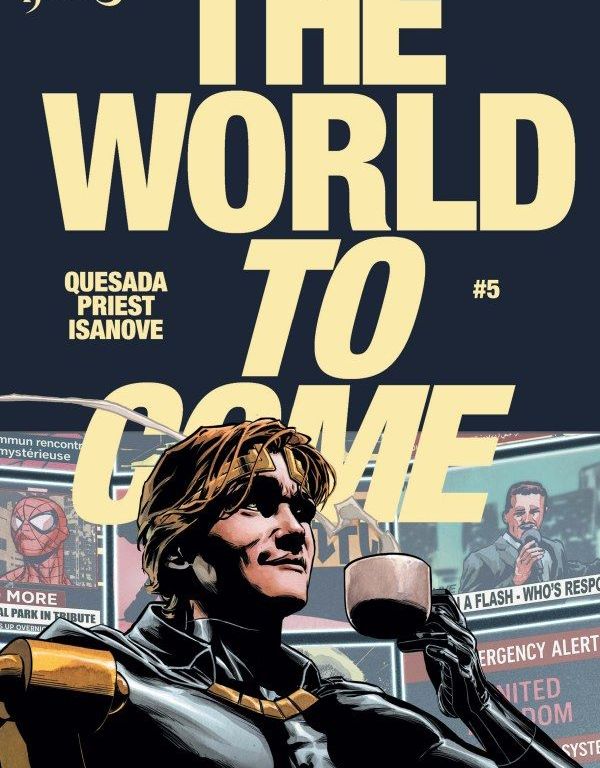
- Written by: Christopher Priest
- Art by: Joe Quesada
- Colors by: Richard Isanove
- Letters by: Richard Starkings, Tyler Smith
- Cover art by: Joe Quesada, Richard Isanove (cover A)
- Cover price: $4.99
- Release date: December 31, 2025
Marvel Knights: The World to Come #5, by Marvel on 12/31/25, presents a densely layered political thriller that mistakes narrative complexity for narrative coherence, and dazzles the eye while bewildering the brain.
First Impressions
The opening pages grip with apocalyptic urgency. A sick T’Challa emerges from a Vatican tomb after three years of exile, his body deteriorated and his purpose crystalline: return home to reckon with a son who has remade the world in fascism’s image. The tone is operatic and dread-soaked, establishing stakes that feel genuinely consequential even if the path to them remains deliberately murky.
Recap
Previously, Ketema had consolidated power through assassination and ideological capture, transforming Wakanda into a fascist state while hunting his presumed-dead father across the globe. Everett K. Ross stood by T’Challa’s side as a reluctant advisor, caught between his loyalty to the old king and the knowledge that T’Challa’s return could spark global war. The council remained imprisoned, the clergy executed, and a nation held in thrall by a young king whose resentment burned hotter than his capacity to govern wisely.
Plot Analysis
The issue opens five years before the present, with T’Challa arriving at the Vatican on the verge of death, meeting with Cardinal Matthew (Murdock) about his plans to return home. Ross reminisces about his relationship with the old king while watching T’Challa prepare for an impossible mission. The narrative then jumps backward another two years to Washington DC, where Ketema discovers his father’s ultimate contingency plan: a magical artifact locked in a reinforced prison, guarded by an enchanted dog, capable of erasing every superpowered being from Earth. This “Rapture” succeeds, leaving the world defenseless and dependent on Wakanda’s advanced technology.
Over the next seven years, Ketema orchestrates an elaborate scheme to consolidate global power. He uses a solar flare triggered by Wakandan tech to disable the world’s power grids, then positions Wakanda as savior, gradually absorbing nations into his empire under the banner of peace and prosperity. Pantherism becomes the world’s dominant religion, surveillance becomes normalized, education becomes controlled, and dissent becomes dangerous. Meanwhile, T’Challa’s sister Shuri remains locked in a tower, and Queen Monica is imprisoned in a shrine dedicated to her dead predecessor while Ketema attempts to manipulate her into revealing secrets.
At the story’s present moment, Ross finds T’Challa in the depths of a techno-jungle beneath Wakanda, along with old allies including a mysterious figure called Frank, and encounters a ragtag resistance movement. T’Challa himself appears in England, recruiting a university professor named Dr. William McGregor as a “witness” to whatever comes next. Across the globe, former Dora Milaje fight off Wakandan secret police in China, signaling that an uprising is imminent. The issue culminates with T’Challa standing before Ketema in the capital, ready for confrontation, while McGregor reflects on whether the old king orchestrated all of this suffering as part of a larger, manipulative design.
Writing
The structure is fundamentally fractured. The issue jumps between five different timelines without clear signposting, forcing readers to either deduce context or accept confusion as an artistic choice. Dialogue crackles with wit and philosophical weight, but this density becomes a liability. When characters discuss Thomas Hobbes and Montesquieu in the middle of a global crisis, the writing prioritizes intellectual performance over narrative clarity. Pacing oscillates between glacial exposition and frenetic plot movement. Some scenes breathe and build tension; others snap together with the abruptness of a commercial cut, leaving readers uncertain what just happened and why it mattered. The writing refuses pedestrian explanations, which earns respect, but earns no points for reader comprehension.
Art
This is where the comic genuinely excels. Joe Quesada and Richard Isanove craft panels that are visually arresting and emotionally precise. Composition ranges from intimate psychological moments to sprawling establishing shots of a globalized empire. Color work is deliberately muted and authoritarian, with deep reds, oppressive grays, and occasional bursts of sacred gold when religious imagery enters the frame. The synergy between visual and narrative is exceptional; even when dialogue obscures meaning, the art clarifies mood and stakes. Backgrounds are detailed and lived-in, suggesting a world that has genuinely transformed. Character expressions convey layers of motivation and internal conflict that the dialogue sometimes fails to articulate. The art is working overtime to compensate for the narrative’s willful obscurity.
Character Development
Ketema emerges as the issue’s emotional center, painted as both tragic and terrifying. His resentment of a father he barely knew, his hunger for legitimacy, and his embrace of authoritarianism are sketched convincingly across multiple timelines. T’Challa remains enigmatic, which works for his role as distant patriarch but undercuts relatability. Ross functions as the reader’s surrogate, offering grounded commentary, but even he becomes obscured by the issue’s larger conspiracy. Secondary characters like Queen Monica, Shuri, and the Dora Milaje are consistent in their resistance and trauma but lack enough screen time to generate genuine emotional investment. Dr. McGregor’s voiceover provides philosophical framing, but his character remains abstracted from direct participation in the crisis.
Originality & Concept Execution
The premise is audaciously original: imagine a young king inheriting his father’s contingency plans and using them to remake the world as a benevolent dictatorship. The fusion of superhero mythology with political philosophy is genuinely fresh. The execution, however, betrays the concept. By burying the plot under five competing timelines and cryptic dialogue, the issue obscures the brilliance of its own ambition. A clearer structural approach would allow readers to appreciate the intellectual audacity. Instead, the comic demands a second reading just to establish basic plot coherence, which feels less like artistic complexity and more like narrative self-sabotage.
Positives
The visual storytelling is exceptional. Quesada and Isanove deliver artwork that is both atmospheric and dynamically composed, creating a lived-in world where every detail contributes to the sense of authoritarian dread. The premise itself is remarkable: a story about what happens when a benevolent despot offers the world peace in exchange for freedom. The writing’s refusal to offer moral certainty is refreshing; no character escapes criticism, and the moral calculus remains genuinely complex. The scope is ambitious, spanning years and continents while maintaining thematic coherence. For readers willing to invest unreasonable amounts of effort, the rewards are substantial.
Negatives
The narrative structure is bewildering in a way that frustrates rather than intrigues. Jumping between five different timelines without clear transitions or consistent visual cues leaves even attentive readers confused about basic sequence of events. Plot developments that should land with emotional impact instead land with a dull thud because readers are still figuring out when they occur. The dialogue prioritizes philosophical density over clarity, with characters explaining contingency plans through oblique references to religious scripture and political theory rather than direct exposition. The pacing in several sections feels glacial, with pages devoted to establishing shots while crucial plot information arrives via whispered conversations or cryptic narration. Most damaging, the issue fails to deliver satisfying payoff for its setup. After building to a confrontation between T’Challa and Ketema, the issue simply ends, leaving readers unable to assess whether five years of reading has led anywhere meaningful.
About The Reviewer: Gabriel Hernandez is the Publisher & EIC of ComicalOpinions.com, a comics review site dedicated to indie, small, and mid-sized publishers.Follow @ComicalOpinions on YouTube, Facebook, Instagram, and Twitter
The Scorecard
Writing Quality (Clarity & Pacing): [0.5/4]
Art Quality (Execution & Synergy): [3.5/4]
Value (Originality & Entertainment): [1/2]
Final Verdict
Marvel Knights: The World To Come #5 is frustrating in proportion to its ambition. The artwork is phenomenal, the premise is genuinely inventive, and the world-building is global. But the narrative structure is so obsessed with complexity that it collapses under its own weight. A reader should not require a timeline diagram to understand basic plot progression. The issue demands respect for its intellectual scope while simultaneously failing to deliver narrative clarity necessary to make that respect stick.
5/10
We hope you found this article interesting. Come back for more reviews, previews, and opinions on comics, and don’t forget to follow us on social media:
Connect With Us Here: Weird Science DC Comics / Weird Science Marvel Comics
If you’re interested in this creator’s works, remember to let your Local Comic Shop know to find more of their work for you. They would appreciate the call, and so would we.
Click here to find your Local Comic Shop: www.ComicShopLocator.com
As an Amazon Associate, we earn revenue from qualifying purchases to help fund this site. Links to Blu-Rays, DVDs, Books, Movies, and more contained in this article are affiliate links. Please consider purchasing if you find something interesting, and thank you for your support.
 Weird Science Marvel Comics