- Written by: J. Michael Straczynski
- Art by: Sean Damien Hill, Jay Leisten, Oren Junior
- Colors by: Alex Sinclair
- Letters by: VC’s Joe Caramagna
- Cover art by: Pete Woods (cover A)
- Cover price: $3.99
- Release date: December 24, 2025
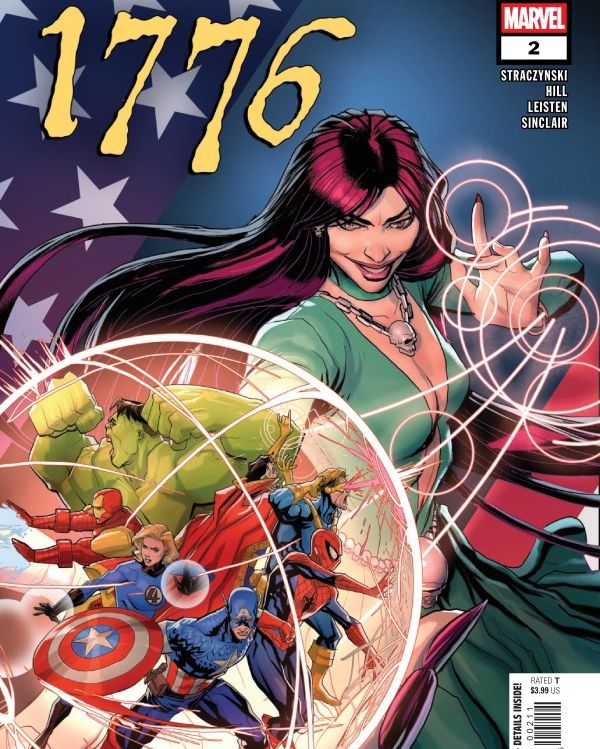
1776 #2, by Marvel on 12/24/25, sends the Avengers into a philosophical history seminar where the real enemy turns out to be tedium dressed up in Revolutionary War costumes.
First Impressions
The opening pages promise action and consequence, with the Avengers already deep in the time period and on the run from Continental Army soldiers. Unfortunately, the emotional urgency evaporates within pages as the comic shifts into lengthy exposition about historical figures, military logistics, and founding father politics that has almost nothing to do with the core conflict. By the time Spider-Man is narrating Black soldiers’ contributions to the war, the book feels more like a lecture than a story.
Recap
In 1776 #1, the Avengers learned that Morgan le Fay, an immortal sorceress, traveled back to 1777 to help the British win the Revolutionary War and prevent the United States from forming entirely. Doctor Strange sent Iron Man, Captain America, Spider-Man, and the Hulk back to stop her, with Clea, the Sorceress Supreme, as their guide. The issue ended with the team arriving in Saratoga, uncertain of what awaited them in this dangerous historical timeline.
Plot Analysis
Issue 2 opens with Captain America and Spider-Man already captured by Continental Army soldiers who believe them to be spies. Rather than allow combat or clever escapes, the story diverts into extended historical explanation delivered through Spider-Man’s observation of Black soldiers in the colonial forces. The two are eventually brought to General Gates, who dismisses their warning about Morgan le Fay as madness. Meanwhile, Iron Man arrives in Philadelphia and locates Benjamin Franklin, revealing his time-traveler identity through his modern speech patterns and casual references. Franklin immediately believes Iron Man and agrees to help him convince the Continental Congress to evacuate Philadelphia before Morgan’s forces arrive. The Hulk’s whereabouts remain mysterious, though a soldier mentions seeing a green man leaping between trees. The issue concludes with Clea confronting Morgan le Fay directly, offering peaceful negotiation, only to have Morgan reject her outright and promise an army greater than any in history. Clea accepts the challenge, declaring her own independence and strength as the conflict escalates into a magical confrontation.
Writing
The writing in 1776 #2 suffers from a fundamental structural problem; it prioritizes historical education over narrative momentum. The comic dedicates substantial panel space to Captain America explaining the historical reality of Black soldiers in the Continental Army to Spider-Man, including a full account of Peter Salem’s role at Bunker Hill and Major John Pitcairn’s death. While historically accurate, these tangents drain the issue of urgency and feel inserted as historical facts rather than woven naturally into the story. The dialogue is functional but flat; characters speak in stilted exposition, particularly when delivering information that pushes the plot forward. Captain America’s line, “Since technically, I am history,” is an attempt at humor but lands as a groan-worthy acknowledgment of the problem itself. Pacing is the real culprit. The issue moves from captured Avengers to historical exposition, then shifts to Iron Man in Philadelphia for more exposition about Morgan’s powers, then to Clea’s direct confrontation with the sorceress. Each scene stops the story cold for characters to explain stakes, abilities, or history. The structure creates a start-stop rhythm that prevents any real momentum from building.
Art
The artwork in this issue is wildly inconsistent, which undercuts any visual coherence the story might achieve. Multiple inkers are credited for different page sections (Jay Leisten handles pages 1-5, 9-16, and 19-20; Oren Junior takes pages 6-8 and 17-18), and the stylistic shift between their work is jarring and unprofessional. Leisten’s linework is tighter and more detailed, while Junior’s pages feel rushed and less refined, creating a visual whiplash effect that makes it hard to stay engaged with the narrative. The composition in crowded scenes like the Continental Congress is muddled, with too many characters and too much detail competing for attention. Some panels are nearly illegible due to cluttered backgrounds. The color work by Alex Sinclair is the strongest visual element, using muted Earth tones appropriate to the historical setting, but the inconsistent pencil and ink work undermines this effort. Several action sequences lack dynamic staging; the fight choreography is unclear, and the sense of spatial relationship between characters feels flat. The final splash page of Clea and Morgan le Fay facing off has potential but is undercut by the weak linework beneath it.
Character Development
Character development remains minimal throughout 1776 #2. Captain America and Spider-Man function as exposition delivery devices rather than characters experiencing this timeline as a real threat. Their capture, interrogation, and later dismissal by General Gates should create tension or vulnerability, but the scene plays out as comedic filler. Iron Man’s encounter with Benjamin Franklin is meant to show quick thinking and charm, but it reduces both figures to their most obvious traits: the anachronistic inventor and the historical genius recognizing an outsider. Franklin’s immediate acceptance of Iron Man’s story stretches credibility. General Gates registers only as an obstacle, impatient and dismissive without depth. Spider-Man’s extended historical monologue about Black soldiers is an attempt to add character voice, but it reads as the writer inserting educational material rather than the character naturally reflecting on history.
The most developed character interaction is between Clea and Morgan le Fay, but it’s brief and relies entirely on magical jargon and threats. Morgan’s motivation remains vague; the comic never clarifies why she’s allied with the British or what her ultimate goal is beyond ensuring British victory. Clea’s character arc is minimal; she exists to represent magical opposition and deliver witty comebacks like the “whosoever smelt it, dealt it” line, which feels wildly out of place and undermines her authority as the Dark Dimension’s Sorceress Supreme.
Originality & Concept Execution
The core concept of Avengers in the Revolutionary War is solid, and the first issue established genuine stakes. However, 1776 #2 abandons the concept’s potential by burying superhero conflict under American history lessons. The sorceress antagonist becomes secondary to lectures about war logistics, founding father politics, and colonial military composition. The comic tells rather than shows; characters explain what’s happening and why it matters instead of letting the story unfold through action and consequence. The execution falters because the writer seems more interested in historical accuracy than narrative tension.
This is the opposite of what made the concept fresh; the appeal was the collision between two worlds, not the subordination of superhero action to textbook recitation. The final Clea versus Morgan confrontation hints at the book’s true conflict, but by that point, so much page space has been consumed by historical exposition that the magical duel feels rushed and anticlimactic. The comic fails to balance its two genres; it doesn’t commit fully to either the historical accuracy angle or the superhero adventure angle, leaving readers caught between two half-realized stories.
Positives
The most effective element of 1776 #2 is Alex Sinclair’s color work, which creates a consistently appropriate mood across the book despite the visual inconsistencies in linework. The color palette grounds the story in its historical setting while making the occasional magical elements stand out. The Benjamin Franklin and Iron Man scene has promise, playing on the meeting of two inventor minds across centuries with genuine warmth in Franklin’s dialogue. The final page, with Clea directly confronting Morgan and refusing to back down, provides a moment of actual stakes and personal agency that the rest of the issue lacks. These scattered bright spots prove the creative team understands what 1776 could be if the pacing and focus were corrected.
Negatives
The overwhelming negative is the comic’s obsession with historical lectures at the expense of forward momentum. Captain America’s extended explanation of Black soldiers in the Revolutionary Army, while historically important, consumes panels that could have advanced the plot or deepened character relationships. The artwork’s inconsistency, caused by two incompatible inkers, makes the issue visually jarring and amateurish. The repeated pattern of characters explaining stakes, history, or powers instead of demonstrating them through action becomes exhausting by the midpoint. General Gates dismissing the Avengers as madmen and ordering their execution feels unearned; the scene lacks the dramatic weight it should carry.
The dialogue throughout is stiff and expository, particularly lines like “I do not have the time or patience to deal with madmen,” which sounds like a stock villain line rather than a character responding to a genuine crisis. Most damaging is the misdirection; readers came for Avengers versus Morgan le Fay in a historical setting, but they got a history textbook illustrated in two different art styles. The disconnect between the premise and the delivery creates a sense that the writer lost sight of what story was being told.
About The Reviewer: Gabriel Hernandez is the Publisher & EIC of ComicalOpinions.com, a comics review site dedicated to indie, small, and mid-sized publishers.Follow @ComicalOpinions on YouTube, Facebook, Instagram, and Twitter
The Scorecard
Writing Quality (Clarity & Pacing): [1/4]
Art Quality (Execution & Synergy): [1/4]
Value (Originality & Entertainment): [1/2]
Final Verdict
1776 #2 is a case study in what happens when a writer prioritizes historical accuracy over narrative momentum. The Avengers versus a sorceress in the Revolutionary War had real potential, but this issue buries that conflict under tedious exposition and battles it out with inconsistent artwork that can’t support even the modest ambitions it achieves.
3/10
We hope you found this article interesting. Come back for more reviews, previews, and opinions on comics, and don’t forget to follow us on social media:
Connect With Us Here: Weird Science DC Comics / Weird Science Marvel Comics
If you’re interested in this creator’s works, remember to let your Local Comic Shop know to find more of their work for you. They would appreciate the call, and so would we.
Click here to find your Local Comic Shop: www.ComicShopLocator.com
As an Amazon Associate, we earn revenue from qualifying purchases to help fund this site. Links to Blu-Rays, DVDs, Books, Movies, and more contained in this article are affiliate links. Please consider purchasing if you find something interesting, and thank you for your support.
 Weird Science Marvel Comics