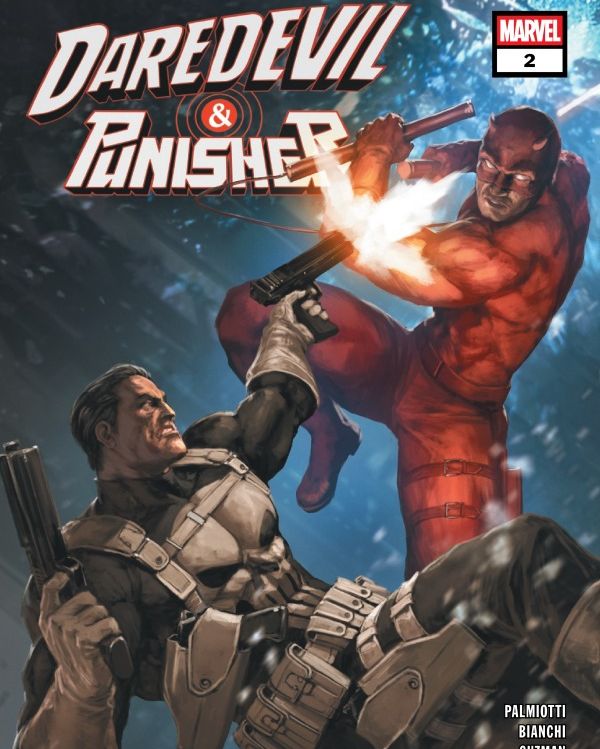
- Written by: Jimmy Palmiotti
- Art by: Tommaso Bianchi, Gabriel Guzman
- Colors by: Bryan Valenza
- Letters by: VC’s Joe Sabino
- Cover art by: Skan (cover A)
- Cover price: $3.99
- Release date: December 17, 2025
Daredevil/Punisher: The Devil’s Trigger #2, by Marvel on 12/17/25, picks up after the Punisher walks free with a bullet wound, and Matt must choose between cleaning up the criminal power vacuum or hunting Castle himself.
First Impressions
The opening pages drop readers right back into Matt’s internal crisis as news reports confirm the deaths of Dino Gnucci and Carlo Gnucci, hammering home the scale of Punisher’s campaign and the paralysis it creates for anyone still believing in due process. The emotional gut punch lands immediately; this is not a book coasting on Daredevil-versus-Punisher nostalgia but instead squarely asking whether Matt’s whole moral framework crumbles once the bills come due. You feel the weight of Matt’s exhaustion before you even turn the first page, and that heavy mood sticks with you throughout.
Recap
In the prior issue, Punisher orchestrated an elaborate trap for Daredevil, luring him to a warehouse where he forced Matt into a false moral choice: shoot Frank or watch him kill Dino Gnucci. Matt refused to pull the trigger, and Punisher shot Dino anyway, revealing the gun was rigged and the choice was always meaningless. Punisher then left Matt hanging above a secret meeting of rival gang leaders, including criminals Daredevil had previously sent to prison, forcing Matt to witness how his legal victories did nothing to keep them locked up and proving that the legal system fails where Punisher’s methods succeed.
Plot Analysis
Matt wakes Saturday morning bruised and questioning everything after the previous night’s ambush, learning through media reports that Dino Gnucci is dead and Carlo was killed days earlier by someone matching Punisher’s description, leaving the Gnucci organization in shambles. His body crashes hard despite his mind racing; he swings home in daylight through Manhattan, grateful that tourists never look up, and sits with the creeping realization that his legal victories against Gina Russo and Big Tony Rizzoli somehow failed to keep them imprisoned, both criminals somehow walking free after decades-long sentences. Misty Knight calls early Saturday asking for a favor and wants Matt to meet her at a diner to discuss the Russo and Rizzoli cases, bringing official records he cannot access; meanwhile, Matt also encounters his new neighbor Katherine in the apartment building lobby, a chance meeting heavy with genuine human connection, flirtation, and a reminder that life outside vigilantism still exists.
After sleeping through most of the day, Matt heads to the Q train to meet Misty, but Punisher boards the same train car bleeding from shoulder and rib wounds, having just fought his way through muggers who recognized him; the confined train car erupts into brutal combat, with Daredevil separating the assailants while Punisher fights through his injuries, and the moment forces Matt to confront Castle and challenge him directly about killing when the system cannot be trusted. Punisher counters that his way eliminates repeat offenders permanently, laying out the core moral argument again, before fleeing the train to continue his mission rather than engage in philosophical debate with Matt, leaving Daredevil with a choice: follow Castle and stop him, or take the injured criminals to the hospital and let his old enemy slip away to finish whatever he started.
Writing
The pacing splits cleanly between three distinct movements: Matt’s Saturday morning reckoning with the aftermath and Russo/Rizzoli revelations, his brief human connection with Katherine and the Misty Knight meeting setup, then the climactic train car confrontation with Punisher. This structure keeps the issue digestible while building tension, though the transitions between the intimate apartment scene and the subway violence feel slightly abrupt, asking readers to shift emotional gears without a smooth bridge. Palmiotti’s dialogue is functional and sharp where it matters most; Misty’s dry wit and the train muggers’ confidence create authentic voices, and Matt’s internal monologue anchors the growing despair effectively.
However, Punisher’s arguments feel less like authentic character voice and more like speeches, delivering his “permanent solution versus flawed system” ideology with essay-length precision rather than the natural, off-the-cuff tone that would make Castle feel like a man rather than an argument. The Katherine subplot introduces a humanizing beat, but the quick cut away from that moment to the Misty exposition and onward to the subway violence sometimes makes the pacing feel like it is rushing to hit action beats rather than allowing scenes to breathe.
Art
The art team handles the shift from quiet Saturday morning grief to sudden explosive action with skill and clear visual hierarchy. Tommaso Bianchi’s work on pages 1 through 2 and 8 through 20 establishes Matt’s exhaustion through panel composition; hunched postures, tight close-ups of bruised features, and the heavy shadows under his eyes communicate fatigue without narration. Gabriel Guzman’s pages 3 through 7 covering the apartment building and diner scenes use warmer, more open layouts that visually contrast with the darkness of Matt’s internal state, creating an interesting tension between setting and mood; Katherine’s introduction benefits from lighter line work and softer expressions that make the scene feel like genuine human possibility in a comic drowning in moral dread.
Bryan Valenza’s colors shift effectively between the muted grays and blacks of Matt’s home and thoughts to the brighter daylight scenes, though the transition is sometimes so jarring that it reads less like mood shift and more like an abrupt tonal whiplash. The subway fight benefits from dynamic paneling, with multiple perspectives on the violence and clear spatial awareness so readers never lose track of where bodies are in the confined train car; however, some of the smaller panel sequences in the crowd moments lack clarity, making it briefly unclear whether bystanders are getting crushed or moving safely away, and that momentary confusion undercuts the physical choreography.
Character Development
Matt Murdock is drawn consistently throughout as a man breaking under the weight of proof that his faith in institutions was naive; the shock of learning Russo and Rizzoli walked free after massive sentences hits harder because the issue establishes his belief in courtroom justice as genuine, not performative. His hesitation on the train to stop Punisher from completing a kill reflects his core crisis; he wants to prove his way works, but the issue implies he is running out of evidence that it does. Katherine serves primarily as a reflection of normal life and unspoken romantic potential, but she feels rushed and slightly underdeveloped for the space she occupies; her introduction and departure happen so quickly that readers cannot fully invest in her significance beyond “civilian reminder that Matt exists outside crime.”
Punisher emerges more as ideology than character in this issue; his wounds and his presence on a subway full of civilians suggest he is human and desperate, yet his dialogue consistently reduces him to a philosophical position rather than a man with stakes or fear, making it hard to know what he genuinely wants beyond proving Matt wrong. Misty Knight lands with natural camaraderie and genuine concern for Matt’s state, and her character work here exceeds what many issues might offer for a supporting character.
Originality & Concept Execution
The central premise of the series continues to push the idea that Daredevil and Punisher represent opposing justice systems competing for dominance; issue two deepens this by making Matt’s failure visible and personal. Russo and Rizzoli walking free after decades-long convictions is the kind of systemic failure that no amount of courtroom victories can overcome, and Palmiotti executes this resonance cleanly. However, the “train fight” feels like a well-worn action beat in comics and superhero media; having the two ideological rivals collide unexpectedly is solid, but the sequence itself does not break new ground in how such confined space fights typically play out. The Katherine subplot attempts to ground Matt in civilian normalcy, and while the effort is admirable, the execution feels tangential to the central conflict rather than truly integrating Matt’s personal life into the thematic core of the series. The issue succeeds more in deepening the moral crisis established in issue one than in surprising readers with unexpected character turns or narrative pivots; it is competent escalation rather than reinvention.
Positives
The strongest aspect of this issue is its refusal to let Matt’s crisis feel abstract; the Russo and Rizzoli revelations ground Punisher’s ideology in concrete failure rather than philosophical debate. Readers get to feel exactly what Matt feels when he learns that his legal victories were somehow reversed, and that emotional resonance makes the subsequent train fight feel like genuine collision of opposing philosophies rather than choreographed hero-villain combat. The pacing of the Saturday morning sequence, from waking to the news reports to the Misty phone call, creates a logical and emotionally coherent flow that sets up all the pieces for the collision to come without feeling mechanical.
The artwork effectively communicates Matt’s physical and emotional exhaustion through panel work, composition, and color choices, and Bianchi’s line work during the train fight conveys spatial clarity and impact so readers can follow the violence without becoming confused about positioning. Palmiotti’s use of Matt’s internal monologue consistently reinforces his central crisis about the efficacy of law versus Punisher’s brutal results, and that thematic through-line makes the issue feel focused and intentional rather than episodic.
Negatives
The Katherine subplot feels obligatory and underdeveloped, taking up valuable page real estate without meaningfully advancing either the central conflict or Matt’s character arc beyond a fleeting reminder that civilian life exists; the romantic beat reads as a speed bump rather than integrated character work, and the quick jump from flirtation to subway violence makes the emotional investment feel unearned. Punisher continues to function more as a philosophical position than as a fully realized character with authentic voice and personal stakes; his dialogue explaining his way and his argument against Matt’s system is intellectually sound but emotionally flat, making Castle feel less like a hardened vigilante and more like a philosophy major lecturing during a train fight.
The visual clarity issues in some of the smaller crowded panels during the subway sequence undercut what is otherwise strong dynamic action work, and for readers paying three dollars and ninety-nine cents, momentary confusion about spatial positioning is frustrating rather than forgivable. The writing also leans on exposition at several points; Misty’s briefing about Russo and Rizzoli is necessary information, but the diner scene sometimes feels like Matt sitting still to absorb plot rather than actively investigating or discovering, which slows the narrative pacing in a comic that is already split between quiet morning moments and sudden violence.
About The Reviewer: Gabriel Hernandez is the Publisher & EIC of ComicalOpinions.com, a comics review site dedicated to indie, small, and mid-sized publishers.Follow @ComicalOpinions on YouTube, Facebook, Instagram, and Twitter
The Scorecard
Writing Quality (Clarity & Pacing): [2.5/4]
Art Quality (Execution & Synergy): [2.5/4]
Value (Originality & Entertainment): [1/2]
Final Verdict
Daredevil/Punisher: The Devil’s Trigger #2 is a solid middle chapter that deepens the central moral crisis without reinventing the formula; the Russo and Rizzoli revelation hits hard enough to make readers feel Matt’s despair, and the train confrontation delivers action that serves the theme rather than overshadowing it. However, the Katherine subplot feels padding, Punisher continues to lack genuine character weight beneath his ideology, and some panel clarity issues in the action sequence chip away at the visual coherence. If you are already invested in the series and want to see how Matt’s faith in the legal system finally breaks, this issue earns a place in your monthly stack. If you are new to the story and hoping for a character-driven two-hander between equals, this is a Daredevil book that uses Punisher as a moral catalyst rather than a fully realized co-lead.
6/10
We hope you found this article interesting. Come back for more reviews, previews, and opinions on comics, and don’t forget to follow us on social media:
Connect With Us Here: Weird Science DC Comics / Weird Science Marvel Comics
If you’re interested in this creator’s works, remember to let your Local Comic Shop know to find more of their work for you. They would appreciate the call, and so would we.
Click here to find your Local Comic Shop: www.ComicShopLocator.com
As an Amazon Associate, we earn revenue from qualifying purchases to help fund this site. Links to Blu-Rays, DVDs, Books, Movies, and more contained in this article are affiliate links. Please consider purchasing if you find something interesting, and thank you for your support.
 Weird Science Marvel Comics