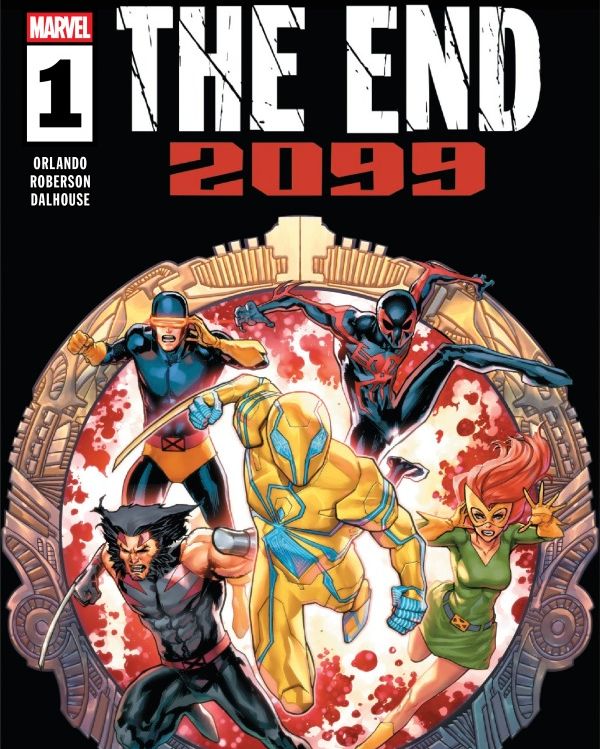
- Written by: Steve Orlando
- Art by: Ibraim Roberson
- Colors by: Andrew Dalhouse
- Letters by: VC’s Joe Caramagna
- Cover art by: Dave Marquez, Jay David Ramos (cover A)
- Cover price: $4.99
- Release date: December 10, 2025
The End 2099 #1, by Marvel on 12/10/25, opens with a cosmic threat so enormous, so galaxy-threatening, that the entire premise hinges on whether Steve Orlando can make you actually care about this particular apocalypse before the credits roll.
First Impressions
The opening pages thrust you into pure chaos: a data processor planet called Ioda gets obliterated, civilization-wide systems crash, and immediately we’re bouncing across seventeen different locations hearing about the fallout. It’s a lot, and not in the energetic way. Instead of building dread, the rapid-fire scene-hopping feels like Orlando is desperately trying to convince you that stakes exist before he has earned your emotional investment in any single character or location.
Plot Analysis
The story begins with Dracula, reforged as Bloodwielder, serving as the Herald to a cosmic entity called Abyssus, a creature born from the fusion of Galactus and Knull. Abyssus destroys the planet Ioda, causing a cascading technological collapse across the galaxy. This threat is so severe that even Mephisto, the demon lord himself, recognizes Abyssus as a danger. The Silver Surfer 2099 visits Hell and convinces Mephisto to take action by pointing out that Abyssus devours souls indiscriminately, stealing what Mephisto would normally claim in death.
Recognizing mutual self-interest, Mephisto and Abyssus strike a wager. Rather than fight directly, they will settle their dispute through chosen warrior armies. Mephisto will select heroes from across the universe, while Abyssus calls upon creatures with symbiote infection from alternate universes. Mephisto gathers the heroes of 2099, including Spider-Man, Ghost Rider, Phoenix, and others, and explains the stakes: if the heroes fail, their universe faces destruction. Spider-Man objects, seeing through the setup and urging the team to reject the terms, but the other warriors accept the wager and prepare for battle.
The issue ends with the revelation that Abyssus has his own army of symbiote-infected warriors, and that this conflict will pit 2099 heroes against 3099 warriors from alternate timelines. Spider-Man remains skeptical and resistant, unwilling to accept Mephisto’s framing of the situation as the only viable path forward.
Writing
Orlando’s pacing is relentless but unfocused. The issue bounces between at least a dozen locations with nearly zero breathing room: Ioda explodes, then we see reactions on Planet Wakanda, Domus Draconum, Praetor-Chandilar, Earth, the Triangulum Galaxy, Contraxxia, Nueva York, and the planet Triein. This constant location-shifting creates a sense of importance without establishing why any specific location matters to the reader. The dialogue, while serviceable, relies heavily on exposition. Mephisto and Abyssus explain the threat repeatedly to different characters. Knull explains himself to Abyssus; Mephisto explains the wager to Knull; the Surfer explains the problem to Mephisto; Mephisto explains everything again to the assembled heroes. This repetition flattens the narrative momentum because nothing new is being revealed after the first explanation.
The structure itself is the main culprit. A first issue needs to establish emotional hooks before throwing cosmically important plot mechanics at the audience. Orlando does the opposite, leading with spectacle and expecting you to care retroactively.
Art
Ibrahm Roberson’s artwork handles the chaos with decent clarity despite the breakneck pacing. Character designs are clean and recognizable, and action sequences have good visual flow. Andrew Dalhouse’s color work is solid and serviceable, though not particularly memorable. The real issue is compositional. With so many locations packed into one issue, Roberson is forced to make every panel count, which means less room for nuanced facial expressions or quiet character moments. The art does its job of conveying plot information, but it doesn’t enhance emotional investment or create visual moments that linger in memory. Everything feels slightly diminished by necessity, like a film trailer trying to pack an entire trilogy into two minutes.
Character Development
This is where the issue truly struggles. Beyond Spider-Man, who explicitly objects to the entire premise, there is almost no character development. The heroes are summoned, told about the threat, and immediately accept. Why does Phoenix accept Mephisto’s framing? What is her internal conflict? Ghost Rider is present but barely utilized beyond a one-panel gag about not being summoned. The 2099 lineup includes recognizable names, but they feel like chess pieces moved into position rather than characters with agency or perspective. Mephisto and Abyssus fare slightly better in that their negotiation reveals something about their relationship, but even that feels mechanical, more like the plot demanding they reach an agreement than these characters genuinely encountering each other.
Spider-Man’s resistance is the only emotional anchor, and Orlando keeps him isolated from the other heroes at the issue’s climax, which undercuts his ability to shift the team’s perspective. His refusal to accept the terms feels correct but ineffectual.
Originality & Concept Execution
The core concept, a tournament-style battle to determine universe survival, is not new. Marvel has done multiversal wars before. What makes this premise potentially interesting is the framing device: Mephisto and Abyssus using mortal champions as proxies instead of direct conflict. That’s clever. The execution, however, is purely mechanical. The issue treats the concept as a setup to be explained rather than a story moment to be experienced. We do not feel the weight of the wager because we are not invested in any character’s personal stakes before the announcement. The idea needed character-driven storytelling to land; instead, it gets exposition-driven plotting. This is a premise that could work in a different approach, but this issue does not prove it.
Positives
The visual clarity of Roberson’s linework ensures that despite the overwhelming amount of information, you can always understand what is happening on the page. The design of Abyssus as a cosmic entity is imposing and visually distinct. Spider-Man’s objection to the entire setup is the smartest creative choice in the issue because it voices the reader’s own skepticism. His refusal to accept Mephisto’s frame without question is the issue’s most human moment, and it grounds what could otherwise feel like a meaningless spectacle. This moment suggests that future issues might actually interrogate the setup rather than blindly accept it.
Negatives
The issue’s fundamental flaw is its structure. Exposition drowns out storytelling. You spend pages listening to Mephisto and Knull explain Abyssus to each other, then watching different characters receive the same information again. This repetition burns narrative real estate without advancing character development or emotional stakes. The constant location-hopping prevents any single scene from breathing or building momentum. By the time you reach the climax, you have been pulled so many directions that emotional investment feels impossible. The setup also leans on multiverse concepts and alternate timeline warriors that require readers to already be invested in characters they have not met. For a new reader, this issue is impenetrable. For an existing fan, it’s a plot delivery system masquerading as a story. The pacing prioritizes information over engagement.
About The Reviewer: Gabriel Hernandez is the Publisher & EIC of ComicalOpinions.com, a comics review site dedicated to indie, small, and mid-sized publishers.
Follow @ComicalOpinions on YouTube, Facebook, Instagram, and Twitter
The Scorecard
Writing Quality (Clarity & Pacing): [1/4]
Art Quality (Execution & Synergy): [3/4]
Value (Originality & Entertainment): [0.5/2]
Final Verdict
The End 2099 #1 is a comic book version of a loading screen, dumping plot mechanics on the reader in hopes they will be sufficiently intrigued to return next month. The issue assumes you already care about the stakes before giving you any reason to. Spider-Man is right to object; the heroes should have done the same. Invest your four dollars and ninety-nine cents elsewhere, or at least wait for issue two before committing. This first installment proves that Marvel can construct a complicated scenario; it has yet to prove that anyone will want to read about it.
4.5/10
We hope you found this article interesting. Come back for more reviews, previews, and opinions on comics, and don’t forget to follow us on social media:
Connect With Us Here: Weird Science DC Comics / Weird Science Marvel Comics
If you’re interested in this creator’s works, remember to let your Local Comic Shop know to find more of their work for you. They would appreciate the call, and so would we.
Click here to find your Local Comic Shop: www.ComicShopLocator.com
As an Amazon Associate, we earn revenue from qualifying purchases to help fund this site. Links to Blu-Rays, DVDs, Books, Movies, and more contained in this article are affiliate links. Please consider purchasing if you find something interesting, and thank you for your support.
 Weird Science Marvel Comics