- Written by: Ryan North
- Art by: Humberto Ramos, Victor Olazaba
- Colors by: Edgar Delgado
- Letters by: VC’s Joe Caramagna
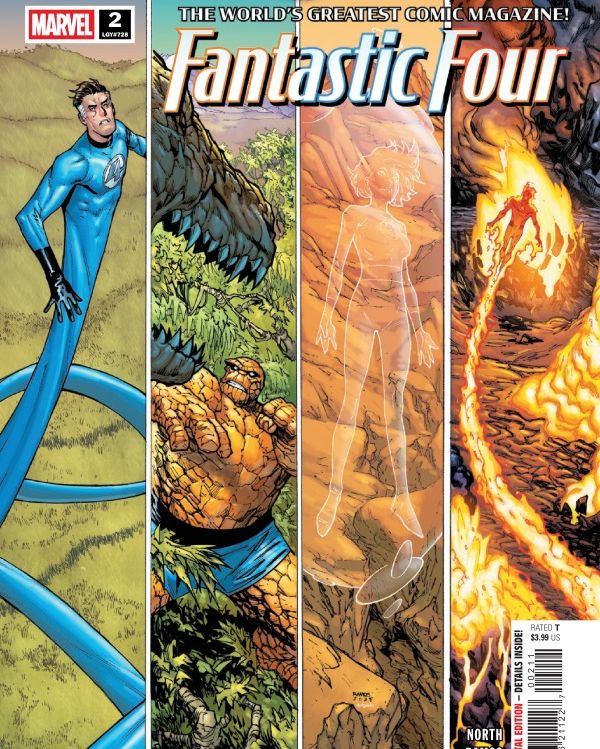
- Cover art by: Humberto Ramos, Victor Delgado (cover A)
- Cover price: $3.99
- Release date: August 13, 2025
Fantastic Four #2, by Marvel on 8/13/25, continues the disjointed saga of the Fantastic Four scattered across time when they fail, succeed, and fail again against Doctor Doom.
First Impressions
My initial reaction to this issue was one of weary resignation. It feels like a chore to read through, burdened by a plot that struggles to justify its own existence. The promise of a grand temporal adventure quickly devolves into a series of uninspired detours, leaving a distinct sense of “Is that all there is?”
Recap
In the preceding issue, Fantastic Four #1, Doctor Doom, now Sorcerer Supreme and Emperor of Earth, used his magical prowess to scatter the Fantastic Four across different historical periods. Johnny Storm landed in a low-oxygen prehistoric era, Ben Grimm found himself surrounded by dinosaurs, Reed Richards was transported to the Middle Ages, and Sue Storm was flung into a far future facing a dying sun. The team’s only hope for reunion rested on the “Forever Stone,” a constant across all eras, but Sue’s stone remained elusive.
Plot Analysis
This issue focuses primarily on Sue Storm’s predicament in the far future, specifically February 26, 7,801,020,245 CE. Earth is a dying world, with only a scant atmosphere remaining, posing an immediate threat to Sue’s survival without water. Her invisibility power, while useful for heat protection, cannot sustain her indefinitely, as Reed’s tracking transmitter embedded in the Forever Stone is also failing.
Sue seeks refuge in a deep cave, bending light around corners to illuminate its depths. She discovers a minuscule puddle of water, the last remnant of what was once a frigid lake. Using her powers as a microscope, she observes that this water contains the last forms of life on Earth: simple, single-celled bacteria, which resemble the planet’s earliest organisms.
Meanwhile, in June 6, 1266 CE, Reed Richards struggles to understand why Sue has not joined them. He theorizes that his Forever Stone tracker might have failed, dismissing the idea of her death as a logical dead end. Despite this, he begins an elaborate process to forge machinery and perform projective calculations, all to ensure the Forever Stone is locatable for Sue.
The narrative shifts to Reed’s meticulous work. He creates futuristic steel centuries ahead of schedule, ensuring it remains hidden from discovery. This advanced material is then used in his complex calculations to develop a method for Sue to pinpoint the Forever Stone, regardless of its signal strength.
The gambit works. Sue finds the stone, unlocks the time sled, and rescues her family so they can return to the present and continue their fight against Doom. Unfortunately, Reed boasts to Doom how they escaped their time adventure, giving Doom the information he needs to defeat them again. The issue ends with a second trip in the time sled.
Detailed Review
Writing
The writing in Fantastic Four #2 is a prime example of a concept that starts with ambition but stumbles in execution. Ryan North’s convenient plot resolution, specifically Reed’s ability to simply invent a way for Sue to find the Forever Stone after it’s stated to be unfindable, feels like a cheap narrative trick. It undercuts any genuine tension built around Sue’s isolation and reduces what should be a desperate quest into a mere waiting game for Reed’s ingenious, yet ill-defined, solution. This convenience is a glaring weakness.
Art
Humberto Ramos’s art continues to be a highlight, injecting much-needed energy into an otherwise faltering story. The dynamic panel layouts and expressive character designs are commendable, especially in depicting Sue’s struggle for survival on a desolate Earth. Edgar Delgado’s coloring adds a vibrant palette, even in the grim future setting, providing visual appeal that often surpasses the narrative’s quality. The artwork is clean, detailed, and effectively conveys emotion and intent, which is crucial given the thinness of the plot.
Characters
Reed Richards, often presented as Marvel’s premier intellect, comes across as surprisingly incompetent in this issue. His initial failure to ensure the Forever Stone’s tracker was robust enough for Sue’s extreme temporal displacement is a colossal mistake for a character of his caliber. Then, his misstep in bragging to DOom how they found their way home fundamentally undermines his heroic genius, making him less of a brilliant problem-solver and more of a clumsy scientist whose oversights create the very problems he then “conveniently” resolves. It strips him of agency and competence, transforming him into a plot device rather than a compelling character.
Positives
The artistic team truly shines, delivering consistent visual storytelling that is both engaging and aesthetically pleasing. Humberto Ramos’s unique style brings a refreshing dynamism to the characters and environments, making even the bleakness of Earth’s far future visually compelling. The subtle emotional expressions and body language effectively convey the characters’ internal states, adding depth where the script occasionally falters. The colors pop and the inks are sharp, elevating the overall reading experience.
Negatives
The primary flaw lies in the plot’s forced resolutions and the poor characterization of Reed Richards. The setup implies a significant challenge for Sue, yet Reed’s almost immediate, off-panel invention of a solution trivializes her struggle and removes any dramatic stakes. Furthermore, Reed, supposedly the smartest man in the Marvel Universe, making such a fundamental error with Doom feels like a disservice to his established intelligence, turning him into a creator of problems rather than a consistent hero.
About The Reviewer: Gabriel Hernandez is the Publisher & EIC of ComicalOpinions.com, a comics review site dedicated to indie, small, and mid-sized publishers.Follow @ComicalOpinions on YouTube, Facebook, Instagram, and Twitter
Fantastic Four #2 struggles to find its footing, relying on convenient plot devices rather than genuine character development or intricate problem-solving. While the art remains a strong point, the narrative choices, particularly regarding Reed Richards’s competence and the swift resolution of seemingly insurmountable challenges, leave much to be desired. It feels less like a Fantastic Four adventure and more like a series of plot points designed to get the team back together, regardless of logical consistency.
6/10
We hope you found this article interesting. Come back for more reviews, previews, and opinions on comics, and don’t forget to follow us on social media:
Connect With Us Here: Weird Science DC Comics / Weird Science Marvel Comics
If you’re interested in this creator’s works, remember to let your Local Comic Shop know to find more of their work for you. They would appreciate the call, and so would we.
Click here to find your Local Comic Shop: www.ComicShopLocator.com
As an Amazon Associate, we earn revenue from qualifying purchases to help fund this site. Links to Blu-Rays, DVDs, Books, Movies, and more contained in this article are affiliate links. Please consider purchasing if you find something interesting, and thank you for your support.
 Weird Science Marvel Comics