
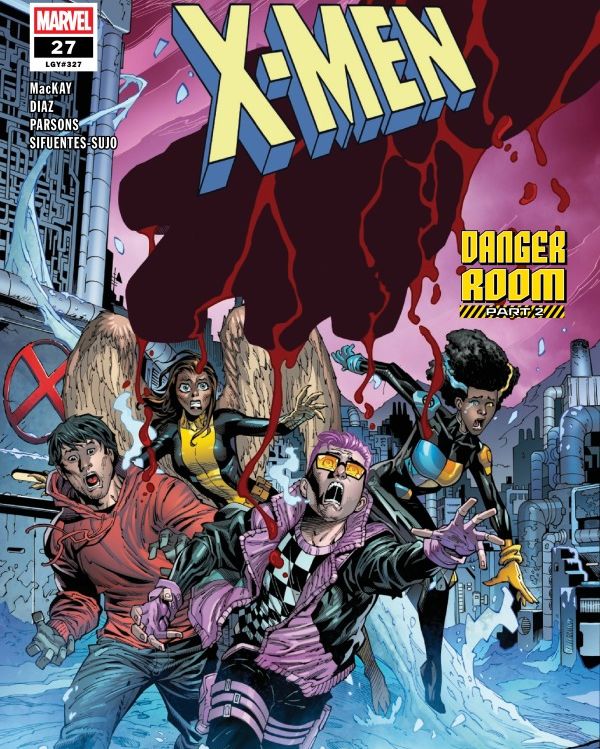
- Written by: Jed MacKay
- Art by: Netho Diaz, Sean Parsons
- Colors by: Fer Sifuentes-Sujo
- Letters by: VC’s Clayton Cowles
- Cover art by: Netho Diaz, Sean Parsons, Fer Sifuentes-Sujo (cover A)
- Cover price: $4.99
- Release date: March 18, 2026
X-Men #27 (Marvel, 3/18/26): Writer Jed MacKay and artist Netho Diaz escalate a targeted psychological assault on Cyclops and his team, with Psylocke as the pressure point in a tactical horror-trap at sea. The execution is confident but uneven, with sharp character beats undercut by a few clunky choices; Verdict: Worth reading.
First Impressions
You drop into X-Men #27 and instantly feel like the creative team finally names the real enemy, not just in-universe, but structurally, since this whole “Danger Room” cabal is built from the kind of people who weaponize systems for fun. The opening sequence of Maxine Danger recruiting her psychopath all‑stars hits like a dark character-study reel, briskly paced and chillingly calm, and it immediately reframes the broader arc as a premeditated campaign rather than a random string of bad mutant days. From there, the issue plays like a pressure-cooker thriller that keeps tightening screws on Cyclops at sea and Magneto back in Merle, even if a few transitions feel more mechanical than organic. It reads like a solid investment of time if you care about execution and long-term fallout, not just splashy cameos or nostalgia bait.
Recap
Last issue, Cyclops and his strike team raced out of Merle, Alaska to rescue Sheriff Paula Robbins, only to learn their shipboard rescue was an elaborate trap, while Psylocke peeled off to deal with John Greycrow’s arrest and Glob Herman tried to keep the peace at home. The big takeaway was simple and brutal: the X-Men are stretched thin, operating from a former Sentinel factory in a town that once built their worst nightmares, and someone is now using that tension as ammunition. The plot synopsis you provided leans into that setup, from Cyclops and Psylocke investigating a ransacked police station to Deputy Smith begging mutants for help, while other X-Men push into dangerous missions at sea and in prison. The issue made it clear the team’s sanctuary is fragile, their allies are outnumbered, and their enemies are deliberately isolating key players to make the eventual punch hurt more.
Plot Analysis (SPOILERS)
X-Men #27 opens by confirming that the chaos ripping through Cyclops’ squad and Merle is not random, it’ i’s curated. In a sequence of “Then” prison interviews, Maxine Danger strolls through different facilities recruiting her Danger Room, starting with former S.H.I.E.L.D. operations planner Charlene Jackson, who proudly engineered high-casualty missions just to rack up numbers until she was finally caught. Maxine follows that with Colton Colton, a trailer-park manipulator who sparked a community-wide slaughter simply to see if he could, and a pair of delusional would-be Skrull guerrillas, Grigos and Marquez, who targeted infrastructure to lure first responders and notch a body count. Each vignette lays out their “work” in flashback, then cuts to the present where all four now sit together in a high-tech briefing space as Maxine dubs them her Danger Room and asks for status reports on their operation against the X-Men.
Charlene lays out how separating Psylocke from Cyclops by targeting Greycrow removed his best field officer, compromised their alien gunship, and created the perfect opportunity to trap the main team on an infested ship in the Gulf of Alaska. Colton then explains how he has been stoking resentment in Merle, nudging “muties versus normies” fractures, and specifically setting up Glob Herman and the remaining X-kids and veterans like Magneto and Liu as vulnerable pieces once the heavy hitters left town, a plan punctuated by a grim full-page image of Glob bleeding on a table while his friends look on. Grigos and Marquez describe themselves as POWs from Secret Invasion, twisted into believing they are Skrulls imprisoned in human bodies, and Maxine coolly reframes their attacks on infrastructure and emergency services as preliminary tests before turning their tactics against super heroes. The issue closes with Charlene’s narration summarizing the current state of play on the living, techno-organic ship surrounding Cyclops’ team, fully weaponized by the Beyond Corporation, and she confidently declares that a handful of non-powered, psychopathic planners now have the X-Men dancing toward their graves while Cyclops rallies his people with a promise to fight their way out and make their unseen tormentors pay.
Writing
MacKay structures this issue like a villain-side bottle episode that quietly pulls together the threads he has been laying across Merle, the sea mission, and the prison subplot, and that structural choice mostly pays off because it finally clarifies motive and method. The pacing moves efficiently from one recruitment flashback to another, using Maxine’s interviews to define each member’s specialty, then sliding into their present-day debrief so you can see how those talents map directly onto the X-Men’s current problems, which gives the whole thing a satisfying “oh, that is how it all fits” vibe. Dialogue is intentionally clinical and chilling, especially with Charlene and Maxine, who talk about body counts and bait like line items, although a few lines veer into slightly overwritten villain monologue territory that states the thesis a bit too cleanly instead of trusting readers to connect all the dots. Thematically, framing normal humans and delusional would-be Skrull operatives as the real danger to mutants reinforces the long-running X-Men idea that systemic hatred and weaponized bureaucracy can do more damage than raw powers, and this issue leans into that idea in a way that feels grounded and quietly nasty rather than bombastic.
Art
Netho Diaz and Sean Parsons lean hard into clear, legible storytelling, which is exactly what you want from an issue that lives and dies on conversations, flashbacks, and emotional reveals rather than constant beam-clash spectacle. The prison sequences are staged with smart, grounded compositions that keep Maxine and each recruit framed in opposition across tables, bars, or narrow corridors, and the paneling subtly reinforces who has control in the room at any given moment. Colton’s trailer-park flashback is a highlight, where the layouts pull back to show the full chaos he orchestrated, with burning trailers, scattered bodies, and casual drinking in the foreground, and that contrast sells his sociopathy more effectively than any line of dialogue. Even when the script shifts back to the present and the Danger Room team stands in a sleek operations center, the page design keeps your eye flowing naturally from face to face and then out to the X-Men’s various predicaments on screen, maintaining clarity even as the exposition ramps up.
Fer Sifuentes-Sujo’s colors quietly do a lot of heavy lifting here, using distinct palettes to separate timelines and mentalities, which keeps the issue readable and mood-rich even as it jumps from prison interiors to burning communities to cold Alaskan seas. The Arbfeld and Calford sequences lean on sickly institutional greens and harsh fluorescents, so Maxine’s white coat and bright hair cut through the panels like a scalpel, visually marking her as both intruder and conductor of the violence she is recruiting. Colton’s flashback shifts into hot oranges and deep shadow, with smoke and fire softening the linework just enough to make the whole scene feel grimy and suffocating, while the scenes of Glob’s injury and Magneto’s desperation pull in cooler blues and purples that emphasize clinical dread instead of bombast. The only rough spot is that some of the techno-organic ship imagery feels a bit generic, more “standard Marvel goo-and-cables” than uniquely unsettling, which slightly undercuts the idea that this is a living battlefield tailored specifically to break the X-Men.
Character Development
On the character front, this is primarily a villain showcase, and it succeeds by making each Danger Room recruit feel distinct in motive and texture, even if you would never want to spend more than a few pages in their heads. Charlene’s cold satisfaction with her S.H.I.E.L.D. body count reads as someone who treated hero infrastructure as her own personal murder sandbox, and the script sells her as a terrifyingly plausible “numbers person” who only cares about maximized impact, which makes her a smart foil for Cyclops’ disciplined command mindset. Colton’s “just to see if I could” line is chilling not because it is flashy, but because it nails a certain kind of small-town resentment that metastasizes into mass violence, and that makes his current project in Merle feel uncomfortably believable. The Skrull-obsessed pair are less deep but still effective as a representation of how conspiracy and delusion can be weaponized, and together this crew gives the X-Men a set of enemies whose power is entirely in planning, not in blasting, which fits the book’s current focus on systemic threats and keeps the cast motivations consistent with the broader “mutants versus institutions” conflict.
Originality & Concept Execution
The core concept here is not brand-new on paper, “normal” humans and fringe operatives outthinking superheroes is a staple, but the execution feels fresh enough because MacKay grounds the Danger Room in very specific flavors of cruelty. Instead of building another costumed super-team, the script presents a sociopathic S.H.I.E.L.D. planner, a trailer-park social arsonist, and two self-styled alien guerrillas as a think tank focused on breaking the X-Men through targeted psychological warfare, and that is a compelling pivot from the usual mutant-supremacist or robot-threat playbook. The issue also reinforces the long-term premise that the X-Men’s greatest vulnerabilities are not their power levels, but their responsibilities to communities like Merle and allies like Sheriff Robbins, and the Danger Room is explicitly built to exploit those obligations. Conceptually, this installment mostly sticks the landing, although the techno-organic ship twist could use a bit more unique visual or conceptual flair to really stand apart from previous “living weapon” storylines.
Pros and Cons
What We Loved
- Maxine Danger’s recruitment interviews brilliantly establish each mastermind’s psychology and niche.
- Clear, grounded layouts keep dense dialogue and multiple timelines easy to follow.
- Glob Herman’s hospital scene and Magneto’s reaction inject genuine emotional stakes.
Room for Improvement
- Some villain monologues over-explain strategy instead of trusting reader inference.
- Techno-organic ship visuals feel a bit generic for such a key horror element.
- Limited on-page X-Men perspective may frustrate readers craving team interaction.
About The Reviewer: Gabriel Hernandez is the Publisher & EIC of ComicalOpinions.com, a comics review site dedicated to indie, small, and mid-sized publishers.
Follow @ComicalOpinions on YouTube, Facebook, Instagram, and Twitter
The Scorecard
Writing Quality (Clarity & Pacing): 3/4
Art Quality (Execution & Synergy): 3/4
Value (Originality & Entertainment): 1/2
Final Verdict
X-Men #27 gives you a sharply constructed villain spotlight that finally pulls the “Danger Room” concept into focus, anchored by crisp pacing, chilling character work, and visually clear storytelling that respects your time. On the positive side, the recruitment vignettes, the emotional gut-punch of Glob’s condition, and the way everything cleanly ties back into Cyclops’ current nightmare at sea make this feel like a well-planned chapter rather than interchangeable middle-act fluff. On the downside, a few over-expository speeches and somewhat generic techno-organic visuals keep it from hitting truly elite territory, especially if you want more page time with the actual X-Men processing what is happening to them.
7/10
We hope you found this article interesting. Come back for more reviews, previews, and opinions on comics, and don’t forget to follow us on social media:
Connect With Us Here: Weird Science DC Comics / Weird Science Marvel Comics
If you’re interested in this creator’s works, remember to let your Local Comic Shop know to find more of their work for you. They would appreciate the call, and so would we.
Click here to find your Local Comic Shop: www.ComicShopLocator.com
As an Amazon Associate, we earn revenue from qualifying purchases to help fund this site. Links to Blu-Rays, DVDs, Books, Movies, and more contained in this article are affiliate links. Please consider purchasing if you find something interesting, and thank you for your support.
 Weird Science Marvel Comics