
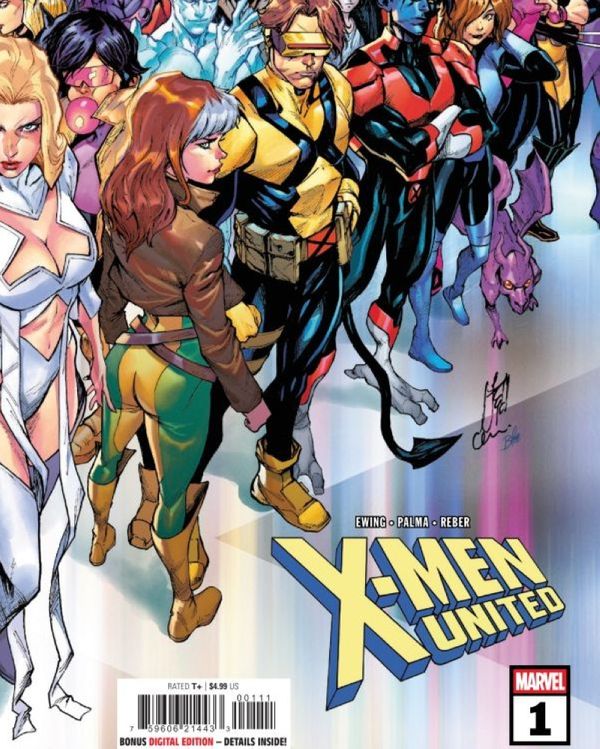
- Written by: Eve Ewing
- Art by: Tiago Palma
- Colors by: Brian Reber
- Letters by: VC’s Joe Sabino
- Cover art by: Stefano Caselli, Federico Blee (cover A)
- Cover price: $4.99
- Release date: March 11, 2026
X-Men United #1 (Marvel, 3/11/26): Writer Eve L. Ewing and artist Tiago Palma launch Graymatter Lane, a telepathic mind palace school where Emma Frost and Kitty Pryde train young mutants post-Krakoa. Cyclops distrusts the security built on Sinister tech, Wolf Cub goes feral during first-day training, and a mysterious discovery at Verate hints at future complications. The execution is ambitious yet uneven, balancing idealistic setup with immediate danger but struggling to give readers a clear focal hero. Verdict: Worth reading for Exceptional X-Men fans only.
First Impressions
X-Men United #1 opens with elegant visual world-building and Emma Frost’s luxurious telepathic invitation to Graymatter Lane, but it stumbles under the weight of its own ambition. Ewing introduces a sprawling cast list featuring dozens of mutants, student mentors, and faculty, yet fails to anchor the reader to a single protagonist whose journey we can follow. The issue feels like a pilot episode that prioritizes setting over character, presenting an institutional infrastructure overhaul rather than a tight narrative engine. The tone oscillates between hopeful relaunch energy and immediate crisis, never fully committing to either emotional register. Within the first ten pages, you know the setting and the stakes, but you don’t know whose story this is, and that absence of narrative clarity is the issue’s biggest liability.
The emotional beats land inconsistently. Emma’s speech about unity and responsibility feels rote rather than rousing, Cyclops’ paranoia reads as obstinate rather than justified, and the Wolf Cub incident delivers visceral shock but lacks emotional weight because we barely know the kid before he loses control. Tiago Palma’s art gives Graymatter Lane a fantastical Alice-in-Wonderland quality with organic architecture and psychedelic portals, but some character expressions feel stiff during critical dialogue exchanges. Brian Reber’s colors shine brightest in the mind palace environments and the pink-hued recruitment sequence, though the muted tones during the faculty debate undersell the tension. First impressions leave me cautiously intrigued but narratively adrift.
Plot Analysis (SPOILERS)
Emma Frost opens Graymatter Lane, a telepathic mind palace accessible globally to mutants via individual psychic doorways, and sends invitations across the world at 10 PM Greenwich Mean Time. Kitty Pryde partners with Emma as co-headmistress, though Emma insists on collective leadership rather than a single figurehead. Nightcrawler, Cyclops, Storm, Rogue, Gambit, Magneto, Beast, Iceman, and the Wolverines gather for the inaugural faculty meeting where Prodigy outlines curriculum, combat strategy is co-taught by Laura Kinney and Logan, mutant anatomy by Hank McCoy, teamwork principles by Storm, and history and philosophy by Magneto. Cyclops immediately raises security concerns, warning that mutants gathering in large numbers historically become sitting ducks for attacks. Axo, an emotional empath and Emma’s nephew, explains that he and Emma built multiphasic telepathic defenses using Mister Sinister’s recovered tech from Verate, claiming the psionic walls are impervious to physical, psychic, extraterrestrial, and demonic threats. Cyclops objects strenuously, accusing Emma of reckless overconfidence and storming out when Kitty asserts they don’t need his permission. Rogue cuts through the posturing, noting that Cyclops isn’t questioning Emma and Kitty’s competence but rather expressing his mistrust of the X-Men themselves after years of internal betrayals.
Logan and Laura Kinney introduce their combat class in the Danger Room, warning students that injuries sustained in the mind palace manifest in their real bodies. Bronze, a sophomore student mentor, assists as Laura demonstrates blocking techniques using her claws against Trista’s metallic skin. Students pair off to practice, tensions flaring when Loolo, an Arakkii child warrior, bristles at age-related comments and Ben Liu questions why adults like himself are enrolled. During a sparring exercise with Galura, a winged mutant, Wolf Cub abandons defensive posture and transforms into a feral berserker state after smelling blood from Animalia’s minor cut. He slashes Animalia and Galura before Logan subdues him with a sleeper hold, leaving three injured students and faculty questioning whether Graymatter Lane’s altered mental state makes students more susceptible to losing control. Axo and the student mentors, Bronze, Melee, Rift, and Sophie Cuckoo, regroup after the disaster, using the Empathy Engine, a Cerebro-like device stored in a constantly moving quantum stream only Rift can locate, to identify isolated young mutants. They recruit Mariama Lachance, a 13-year-old French mutant with a tail who’s bullied at school, using path-dependent projection cards that display personalized invitations and a confetti-filled welcome from Bronze.
Axo, Sophie Cuckoo, and Hellion return to Verate headquarters in Chicago to recover additional Sinister tech caches that will reduce the emotional toll of running the Empathy Engine. Sophie hears mysterious tapping on glass and discovers something shocking that Kitty reacts to with profanity. Meanwhile, Kitty introduces Bronze to a Lockheed clone left behind by Sinister, a female dragon with a yellow splotch who growls at Bronze before the newly recruited Mariama suggests naming her Marigold. Back at the Factory in Merle, Alaska, Cyclops tells Glob Herman he’s “handling” the Graymatter Lane problem, dismissing Glob’s objections. The issue ends with Cyclops ominously stating he’s doing what’s best for them, setting up a faction conflict for issue #2.
Writing
Ewing’s script prioritizes institutional world-building over character-driven storytelling, and that structural choice undermines the issue’s emotional impact. The opening Emma Frost sequence delivers elegant atmosphere with Debussy’s String Quartet and the ritualized unveiling of Graymatter Lane, but once the faculty convenes, the pacing bogs down into procedural exposition. Prodigy rattling off curriculum bullet points feels like reading a school brochure rather than experiencing narrative momentum. The Cyclops versus Kitty debate occupies critical real estate but lacks dramatic escalation because both characters argue past each other rather than engaging substantively with the moral dilemma. Cyclops raises legitimate security concerns about gathering mutants post-Krakoa trauma, yet the script never allows him a persuasive articulation of why Sinister tech specifically is dangerous, reducing him to paranoid obstructionist. Kitty counters with appeals to responsibility and Charles Xavier’s legacy, but the dialogue feels rhetorical rather than rooted in personal stakes.
Rogue’s interjection cuts closer to the truth by reframing Cyclops’ objections as internal mistrust rather than external threat assessment, but Ewing doesn’t pursue that thematic thread with enough depth to justify the page count devoted to the faculty squabble. The Wolf Cub incident injects visceral danger and raises narrative questions about Graymatter Lane’s unintended consequences, yet the aftermath feels rushed. Beast hypothesizes that accessing the mind palace may increase susceptibility to ferality, which is a compelling hook, but the moment passes without meaningful character reflection or emotional fallout for Wolf Cub himself. The recruitment subplot with Mariama offers sweetness and specificity, showing rather than telling how Graymatter Lane extends hope to isolated young mutants, but the tonal whiplash between the confetti welcome and the Danger Room bloodshed exposes the issue’s structural unevenness. Ewing juggles too many threads without giving any single storyline the breathing room to land emotionally.
Art
Tiago Palma’s pencils bring visual imagination to Graymatter Lane’s fantastical architecture, rendering the mind palace as a surreal organic landscape with mushroom-shaped structures, glowing bioluminescent plants, and psychedelic purple-bordered portals. The early splash pages showing mutants across the globe receiving Emma’s telepathic invitation deliver dynamic composition, using jagged panel shapes to convey the fractured simultaneity of the broadcast. Palma’s action choreography during the Wolf Cub attack sequence escalates effectively from controlled sparring to chaotic violence, with Wolf Cub’s transformation rendered through sequential close-ups on feral eyes, extending claws, and snarling teeth that build dread before the payoff slash. Laura Kinney’s demonstration of blocking techniques uses clean visual storytelling, her claws scraping against Bronze’s metallic arm with a satisfying CLANG sound effect that conveys impact without dialogue.
However, Palma’s figure work falters during conversational sequences where character acting should carry emotional subtext. The faculty debate features stiff, static talking-head panels where Cyclops, Kitty, and Emma stand in rigid poses delivering exposition rather than embodying tension through body language or facial nuance. Cyclops’ anger reads as generic scowling rather than the specific exhaustion and trauma-fueled fear that should underpin his objections. Emma’s expressions remain icily neutral throughout, missing opportunities to show vulnerability or defensiveness beneath her poised exterior. Brian Reber’s color work elevates the psychedelic mind palace environments with saturated purples, pinks, and greens that give Graymatter Lane a dreamlike otherworldly quality, and the recruitment sequence in France benefits from warm golden lighting that contrasts Mariama’s lonely bedroom with the vibrant pink energy of Bronze’s arrival. The Danger Room palette shifts to cooler blues and grays to signal danger, though the transition lacks the sharp tonal contrast needed to fully sell the mood shift. Letterer Joe Sabino’s sound effects integrate cleanly into panels, particularly the SPLISH of tea pouring and the SNIKT of claws extending, but some speech balloons crowd panels during group scenes, forcing readers to hunt for dialogue flow.
Character Development
X-Men United #1 assembles a massive ensemble cast but fails to establish a clear protagonist whose internal journey anchors the narrative. Emma Frost and Kitty Pryde function as institutional co-leaders rather than characters with active goals, obstacles, or personal stakes beyond “make the school work.” Emma’s telepathic broadcast and speech about unity feel performative rather than revealing inner conflict, and the script offers no window into her emotional state beyond surface-level confidence. Kitty Pryde similarly operates in administrative mode, defending the school’s existence without articulating what this project personally means to her after years of scattered X-teams and Krakoa’s collapse. The issue gestures toward their partnership as significant, Emma refusing the headmistress title to emphasize collective leadership, but that choice remains conceptual rather than emotionally textured.
Cyclops emerges as the closest thing to an active character with clear motivation (protect mutants from repeating past traumas) and a defined obstacle (convincing Emma and Kitty to abandon Graymatter Lane). Yet his characterization suffers from the script’s refusal to grant him persuasive articulation of his fears. He raises valid security concerns but never explains why Sinister tech specifically is dangerous, leaving him positioned as paranoid antagonist rather than reasonable dissenting voice. Rogue’s observation that Cyclops mistrusts the X-Men themselves rather than external threats offers psychological depth, but the issue doesn’t follow through by showing Cyclops grappling with that mistrust internally. His final scene with Glob Herman, ominously vowing to “handle” the situation, positions him as villain-coded obstacle rather than tragic figure acting from trauma. Wolf Cub receives the most visceral character moment (feral transformation and hurting classmates), yet the aftermath skips his emotional processing entirely, cutting away to student mentors debating recruitment logistics. We don’t see Wolf Cub’s shame, fear, or confusion after regaining control, which robs the incident of lasting character impact. Axo, Bronze, Melee, Rift, and Sophie Cuckoo function as likable student archetypes, their banter providing tonal relief, but none emerge as fully realized individuals with distinct internal conflicts.
Originality & Concept Execution
X-Men United’s core premise, a telepathic mind palace school that exists nowhere and everywhere simultaneously, offers fresh visual and thematic potential for exploring mutant education post-Krakoa. The concept smartly sidesteps traditional Xavier School logistics (physical location vulnerable to attack) by situating Graymatter Lane in psychic space accessible via individualized mental doorways. The “you get hurt in here, you get hurt out there” rule raises immediate stakes and distinguishes this mind palace from consequence-free dream sequences. Emma Frost and Kitty Pryde co-leading addresses the franchise’s historical pattern of singular patriarchal leadership, positioning Graymatter Lane as an explicitly collective endeavor that rejects Xavier’s model. The Empathy Engine recruitment system, which identifies isolated young mutants feeling depression or alienation rather than simply detecting X-genes, adds emotional specificity to the “find new mutants” formula and aligns with contemporary mental health discourse.
However, the execution undercuts the premise’s originality by retreating into familiar X-Men tropes. The faculty debate rehashes “is the school safe” arguments that have cycled through every X-institution from Xavier’s original school to Utopia to the Jean Grey School to Krakoa. Cyclops playing paranoid skeptic feels like a manufactured conflict rather than organic character evolution, recycling the “Cyclops doubts the plan” beat without fresh insight. The Danger Room incident, while viscerally rendered, follows predictable “student loses control on first day” plotting that’s been executed more memorably in previous X-runs. The Sinister tech revelation positions Graymatter Lane’s defenses as a ticking-time-bomb plot device rather than engaging with the ethical complexity of using a genocidal villain’s technology to protect children. Ewing gestures toward that moral gray area when Cyclops objects, but the script treats his concerns as obstinacy rather than legitimate philosophical debate. The issue’s most original element, the path-dependent projection recruitment cards that show each mutant personalized messaging, gets minimal page time compared to repetitive faculty squabbling.
What We Loved
- Mind palace concept delivers visually and thematically distinct school setting that sidesteps physical vulnerability through psychic architecture innovation.
- Empathy Engine recruitment targeting isolated mutants via emotional distress rather than X-gene detection alone adds contemporary mental health awareness and compassion.
- Wolf Cub feral transformation sequence escalates from controlled sparring to chaotic violence with visceral panel-to-panel progression and satisfying SNIKT sound design.
Room for Improvement
- Lacks clear protagonist whose internal journey and emotional stakes anchor sprawling ensemble cast through relatable perspective and decisive goal-driven action.
- Faculty debate burns page count on repetitive “is it safe” arguments without allowing Cyclops persuasive articulation or engaging Sinister-tech ethics meaningfully.
- Wolf Cub aftermath skips emotional processing entirely, cutting away before showing shame or fear, robbing incident of lasting character impact beyond plot function.
About The Reviewer: Gabriel Hernandez is the Publisher & EIC of ComicalOpinions.com, a comics review site dedicated to indie, small, and mid-sized publishers.Follow @ComicalOpinions on YouTube, Facebook, Instagram, and Twitter
The Scorecard
Writing Quality (Clarity & Pacing): 1.5/4
Art Quality (Execution & Synergy): 2.5/4
Value (Originality & Entertainment): 1/2
Final Verdict
X-Men United #1 assembles an ambitious institutional reboot with visually imaginative world-building and timely thematic hooks about collective leadership and mental health-focused recruitment, yet it stumbles by prioritizing setting over story. Ewing constructs Graymatter Lane as a psychic marvel, a nowhere-everywhere school that elegantly sidesteps physical vulnerability, and Palma renders that concept with surreal architectural flair that distinguishes the mind palace from standard superhero campuses. However, the issue’s fatal flaw is its lack of a clear protagonist whose internal journey and emotional stakes anchor the sprawling ensemble.
5/10
We hope you found this article interesting. Come back for more reviews, previews, and opinions on comics, and don’t forget to follow us on social media:
Connect With Us Here: Weird Science DC Comics / Weird Science Marvel Comics
If you’re interested in this creator’s works, remember to let your Local Comic Shop know to find more of their work for you. They would appreciate the call, and so would we.
Click here to find your Local Comic Shop: www.ComicShopLocator.com
As an Amazon Associate, we earn revenue from qualifying purchases to help fund this site. Links to Blu-Rays, DVDs, Books, Movies, and more contained in this article are affiliate links. Please consider purchasing if you find something interesting, and thank you for your support.
 Weird Science Marvel Comics
I bought and read all thirteen physical issues of Exceptional X-Men, and when I saw that 13 was the last issue, I lost a lot of faith in Eve Ewing. She created compelling characters, but there were so many plot holes in that story and points when I found myself asking “WTF, mate?” that not even Kitty’s redemption arc after being Shadowkat mattered to me anymore. I won’t pick this up because I work in education; I want to see kids in reality genuinely excited when they have those “Eureka!” moments learning something awesome. I don’t want to read another Eve story with shoddy Eve research and a phoned-in narrative that apparently insinuates anyone can teach just by being a mutant and has too many characters to convincingly capture those “A-ha!” moments in the book.
LikeLike