- Written by: Deniz Camp
- Art by: Pere Perez
- Colors by: Federico Blee
- Letters by: VC’s Travis Lanham
- Cover art by: Dike Ruan, Neeraj Menon
- Cover price: $4.99
- Release date: February 25, 2026
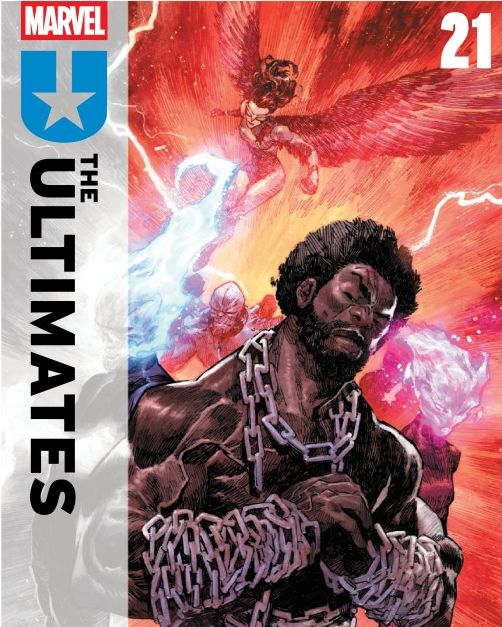
The Ultimates #21 (Marvel, 2/25/26): Writer Deniz Camp and artist Pere Pérez drive Luke Cage and an army of powered ex-prisoners into an all-out street-level revolution against the Maker’s Council, framed as a literal handbook for tearing the old world down. The pacing is tight and propulsive but the message-heavy script leans into sermonizing about collective uprising and digs at “no politics” readers hard enough that the whole thing feels more like a soapbox than a story, Verdict: For die-hard Ultimates and political dystopia fans only.
First Impressions
Ultimates #21 hits the ground running and barely slows down, stitching together multiple citywide uprisings with a clarity and rhythm that a lot of event books would kill for. You feel the momentum in how the issue hops from Luke Cage’s squads to on-the-ground clashes with the Maker’s Council, and the pacing gives the action sequences a clean, escalating beat that makes every page turn feel purposeful rather than padded.
The problem is that the script cannot resist turning almost every victory into a lecture about revolution as a moral inevitability, complete with handbook excerpts and blunt calls to overthrow power structures that read less like character voice and more like the writer grabbing the mic for a Marvel adaptation of the Communist Manifesto. There is also a clear jab aimed at long-time Marvel readers who say they want politics out of superhero comics, and the tone around that beat feels less like pointed satire and more like a scolding, which undercuts the otherwise smart structural work around the uprising.
Recap
The Ultimates #20 centered on Vision revealing itself as Jim Hammond’s evolved network consciousness coordinating a massive, multi-node rebellion centered in Detroit. Vision exposed how Hammond traveled back to 1947 to seed infrastructure and investments that could undercut the Maker from inside the timeline, while Detroit’s underground workers secretly built the Anti War Machine mech that rose up to crush a H.A.N.D. Helicarrier assault. As the network of resistance fighters executed synchronized prison breaks and sabotage operations, the Helicarrier fleet’s numbers plummeted while Vision shattered the Fury LMD’s mind by restoring his erased memories, leaving Detroit standing unbroken as a symbol of organized, data-driven rebellion while the Maker stayed ominously absent.
Plot Analysis (SPOILERS)
The issue opens by framing the story as an in-universe “Ultimates Handbook,” a revised revolutionary manual that declares the time for peaceful protest over and calls for coordinated demands backed by force, setting the ideological tone before any punches are thrown. From there, the narrative cuts to Luke Cage leading teams of powered former prisoners, each cell operating off the network’s playbook as they move through different urban centers to knock out infrastructure tied to the Maker’s Council. The captions explain that these are not random riots but carefully choreographed strikes built on years of planning, and the art tracks Cage’s squads as they liberate facilities, flip police and security forces, and rally bystanders who have finally seen through the propaganda that kept the Council in power.
Parallel scenes show other Ultimates operating as anchors for these fronts, with characters like Captain America and Wasp appearing in targeted engagements that give the revolution a recognizable heroic face while still centering the masses as the real engine of change. Pérez stages wide shots of crowds sweeping through streets and occupying key buildings while smaller panels zoom in on individual fighters, creating a sense of scale that sells the idea of a global uprising even as we only see specific hotspots. Vision’s presence is felt through tactical narration and networked updates rather than direct speeches, reinforcing that the true protagonist is the collective strategy rather than a single caped icon.
Throughout the battle sequences, voiceover excerpts from the Ultimates Handbook spell out a philosophy of power that explicitly rejects incremental reform and frames violent resistance as the only meaningful language the ruling class understands. These captions lean into historical rhetoric about power conceding nothing without demand and celebrate ex-prisoners as the vanguard of a new order, while panels show the Council’s elite scrambling as their control grids crumble. The contrast between the energized crowds and the isolated, panicked elites visually underlines the book’s argument that the old system is not just cruel but structurally unsalvageable.
In the final stretch, the Ultimates and their allies consolidate key wins, toppling local Council proxies and installing worker-led councils and community assemblies that begin redistributing resources, presented as a sketch of a new, cooperative order that looks a lot like a soft-focus revolutionary utopia. Dialogue and captions make it clear that capital, policing, and governance will now operate under collective control, and the celebratory tone suggests this is the righteous endpoint of the struggle rather than a messy transitional phase. The last pages drive the theme home with a mix of hopeful crowd shots and pointed narration that calls out readers who think superhero stories should avoid politics, framing them as people who, in practice, side with the status quo even as they cheer heroes in masks.
Writing
The pacing is easily the strongest part of the script, with Camp structuring the issue as a series of rising waves that move from handbook thesis to street-level execution to ideological victory without dead air. Every scene has a clear objective, and the constant cutaways between different fronts keep the energy high while still giving individual beats enough space to land, which is not trivial in what is basically a war montage across an alternate Earth. Structurally, framing the issue around the Ultimates Handbook gives the revolution a spine and a recurring motif, so even when the visual field jumps from Luke Cage’s squads to broader uprisings, the reader never loses track of the underlying plan.
Dialogue is where the cracks show, because much of the spoken and captioned text abandons character specificity in favor of manifesto-style declarations that sound like the writer addressing the reader directly. The hand-wringing over people who say they want “apolitical” superhero comics becomes an in-story jab that feels aimed at critics rather than anything these characters would naturally say while coordinating life-or-death operations, and it drags the conversation out of the fictional world and into Twitter-war territory. Thematic depth is not the problem, since the book clearly wants to explore collective power, state violence, and the ethics of uprising, but the delivery is so blunt and one-sided that nuance gets flattened into applause lines.
Art
Pere Pérez brings a clean, readable approach to layouts, with panel compositions that guide the eye smoothly through crowd scenes and large-scale battles, which is essential in an issue built on synchronized revolts across multiple locations. The action is easy to track, body language reads cleanly even in smaller panels, and the camera often pulls back at just the right moment to show the full weight of a crowd overtaking a street or facility, reinforcing the story’s emphasis on mass action. When the script calls for quick shifts between settings, the visual transitions stay coherent, so the revolution feels like a single coordinated storm rather than a montage of disconnected riots.
Federico Blee’s colors lean into warm, blazing palettes for street fights and cooler tones for control rooms and Council spaces, creating a tonal contrast that visually separates the insurgent energy from the stale, sterile authority of the elites. The use of red and orange around Cage’s teams amplifies the sense of heat and danger, while the flatter, more subdued colors around the Council’s infrastructure underline how cold and technocratic their power is. There are moments where the crowd scenes blur into a general wash of tone and motion rather than sharply defined individuals, which arguably fits the “collective” theme but also makes some panels feel more like propaganda posters than lived-in environments.
Character Development
Character work takes a back seat in this chapter, and while that is a defensible choice for a climax issue built on systems and movements, it does mean Luke Cage, Cap, Wasp, and the rest function more as avatars of the uprising than as people with freshly explored inner lives. Luke’s motivation as a former prisoner leading other ex-inmates into coordinated revolt is inherently rich, yet here it is mostly reiterated through slogans and logistical competence rather than any new personal conflict or doubt that could deepen his arc. Characters who have carried heavy moral weight in prior issues, like Wasp and Vision, largely operate off established trajectories instead of getting new hinge moments, which keeps them consistent but also leaves their emotional growth static in this chapter.
Relatability hinges on whether the reader buys into the idea that these heroes are not just endorsing revolution in the abstract but have thought through what comes after, and the issue does not spend much time wrestling with those questions on an individual level. For readers wary of rapid systemic overhaul framed as unambiguously righteous, the lack of internal pushback or messy debate among the Ultimates can feel like an absence rather than a deliberate artistic choice. The result is a cast that acts in line with prior motivations but rarely surprises, which is fine for plot execution but leaves the emotional temperature cooler than the rhetoric suggests it should be.
Originality & Concept Execution
The core concept of an Ultimates issue functioning as an in-world revolutionary manual that shows how years of planning and network-building culminate in a coordinated uprising is genuinely fresh, especially for a Big 2 superhero book. You can see the thought that went into blending superhero spectacle with insurgent playbook language, from the way the handbook excerpts overlay battle scenes to the emphasis on ex-prisoners as a deliberately empowered vanguard against the Maker’s global surveillance state. As a premise, “heroes as facilitators of collective revolution rather than singular saviors” is strong and aligns with the broader Ultimates project of rethinking what power looks like when spread across millions of nodes.
Execution stumbles when the book shifts from dramatizing those ideas through story to spelling them out like a manifesto, and the hints of a near-utopian cooperative future arrive so cleanly that they feel more like political wish-fulfillment than a textured outcome. The issue also cannot resist turning its thematic framing into a live argument with parts of the audience, which may be cathartic for the creative team but reads as self-indulgent when you are trying to evaluate the comic as a piece of storytelling rather than a thread reply. There is originality here, no denying it, but the sermonizing tone dulls the edge of what could have been a sharper, more unsettling exploration of revolution’s costs and tradeoffs.
Pros and Cons
What We Loved
- Confident, energetic pacing that moves cleanly between multiple uprising fronts without losing clarity.
- Clear, readable layouts and expressive body language that keep large crowd scenes understandable and engaging.
- Ambitious premise treating heroes as facilitators of a coordinated, long-planned global revolution.
Room for Improvement
- Heavy-handed political narration that frequently drowns out character voice and subtlety.
- Sermon-like jabs at “apolitical” readers that feel more reactive than dramatically earned.
- Near-utopian post-revolution outcome presented with little exploration of consequences or complexity.
About The Reviewer: Gabriel Hernandez is the Publisher & EIC of ComicalOpinions.com, a comics review site dedicated to indie, small, and mid-sized publishers.
Follow @ComicalOpinions on YouTube, Facebook, Instagram, and Twitter
The Scorecard: (Measurable Value Assessment)
Writing Quality (Clarity & Pacing): 2/4
Art Quality (Execution & Synergy): 3/4
Value (Originality & Entertainment): 0/2
Final Verdict
Ultimates #21 is a well-oiled machine when it comes to pacing, visual clarity, and structural ambition, and on that level it absolutely does its job as a climactic uprising chapter. The trouble is that the book keeps stepping away from being a story about these characters in this world and instead turns into a pointed lecture about how real-world revolution should look, complete with digs at anyone who still clings to the fantasy of “politics-free” superhero comics. If you are heavily invested in this Ultimate line experiment and comfortable with a comic that functions as a manifesto as much as a narrative, this is a solid pickup; if you are on a tight pull list and looking for balance between theme and character, you can safely treat this as an optional chapter rather than a mandatory purchase.
5/10
We hope you found this article interesting. Come back for more reviews, previews, and opinions on comics, and don’t forget to follow us on social media:
Connect With Us Here: Weird Science DC Comics / Weird Science Marvel Comics
If you’re interested in this creator’s works, remember to let your Local Comic Shop know to find more of their work for you. They would appreciate the call, and so would we.
Click here to find your Local Comic Shop: www.ComicShopLocator.com
As an Amazon Associate, we earn revenue from qualifying purchases to help fund this site. Links to Blu-Rays, DVDs, Books, Movies, and more contained in this article are affiliate links. Please consider purchasing if you find something interesting, and thank you for your support.
 Weird Science Marvel Comics
How did this score nothing on value? Do you realise that comics may not exist in the future if there is not a worldwide revolution? and I do say May because obviously there’s the situation of us continuing along the status quo of conditions slowly worsening for anyone who isn’t mega wealthy and I’m sure we will all get sustained by universal basic income at some point rather super elite continue to accrue wealth. probably to keep usdocile they will will still release entertainment and this entertainment will probably be made by AI… but that isn’t exactly an incredible future. Anyway I have not read it yet but I just queried how it would get nothing on value.
LikeLike