- Written by: Deniz Camp
- Art by: Terry & Rachel Dodson, Jonas Scharf
- Colors by: Terry Dodson, Edgar Delgado
- Letters by: VC’s Cory Petit
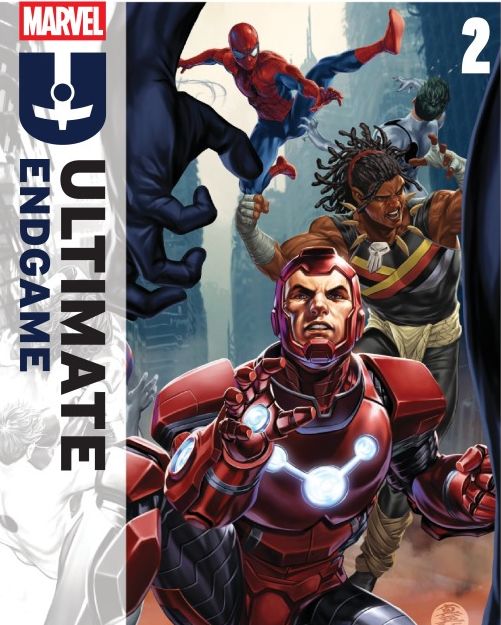
- Cover art by: Mark Brooks (cover A)
- Cover price: $4.99
- Release date: February 4, 2026
Ultimate Endgame #2, by Marvel on 2/4/26, is the kind of event comic that looks expensive at first glance but quietly asks you to pay full price for half a story.
First Impressions
Closing the issue, I felt more annoyed than hyped, like I had just watched a very pretty trailer stretched to 30 pages. The core idea, a forever war in broken time while the Maker becomes the City itself, is rich, but the script spends so long listening to Immortus ramble that the story never really gets out of first gear. When the dust settles, everyone is basically back where they started, so the reading experience feels oddly empty for something this loud and cosmic.
Recap
In Ultimate Endgame #1, the Maker murders King Zuras, then the story jumps to 30 minutes before the Maker’s big return as Iron Lad coordinates a global uprising against the Maker’s Council while heroes and villains brace for impact around the Dome. Peter Parker grabs Richard’s picotech suit from Tony’s legacy tech, says a painful goodbye to MJ and his family, and joins the Ultimates as they prepare to enter the City. When the Dome finally opens, a dust storm hits, the Dome slams shut with the Ultimates trapped inside, and the heroes discover Children of Tomorrow waiting as engineered super soldiers. A mysterious Death’s Head cyborg drags the team out through a dimensional tear, keeps babbling about a broken Immortus Engine, and the issue ends with the network down, the situation worse than before, and a final page twist revealing the Maker’s fate in a way that raises more questions than it answers.
Plot Analysis (SPOILERS)
Inside the City, Immortus narrates Tony through slices of a “Forever War” measured in centuries, describing failed attempts to kill the Maker and his own repeated deaths as the Maker slowly becomes the City itself. The Maker’s consciousness spreads like an oily smog that turns people into receivers for his mind, and Howard admits he extended the Darwin Bubble just to keep that infection contained. This revelation means that only microseconds have passed outside while centuries have ticked by inside, so months have gone by in the real world since the heroes entered the City, raising the stakes of every delay. Howard has clearly gone half-mad from time distortion and booze, and he insists the only viable strategy is containment, not victory.
Outside the Dome, we see the fallout through Phantom Reporter social posts and short scenes, as Latveria empties out, Heaven is quarantined under Hulk’s forces, and radical protests like Shenqi’s followers self immolating highlight how bad things have gotten. In Wakanda, T’Challa debates the true roots of injustice before finally giving Erik Killmonger a single mission, become the Sword of Wakanda and kill the Maker so the continent has any hope of real freedom. Online chatter tracks Killmonger as he seizes a Roxxon uranium mine “for the workers,” then cuts across Algerian and European airspace with a single vibranium sword while whole armies fail to slow him down. The Network speculates about his motives and official status, but the pages are basically a travel montage of Erik cutting a path toward the City.
Back in Immortus’s hideout, Howard explains that Limbo, his stolen-time pocket, sits outside the Maker’s three dimensional reach, and that his Immortus Engine is the key that keeps the Dome intact and the Maker contained. Tony discovers his own Immortus Engine does not work inside this warped geometry and begs his father for help, only to find Howard too fractured, drunk, and time poisoned to fully remember him. When the Maker finally invades Limbo, he lunges for the engine, and the Ultimates scramble to defend it while Howard rants about how any escape could free the Maker and doom reality. The scene sets up a big moral choice, but Immortus is more focused on hoarding time and protecting his own work than on saving the universe.
The confrontation ends when Tony lashes out under pressure and kills his father, ripping out the Immortus Engine just as Howard finally recognizes him and tries to say something human. The Maker tracks them into the collapsing time pocket, but Howard reveals that Limbo was built on borrowed time and that without the engine everything here is about to evaporate, including the Maker’s foothold. Death’s Head hustles Tony and the others back into the City proper as Limbo dissolves, taking Howard and the Maker’s temporary advantage with it. The issue closes on Doom reappearing at the Maker’s side, welcomed back like a favored son while the heroes stand once again trapped in the City with no clear way to win, right back where they started.
Writing
The writing is packed with clever ideas and sharp one liners, but the pacing is badly lopsided, front loading dense Immortus rambling and time jumps, then rushing the emotional climax and fallout. For a comic that needs to feel like the second act of a final event, this spends far too long explaining the Forever War and the Maker-cloud, and not nearly enough time on what any of that actually changes for the heroes in the here and now. The script drifts between Immortus monologues, social media cutaways, and Killmonger’s travelog, so the throughline of “how do we beat the Maker” never gets a solid, escalating spine.
Dialogue swings from fun banter, like Spider-Man cracking jokes about taxidermy and Tachyon wine, to overwritten time-theory rants that read more like Hickman footnotes than human speech. The Howard and Tony material wants to be a gut punch, but Howard is kept intentionally incoherent for so long that his late “Dad” moment lands more as concept than as earned emotion. Structurally, the issue opens with big narration captions, cuts to global updates, then jumps back to the Limbo showdown, so by the time we hit the final page twist with Doom, the story feels like it circled the block instead of moving forward.
Art
The split art approach, Dodsons outside the Dome and Jonas Scharf inside, is meant to visually separate the real world from the warped interior, but the transition between them is flat out jarring. Terry and Rachel Dodson give the outside scenes a lush, almost prestige sheen, with bold figures and clear staging that feel like a high end event book, then the switch to Scharf’s scratchier, more claustrophobic linework inside the City hits like channel surfing to a different series. That tonal break would work if the story eased the reader into it or used layouts to bridge styles, but here it often feels like two comics stapled together rather than a unified aesthetic.
On a panel to panel level, Scharf’s pages are moody and readable, yet the heavy, busy detail sometimes muddies the action, especially in the chaos around the Maker’s attack and the Limbo collapse. Color helps sell the moods, with the City and Limbo soaked in sickly hues that match the “oily smog” and borrowed time concepts, while the Wakanda and world scenes pop with richer tones that sell their scale. Still, the artistic synergy suffers, because the Dodsons’ polished pages set an expectation the interior segments cannot match, turning each transition into a reminder that the book is visually uneven.
Character Development
Tony Stark gets the spotlight, but his arc is more sketched than fully felt, moving from confused son to accidental patricide without enough quiet beats to let his panic and guilt breathe. We see him beg for help, snap under pressure, and scream when Howard dies, yet the script hurries him along so quickly that his emotional state becomes another data point rather than a developed journey. Howard, now Immortus, is intentionally fragmented, which fits the concept but also keeps him at arm’s length, so his last attempts at fatherhood feel more like a meta gag than a tragic payoff.
Killmonger’s portrayal is stylish but wildly inflated, turning him into a one man army slicing through entire national forces with a single sword in a way that strains the internal logic of even a superhero universe. The comic tries to hand wave it with “pure vibranium” and mythology about him being the Sword of Wakanda, yet we never see real tactical cost, injury, or any meaningful resistance, so he reads more like a meme than a person. Doom’s last page reveal as the Maker’s apparent ally is intriguing, but because his motivations are barely touched here, the twist functions more as a hook for next issue than as an organic turn built from this chapter’s character work.
Originality & Concept Execution
Conceptually, “War in Four Dimensions,” a Maker who literally is the City, and an immortal Howard Stark burning through stolen seconds is fresh and ambitious. The social-feed framing on the outside world, with Phantom Reporter tweets and network chatter, gives the global conflict a modern texture that fits the Ultimate line’s vibe. In theory, this issue should be the one where the high concept locks into a clear problem, timeline shock, containment vs victory, and the cost of time travel on human bonds, that propels the rest of the event.
In execution, the book mostly just restates how impossible the situation is without providing a concrete new strategy or a meaningful shift in the board, which makes the originality feel ornamental rather than functional. The Immortus Engine is introduced, explained, destroyed, and removed from play all in one issue, so instead of a driving mystery it becomes a fancy MacGuffin that resets the pieces while leaving the heroes exactly where we started, trapped in the City with no plan. That kind of narrative wheel spinning undercuts the “this is the endgame” promise and makes the comic feel less like a pivotal chapter and more like an expensive recap with one big tragic beat stapled on.
Positives
The strongest value here sits in the high concept sci fi and a few standout moments, particularly the idea of a Forever War playing out over centuries while only months pass outside, and the sick joke that Howard has died countless times trying to kill the Maker. The global check ins sell the scale of the conflict, with Latveria’s evacuations, Heaven’s quarantine, and protest movements giving the sense that the Maker’s shadow reshapes politics and faith, not just superhero fights. Visually, the Dodsons’ outside pages look premium, and some of Scharf’s more grotesque City imagery, the Maker-cloud, spores, and Death’s Head, deliver atmosphere that would impress readers who want their events to feel big, weird, and oppressive.
Negatives
On the downside, the pacing is uneven enough that the comic feels long without feeling full, with too much time spent on Immortus babble and not enough on meaningful choices or new information that changes the game. The art split between Dodsons and Scharf is not just different, it’s clashing, so every transition between outside and inside reminds you that this event does not have a unified visual identity, which is a problem for a flagship finale. Killmonger’s “one sword versus entire armies” run pushes believability past the breaking point, turning what should be a grounded, strategic insurgent into a physics free hype reel that undercuts the stakes. Worst of all, the plot ends with the heroes back where they started, trapped in the City with the Maker still in control, making this chapter feel more like a narrative treadmill than a step forward.
About The Reviewer: Gabriel Hernandez is the Publisher & EIC of ComicalOpinions.com, a comics review site dedicated to indie, small, and mid-sized publishers.
Follow @ComicalOpinions on YouTube, Facebook, Instagram, and Twitter
The Scorecard
Writing Quality (Clarity & Pacing): [2/4]
Art Quality (Execution & Synergy): [2.5/4]
Value (Originality & Entertainment): [0.5/2]
Final Verdict
Ultimate Endgame #2 reads like an ambitious middle chapter that talks a big game about time, war, and inevitability, but spends your money delivering atmosphere instead of advancement. If your budget can only handle event books that move the plot in clear, satisfying strides, this issue does not make a strong case for itself, since it mostly rearranges the same problems with extra garnish. The sci fi ideas and a few visual flourishes might justify a read for die hard Ultimate fans or completionists, yet anyone on the fence could skip this and still understand the status quo going into the next chapter.
5/10
We hope you found this article interesting. Come back for more reviews, previews, and opinions on comics, and don’t forget to follow us on social media:
Connect With Us Here: Weird Science DC Comics / Weird Science Marvel Comics
If you’re interested in this creator’s works, remember to let your Local Comic Shop know to find more of their work for you. They would appreciate the call, and so would we.
Click here to find your Local Comic Shop: www.ComicShopLocator.com
As an Amazon Associate, we earn revenue from qualifying purchases to help fund this site. Links to Blu-Rays, DVDs, Books, Movies, and more contained in this article are affiliate links. Please consider purchasing if you find something interesting, and thank you for your support.
 Weird Science Marvel Comics