- Written by: Stephanie Phillips
- Art by: Emilio Laiso
- Colors by: Sonia Oback
- Letters by: VC’s Joe Caramagna
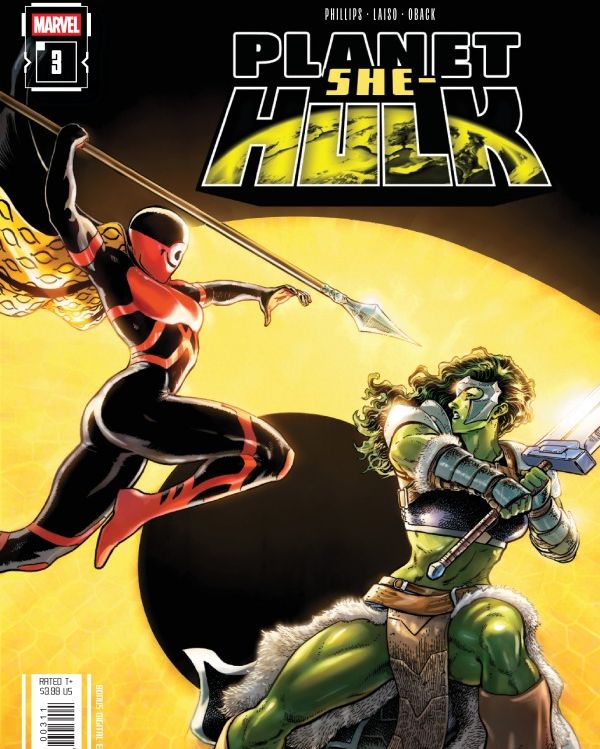
- Cover art by: Aaron Kuder, Sonia Oback (cover A)
- Cover price: $3.99
- Release date: January 21, 2026
Planet She-Hulk #3, by Marvel on 1/21/26, finds itself caught between political machinery grinding forward and Jennifer Walters discovering that her commitment to justice may cost her everything.
First Impressions
The opening slams you with immediate stakes, Korven dismissing his own people to their deaths while Jennifer scrambles to protect them from a Wildebot attack. It’s kinetic, visceral, and exactly what the series needed after issue two’s plodding exposition. Within two pages you understand that nothing on Sakaar works according to Jennifer’s moral compass, and that gap between her principles and Sakaar’s reality is about to tear the entire political structure apart.
Recap
After Myrren’s murder, Korven declared himself king in Planet She-Hulk #2 and ruled through fear rather than consent. Jennifer challenged his legitimacy, but Korven refused to listen. When a ceremonial duel between Jennifer and Juno failed to resolve anything, the conspiracy deepened. Quade, a popular gladiator, emerged as a democratic counter to Korven’s tyranny. During Korven’s coronation ceremony, the Thousand Eyes attacked with a Wildebot, Jennifer and Quade fought together to stop it, and Juno warned Jennifer that betrayal ran deeper than surface-level conflict. Korven publicly challenged Quade’s legitimacy. When Korven refused to fight honorably and ordered his army to kill Quade instead, Juno, the gladiators, and Jennifer stood with the challenger. The issue ended with the Thousand Eyes arriving with their killer robots, setting up a three-way conflict.
Plot Analysis
Issue three opens with the Wildebot attack in full chaos, Jennifer protecting civilians while Korven refuses to shield his own people, prioritizing his personal safety over Sakaar’s welfare. A character named Conrad dies protecting civilians, and Jennifer’s narration notes this isn’t even his first death that week, establishing how disposable life has become under Korven’s rule. As Jennifer lures the robot away, Korven interrupts his royal guard, demanding they protect him instead of his subjects. Jennifer’s internal monologue reflects on nineteen days of funerals, weddings, executions, and failed coronations, all while trying to honor her promise to Bruce Banner.
A confrontation between Jennifer and a Thousand Eyes member reveals the cult’s ideology, emphasizing Sakaar’s former strength and criticizing the planet’s reliance on outside saviors like the Hulks. Jennifer defends innocent people, and the Thousand Eyes member promises violent retribution on all who support either Korven or the people. The issue then pivots to Jennifer’s law school memory, her paper on justice versus order versus power, establishing the intellectual conflict driving her entire arc. This moment crystallizes her desperation to impose legal order on a world that has never known it.
Rowan Creed attempts to frame Quade by falsely claiming his daughter Elara told him that Quade is the Thousand Eyes leader and orchestrated the Wildebot attack to appear heroic. Korven accepts this evidence and arrests Quade for treason, murder, and conspiracy. Rowan manipulates Elara with threats of her own death if she doesn’t stay silent, and Elara begs Jennifer for help after her father drags Quade away in chains. Jennifer promises to help, convinced of his innocence because she witnessed Quade fighting the Thousand Eyes the previous day.
Korven offers Jennifer an unexpected proposition, a trial to determine Quade’s guilt or innocence using her legal knowledge. He reveals he’s been studying Jennifer, understanding her background as an attorney and her dedication to law and due process. Korven announces that Jennifer will serve as Quade’s defense attorney, while Jack of Hearts, an off-world character with cosmic power, will serve as prosecution. The issue ends with this ominous setup, suggesting Jennifer is about to fight for justice within a system designed to destroy her efforts and the person she’s trying to save.
Writing
Phillips makes a crucial tonal correction from issue two by opening with immediate action and consequence. The Wildebot sequence crackles with urgency, and Conrad’s death lands harder because it’s treated as casual tragedy rather than philosophical meditation. However, the issue immediately reverses this momentum once the action concludes, settling into expository dialogue that echoes the previous issue’s weaknesses. Jennifer’s law school reflection feels thematically important but arrives abruptly, breaking narrative flow to explain her character’s intellectual framework. The dialogue between Jennifer and the Thousand Eyes member reiterates the cult’s ideology without revealing anything new or compelling about their motivations beyond “old way good, new way bad.”
Rowan’s manipulation of both Korven and Elara unfolds credibly within the logic of the story, but the scene stretches across multiple exchanges where a single panel could communicate the same information. Korven’s revelation that he’s been studying Jennifer works dramatically, but the explanation of how he deduced her profession and values feels thin given the limited interactions they’ve shared. Pacing recovers in the final pages with Korven’s trial proposition, reestablishing urgency and stakes that immediately grab reader attention and promise genuine consequence. Overall, the issue oscillates between effective action and bloated exposition, never settling into a consistent rhythm that carries momentum through to the conclusion.
Art
Emilio Laiso and Sonia Oback deliver the series’ most visually dynamic work in the Wildebot sequence, with dynamic panel layouts that convey the robot’s massive scale against Jennifer’s smaller frame. Composition effectively communicates spatial relationships during the action, making the movement between Jennifer herding the Wildebot and Korven’s cowardice immediately readable. Color work shifts throughout the issue to reflect emotional tone, using warmer reds during moments of political manipulation and cooler shadows during Jennifer’s law school reflection. The close-up of Jennifer’s face as she realizes Korven’s strategy feels appropriately intense, with facial expression conveying her recognition of the trap she’s fallen into. However, extended dialogue scenes revert to the technical competence of issue two, where clear, readable panel work cannot overcome the repetitive talking points.
Character Development
Jennifer’s character arc gains significant weight in this issue, her law school reflection revealing the intellectual root of her need to impose justice on Sakaar. Her immediate trust in Quade’s innocence, based on a single day of observation, demonstrates both her faith in people and her potential blindness to manipulation. This inconsistency becomes the issue’s greatest strength; Jennifer’s legal mind conflicts with her emotional investment in Quade’s survival, creating internal conflict that could drive future issues. Korven emerges as more complex than issue two suggested, demonstrating not random tyranny but calculated manipulation. His study of Jennifer and strategic deployment of her own values against her shows intellectual depth beyond grief-driven rage. The trial proposal reveals him as a true antagonist who understands his opponent’s weaknesses and exploits them methodically.
Elara develops genuine emotional stakes through her fear and desperation, her willingness to break her father’s control by seeking Jennifer’s help establishing her as more than a political pawn. Rowan Creed finally receives character motivation, his betrayal of Quade driven by self-preservation and paternal manipulation rather than conviction. This complexity elevates him from a two-dimensional schemer to a desperate father willing to sacrifice an innocent person to protect his daughter. Quade remains largely passive across the issue, arrested and removed from the action before the reader gains insight into his response to the accusations. Jack of Hearts’ introduction lacks sufficient context for readers to understand his stakes or his connection to Korven, leaving him as a mysterious antagonist whose motivations remain obscure.
Originality & Concept Execution
The trial setup inverts the series’ central promise. Instead of Jennifer maintaining order through legal process, Korven appropriates that framework to ensure Quade’s conviction, transforming law into an instrument of tyranny. This corruption of Jennifer’s central value through the very system she believes in represents genuine thematic freshness. The concept of an alien legal proceeding where a cosmic-powered being serves as prosecutor, an off-world attorney defends an alien gladiator, and a tyrant king presides over the verdict creates inherent absurdity that feels appropriately disorienting. The Rowan Creed manipulation subplot grounds the political intrigue in personal betrayal, moving beyond abstract faction conflict to examine how violence and fear corrupt individual relationships.
However, the issue does not sufficiently develop the ideological core that made this series initially compelling. The Thousand Eyes remain underdeveloped antagonists with recycled critiques of relying on outside power, and the ideological conflict between Korven’s tyranny, Quade’s populism, and Jennifer’s legalism gets overwhelmed by plot mechanics. The concept of “legal drama meets alien gladiators” potentially carries genuine originality, but this issue treats the trial as a plot device rather than exploring what justice means when one participant controls all the rules. The setup promises more than it delivers on, leaving execution dependent entirely on how the next issue handles the actual trial proceedings.
Positives
The opening Wildebot sequence delivers exactly what issue two lacked: immediate stakes, visual clarity, and emotional consequence. Conrad’s death, treated as a casual tragedy, establishes how completely Korven abandons his people. Jennifer’s law school reflection effectively articulates her character motivation, making her commitment to legal justice comprehensible and grounded in her background as an attorney. Korven’s characterization deepens significantly here, moving from straightforward villain to calculated manipulator who studies his opponents and exploits their values. The trial setup serves as a brilliant narrative trap, forcing Jennifer to fight for Quade within a rigged system that embodies everything she opposes philosophically. This contradiction ensures future issues will explore whether justice can exist within tyranny, a genuinely compelling question.
Elara’s emotional vulnerability and Rowan’s desperate manipulation create personal stakes that elevate the political intrigue beyond faction conflict into human relationships. The issue’s final pages execute genuine tension, leaving readers uncertain whether Jennifer can actually save Quade or whether Korven has engineered his conviction before the trial even begins.
Negatives
The middle section stalls narrative momentum with extended dialogue that repeats information and ideology already established in previous issues. The Thousand Eyes member’s monologue about Sakaar’s history and reliance on Hulks adds nothing substantive to the cult’s characterization, essentially summarizing what readers already understand about their motivation. Jennifer’s interaction with this unnamed antagonist consumes pages without advancing plot or revealing new information about the threat Jennifer faces. Rowan Creed’s manipulation succeeds almost too easily, Korven accepting a transparent accusation without verification, which strains credibility despite the character’s demonstrated capacity for tyranny. The ease with which Rowan manipulates the situation raises questions about whether Korven actually intends to hold a fair trial or whether the entire trial is performance, a thread the issue introduces but fails to explore adequately.
Jack of Hearts enters the narrative completely unexplained, providing no context about who this cosmic-powered figure is or why he’s loyal to Korven. His sudden appearance as prosecutor generates questions the issue never addresses, leaving readers uncertain whether this character carries significance or represents arbitrary plot insertion, partly fueled by his past romantic connection to She-Hulk, The absence of any interaction between Jennifer and Jack, or explanation of their history or connection, wastes an opportunity to establish the prosecution’s threat. Jennifer’s immediate promise to help Quade, based on limited evidence of his innocence, potentially sets up a painful backtrack if he actually is involved in Thousand Eyes conspiracy. The issue doesn’t adequately prepare readers for this possibility, leaving ambiguity about whether Quade is genuinely innocent or whether Jennifer’s judgment has failed her.
About The Reviewer: Gabriel Hernandez is the Publisher & EIC of ComicalOpinions.com, a comics review site dedicated to indie, small, and mid-sized publishers.
Follow @ComicalOpinions on YouTube, Facebook, Instagram, and Twitter
The Scorecard
Writing Quality (Clarity & Pacing): [2/4]
Art Quality (Execution & Synergy): [3/4]
Value (Originality & Entertainment): [1/2]
Final Verdict
Planet She-Hulk #3 recovers enough momentum to justify reading it, but stumbles whenever it leaves action behind. The trial setup promises genuine consequences for Jennifer’s commitment to law and order, and Korven’s characterization finally demonstrates why he might represent a threat beyond simple villainy. However, the issue drowns compelling story setup in middle-section exposition that retreats to the exact dialogue problems issue two exhibited. You get an exciting opening, a thematically rich closing, and a whole lot of wheel-spinning in between.
6/10
We hope you found this article interesting. Come back for more reviews, previews, and opinions on comics, and don’t forget to follow us on social media:
Connect With Us Here: Weird Science DC Comics / Weird Science Marvel Comics
If you’re interested in this creator’s works, remember to let your Local Comic Shop know to find more of their work for you. They would appreciate the call, and so would we.
Click here to find your Local Comic Shop: www.ComicShopLocator.com
As an Amazon Associate, we earn revenue from qualifying purchases to help fund this site. Links to Blu-Rays, DVDs, Books, Movies, and more contained in this article are affiliate links. Please consider purchasing if you find something interesting, and thank you for your support.
 Weird Science Marvel Comics