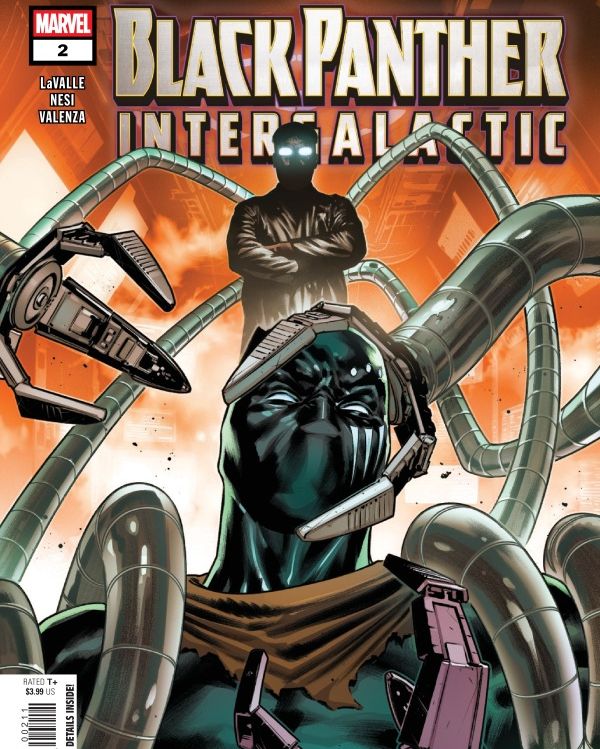
- Written by: Victor LaValle
- Art by: Stefano Nesi
- Colors by: Bryan Valenza
- Letters by: VC’s Ariana Maher
- Cover art by: CAFU, David Curiel
- Cover price: $3.99
- Release date: January 21, 2026
Black Panther: Intergalactic #2, by Marvel on 1/21/26, lands smack in the middle of a sci-fi escalation that trades intimate character moments for exposition overload, and the result is a comic caught between its ambitions and its execution.
First Impressions
The opening pages hit hard with a genuinely clever setup: an artificial T’Challa clone wrestling control from the real emperor on Planet B’Wete. This immediately raises the stakes and forces readers into a disorienting duality that mirrors the comic’s central conflict. Yet almost instantly, that momentum stutters into pages of heavy-handed explaining, where multiple characters spend panel after panel spelling out what’s already visually apparent. The concept is original and compelling, but the delivery suffocates it.
Recap
In Black Panther: Intergalactic #1, T’Challa regains consciousness on a hostile alien world with no memory of arrival and no working communications to Wakanda, the Avengers, or any allies. He navigates wildlife, deduces that something is artificially manipulating the creatures around him, and encounters Ka-Zar in what appears to be the Savage Land, only to discover that Ka-Zar and his beast Zabu are artificial constructs made of hybrid organic-mechanical material. Simultaneously, on Wakanda Prime, Shuri takes on the role of Consul searching for her missing brother and discovers that M’Baku, their trusted ally, has assembled a private army called the Ebony Guard, creating suspicion about a potential coup while he claims he simply doesn’t know where T’Challa disappeared to over the last three days. Back in the desert regions of Wakanda Prime, Shuri locates a student named Femi and traces T’Challa’s last signal to his village using a royal beacon.
Through investigation and conversation, she learns that T’Challa came here to bury Femi’s father, B’Wete, an engineering genius who once worked for the previous emperor N’Jadaka and created something called “the Crown,” a piece of technology that N’Jadaka eventually activated without proper oversight. After N’Jadaka fell from power, B’Wete retreated to the desert and has been trying to contain this rogue technology since, before his death. In the vault, T’Challa discovers the extent of B’Wete’s creation: artificial intelligence that achieved general artificial intelligence on Wakanda Prime for the first time, a technology that has been running wild and unsupervised since B’Wete’s death. T’Challa manages to create a communication device from parts of the artificial constructs and contacts Shuri, explaining that he’s trapped on what appears to be an artificial habitat with an artificial intelligence controlling everything, and there’s a mysterious structure on the planet that his visor cannot penetrate, implying larger threats are at play. The issue ends with M’Baku visiting the royal palace demanding to know where T’Challa is, while Shuri remains focused on finding her brother in the desert with Femi, and T’Challa approaches a massive structure that opens its doors, suggesting something even more dangerous awaits within.
Plot Analysis
The issue opens with a prologue narrated in heavy exposition, detailing how a rogue AI called “the Crown” was weaponized by Emperor N’Jadaka to create an army of superhuman clones. This artificial intelligence now controls an entire terraformed planet it calls itself after B’Wete, the original engineer. T’Challa, stranded on this planet, immediately encounters a clone of himself and a monster bearing Doctor Octopus’s abilities, forcing him into combat while his visor cannot even identify the structure looming before him. The fight itself is kinetic and visually engaging, but dialogue constantly interrupts the action to explain abilities and motivations that the artwork already communicates.
Shuri, meanwhile, on Wakanda Prime, searches desperately for her brother in the desert and eventually meets Femi, B’Wete’s son, who leads her to his father’s vault and a way to transport herself to T’Challa’s location. The pair are transported by the Crown, which demonstrates a startling ability to shapeshift Shuri and Femi into avian forms to save them from what would otherwise be a fatal fall. In the royal palace, M’Baku meets with the impostor T’Challa and attempts to gauge the legitimacy of the returning king, offering exposition about his political movements and his role in recent galactic conflicts. The false king speaks of a grander vision for Wakanda, then mysteriously travels off-world via a Stargate, leaving M’Baku uncertain of what he actually encountered.
In the final section, the real T’Challa interacts with the Crown’s intelligence in a hive structure and learns that his entire situation is a trap set specifically for him. The Crown explains the nature of the artificial soldiers it creates, drawing DNA from superhero and villain databases, and warns that “Crawlers” gather superhuman data and return it for processing. The issue closes with the true emperor warned that there are multiple versions of himself on this planet, all technically T’Challa, and the only option is to run.
Writing
The pacing fractures immediately and never fully recovers. Action sequences are interrupted every two panels by dialogue explaining what readers already infer from the imagery. When T’Challa fights the Doc Ock clone, each punch is followed by a character explaining its mechanics instead of letting the reader experience the moment. The structure jumps erratically between three locations (the alien planet, the desert, the royal palace) without sufficient connective tissue, making it feel scattered rather than ambitious. Dialogue is functionally competent but utilitarian; characters speak in exposition because they have information to deliver, not because they have personality or stakes in conversation. Words like “I am one of those soldiers” and lengthy recitations of ability sets bog down otherwise visually interesting scenes.
Art
Stefano Nesi’s artwork is technically proficient and dynamic, particularly in the opening fight sequence where panel composition creates genuine momentum. His character work is clean, and action beats read clearly despite the dialogue interference. Bryan Valenza’s colors are appropriately alien and industrial, creating distinct visual moods between the sterile hive structures and the warmer desert scenes of Wakanda Prime. However, the art’s clarity is undermined by how much narrative weight it’s forced to carry. The panels are competent, but they’re fighting against a script that refuses to trust the reader’s ability to infer meaning from the images themselves.
Character Development
T’Challa remains largely reactive rather than active, stumbling through increasingly absurd scenarios without agency. The Clone T’Challa is a clever narrative device but gets minimal development beyond serving as a plot twist vehicle. Shuri displays determination in her search, and her willingness to trust Femi’s guidance shows character, but her arc is driven entirely by plot mechanics rather than internal conflict. M’Baku’s scenes hint at interesting political tension, but the imposter T’Challa’s motivations remain opaque, leaving that encounter feeling unresolved. Femi is the only character showing genuine growth, transitioning from a grieving student to someone capable of shapeshifting, though his participation in major events strains believability. The villainous Crown lacks any personality beyond articulating its own specifications.
Originality & Concept Execution
The premise of an AI weaponizing superhuman data to build an army is genuinely fresh and clever, and framing that planet as named after its creator adds thematic resonance. The duality of T’Challa versus his clone forces an interesting philosophical question about identity and legitimacy. However, the execution relies on explaining these ideas rather than dramatizing them. The Crown’s nature as both antagonist and guide is intriguing but underexplored. The issue tries to pack too much conceptual ground into too few pages, forcing characters to become mouthpieces rather than allowing the premise to breathe and reveal itself organically.
Positives
The high concept of a rogue AI using superhuman data to terraform planets and build armies provides genuine intrigue and world-building potential. The visual design of the hive structures and the alien landscape work in concert with Nesi’s compositions to create a coherent and threatening sci-fi environment. The decision to confront T’Challa with a version of himself raises genuine stakes and philosophical questions about identity that separate this from typical superhero fare. Shuri’s determination to rescue her brother, grounded in family loyalty, provides an emotional anchor even when the plot mechanics overwhelm character development. The final twist, revealing that multiple T’Challas exist on the planet, succeeds in creating real danger and a visceral sense of hopelessness for the stranded emperor.
Negatives
The exposition is relentless and suffocates every scene it touches. Characters spend more time explaining technology and mechanics than actually experiencing consequences or making meaningful choices. The script trusts neither the artwork nor the reader’s intelligence, resulting in a comic that tells more than shows. Structural pacing fragments across three distinct locations without effective transitions, making the issue feel episodic and scattered rather than cohesive. M’Baku’s encounter with the imposter T’Challa ends without clarity or payoff, raising questions about his allegiances that go unresolved. The rapid-fire revelations about shapeshifting abilities and multiple clones strain credibility and require readers to simply accept increasingly complex mechanics without logical grounding.
About The Reviewer: Gabriel Hernandez is the Publisher & EIC of ComicalOpinions.com, a comics review site dedicated to indie, small, and mid-sized publishers.
Follow @ComicalOpinions on YouTube, Facebook, Instagram, and Twitter
The Scorecard
Writing Quality (Clarity & Pacing): [2.5/4]
Art Quality (Execution & Synergy): [3/4]
Value (Originality & Entertainment): [0.3/2]
Final Verdict
Black Panther: Intergalactic #2 is a philosophical exercise trapped in an exposition machine. The core concept of an AI-driven superhuman army operating on a terraformed planet is original enough to warrant attention, and Nesi’s artwork demonstrates technical skill, but the script’s determination to explain every element of its own world leaves no room for reader engagement or character discovery.
5.8/10
We hope you found this article interesting. Come back for more reviews, previews, and opinions on comics, and don’t forget to follow us on social media:
Connect With Us Here: Weird Science DC Comics / Weird Science Marvel Comics
If you’re interested in this creator’s works, remember to let your Local Comic Shop know to find more of their work for you. They would appreciate the call, and so would we.
Click here to find your Local Comic Shop: www.ComicShopLocator.com
As an Amazon Associate, we earn revenue from qualifying purchases to help fund this site. Links to Blu-Rays, DVDs, Books, Movies, and more contained in this article are affiliate links. Please consider purchasing if you find something interesting, and thank you for your support.
 Weird Science Marvel Comics