
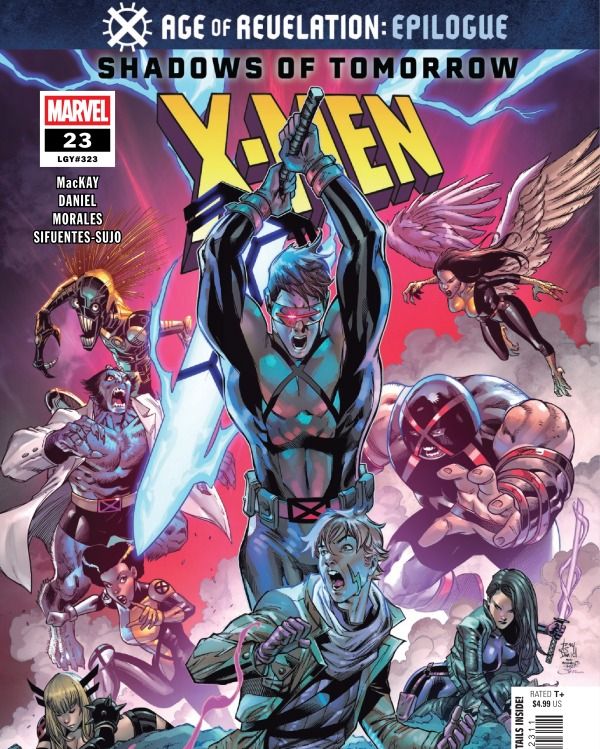
- Written by: Jed MacKay
- Art by: Tony Daniel, Mark Morales
- Colors by: Fer Sifuentes-Sujo
- Letters by: VC’s Clayton Cowles
- Cover art by: Tony Daniel, Mark Morales, Fer Sifuentes-Sujo
- Cover price: $4.99
- Release date: January 7, 2026
In X-Men #23, by Marvel on 1/7/26, the X-Men face an assassin wearing their leader’s face and a time-travel plot that unravels faster than the team can process it.
First Impressions
The opening pages crackle with genuine tension as Cyclops’s mysterious mental breakdown escalates into combat chaos. Future-Cyclops’s methodical takedown of the team, backed by ten years of tactical preparation, feels menacing and earned rather than cheap. MacKay and Daniel commit fully to the conflict, making every moment count before dropping the truth bomb that resets your understanding of everything that just happened.
Recap
In X-Men #22, the team, led by Magik, had recently dealt with the Upstarts and welcomed Doug Ramsey, Bei the Blood Moon, and Warlock to the team after they fled the Office of National Emergency’s pursuit. The trio sought refuge at the X-Men’s Alaska headquarters following an attack on their home. The previous issue ended with this somewhat muted acceptance of three new members, leaving tension unresolved beneath the surface. Now, in this issue, those tensions explode into the open.
Plot Analysis
The issue opens with Future-Cyclops waking in his younger body, immediately disoriented and convinced he’s under psychic attack. The team scrambles to help, unaware that their leader is actually a hostile consciousness from ten years hence, inserted into the present day to assassinate Doug Ramsey before he becomes the world-destroying Revelation. What follows is a brutal, calculated assault on the X-Men team by someone who spent a decade planning every contingency, every counter-move, and every team member’s likely response pattern. Future-Cyclops systematically targets each team member with precision, working with Magik’s younger self, Beast, and others as co-conspirators from the future.
The fight erupts as a tactical masterpiece, with Future-Cyclops narrating his methodology through Cyclops’s internal monologue. He studied the room layout, predicted every hero’s positioning, and prepared psychological pressure specifically calibrated to each team member’s weaknesses. Kid Omega struggles to contain him psychically while Psylocke closes in, but Future-Cyclops has spent ten years anticipating exactly how Psylocke would move. The momentum shifts only when Beast is revealed to still be present-Beast, and he disrupts future-Cyclops’s carefully planned attack, leading to future-Cyclops’s capture.
The conversation that follows, conducted in the brig between Future-Cyclops and Beast, becomes a philosophical reckoning. Future-Cyclops reveals his plan with chilling clarity. He came back to prevent the Age of Revelation, a future where Doug Ramsey’s powers transform him into an apocalypse-level threat. He’s willing to sacrifice his original self and even his own future partner, Beast, to accomplish the mission. The moral horror settles in: Future-Cyclops didn’t betray his friend on a whim. He made a calculated sacrifice because he lived through the consequences of Doug’s ascension. The issue ends with Doug’s final monologue about preventing the future he’s purported to create, and future-Cyclops trying to convince Magneto to help him. Future-Cyclops’s plan to enlist unravels when Magneto reveals he’s powerless, signaling the time future-Cyclops came back to has already changed.. Doug walks free, confident that the X-Men won’t kill him and that his destiny remains inevitable and elsewhere.
Writing
Jed MacKay orchestrates a tonal whiplash that works precisely because the structure demands it. The opening read as chaos, then reveals itself as calculated choreography through Future-Cyclops’s monologue. That pull-back perspective, where the reader suddenly understands the combat sequences through the assassin’s own internal narration, is textbook effective pacing. Dialogue crackles with purpose: Future-Cyclops’s clinical explanations of his ten-year planning cycle contrast sharply with the team’s panicked reactions and Beast’s emotional devastation upon learning the truth. The only structural weakness emerges in the final beats when Doug’s confidence feels slightly rushed, compressed into his monologue without enough breathing room to absorb the full weight of his unchecked power. MacKay prioritizes plot momentum over character development in those closing moments, which works but leaves readers wanting slightly more reflection.
Art
Tony Daniel and Mark Morales deliver kinetic fight choreography that never sacrifices clarity for visual noise. Every punch, dodge, and tactical position reads with absolute precision, which is essential since readers need to understand Future-Cyclops’s strategic layers while experiencing the X-Men’s confusion. Panel composition isolates moments of emotional impact, particularly in Beast’s breakdown and Magneto’s final scene. Fer Sifuentes-Sujo’s color work walks a tightrope between cool, clinical grays during the combat sequences and warmer, intimate tones in the brig conversation. The visual language subtly shifts your emotional register as the issue transitions from action to moral questioning. Cyclops’s optic blasts hit with particular force when Future-Cyclops deploys them, made more devastating by the knowledge that those attacks are powered by scientific precision rather than panic.
Character Development
Future-Cyclops emerges as a genuinely tragic antagonist. His motivations are crystal clear: he lived through a nightmare and came back to prevent it, consequences be damned. That’s compelling because it acknowledges that heroes sometimes make monstrous choices when backed into existential corners. Beast’s reaction carries weight because his character history with Cyclops gets weaponized against him. The conversation in the brig is brutal precisely because you understand both perspectives, though neither is purely sympathetic. Doug, conversely, lacks the depth needed to balance Future-Cyclops’s conviction. His monologues about destiny and change feel performative rather than deeply rooted in clear motivation. He talks about inevitability, but readers haven’t yet seen enough of his actual character to understand what drives his need to reshape the world beyond vague cosmic ambition. TBeast and other team members read as competent but somewhat reactive, which fits their current situation while leaving room for future character exploration.
Originality & Concept Execution
Time-travel murder plots are not new, but the execution here surprises by leaning into the moral weight rather than using time travel as a narrative escape hatch. Most superhero comics use time travel as setup; MacKay uses it as statement about sacrifice, necessity, and the impossibility of certainty even when you think you have perfect information. The premise of an older hero becoming the villain because future circumstances corrupted their ethics delivers genuine philosophical weight. However, the originality gets slightly undercut by the “assassin in hero’s body” trope, which Marvel has executed before with varying success. What saves it is MacKay’s commitment to actually exploring what motivates Future-Cyclops rather than treating him as a simple plot device. The Age of Revelation setup works because it generates real stakes; Doug could genuinely become as dangerous as Future-Cyclops fears.
Positives
The issue’s greatest strength is its refusal to treat Future-Cyclops as a simple villain. MacKay builds genuine sympathy for someone attempting murder through flashbacks and internal monologue. The ten-year planning cycle detail does the heavy lifting here; it transforms what could read as generic villainy into something tactile and earned. Daniel’s fight choreography deserves separate praise, as it manages to be both visually complex and strategically coherent, which is harder than it sounds in superhero comics. The moral complexity of Beast’s situation, where his future self actively conspired to help murder the present-day Doug, creates an emotional gut-punch that elevates the entire issue beyond standard time-travel fare. Sifuentes-Sujo’s color palette during the brig scenes adds psychological dimension, making confined conversations feel more claustrophobic and intimate than they have any right to be. This is the kind of issue that sticks with readers because it makes you think about sacrifice and certainty rather than just delivering cool action beats.
Negatives
The final act stumbles slightly by compressing Doug’s characterization into a single monologue, leaving him feeling like an idea rather than a person. Readers understand Future-Cyclops’s motivation with crystalline clarity, but Doug remains largely opaque, which makes it harder to accept him as the apocalyptic-level threat worth going back in time to assassinate. Magneto’s reinforced helmet limiting his powers gets only one line of explanation, which feels like a narrative convenience that could have used more setup or at least a callback to earlier volumes. The mechanics of how Future-Beast didn’t arrive or coordinated the plan also get glossed over, which creates minor logic gaps. Additionally, the issue assumes readers are deeply invested in the Age of Revelation concept from earlier teases; newcomers might feel lost regarding why this plot matters beyond “bad future person showed up.” These are relatively minor issues in an otherwise tight execution, but they prevent the issue from being a winner.
About The Reviewer: Gabriel Hernandez is the Publisher & EIC of ComicalOpinions.com, a comics review site dedicated to indie, small, and mid-sized publishers.Follow @ComicalOpinions on YouTube, Facebook, Instagram, and Twitter
The Scorecard
Writing Quality (Clarity & Pacing): [3/4]
Art Quality (Execution & Synergy): [3/4]
Value (Originality & Entertainment): [1/2]
Final Verdict
X-Men #23 swaps your emotional foundation, raises genuine stakes, and makes you care about what happens next. The moral complexity separates it from generic time-travel action, and the creative team’s execution is sharp enough to earn the premise’s ambitions. Your four dollars and ninety-nine cents get spent on a genuine conversation about sacrifice wrapped in kinetic visual storytelling.
7/10
We hope you found this article interesting. Come back for more reviews, previews, and opinions on comics, and don’t forget to follow us on social media:
Connect With Us Here: Weird Science DC Comics / Weird Science Marvel Comics
If you’re interested in this creator’s works, remember to let your Local Comic Shop know to find more of their work for you. They would appreciate the call, and so would we.
Click here to find your Local Comic Shop: www.ComicShopLocator.com
As an Amazon Associate, we earn revenue from qualifying purchases to help fund this site. Links to Blu-Rays, DVDs, Books, Movies, and more contained in this article are affiliate links. Please consider purchasing if you find something interesting, and thank you for your support.
 Weird Science Marvel Comics