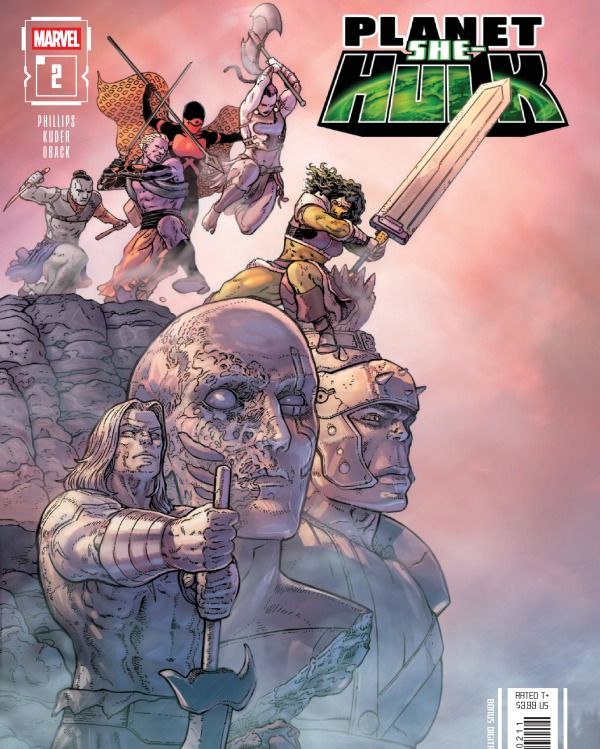
- Written by: Stephanie Phillips
- Art by: Aaron Kuder, Scott Hanna
- Colors by: Sonia Oback
- Letters by: VC’s Joe Caramagna
- Cover art by: Aaron Kuder, Sonia Oback (cover A)
- Cover price: $3.99
- Release date: December 17, 2025
Planet She-Hulk #2, by Marvel on 12/17/25, trades the kinetic energy of its predecessor for extended political posturing and verbal sparring that tests even Jennifer’s patience.
First Impressions
The opening pages dive straight into conflict and dialogue, with Korven declaring himself king in the aftermath of Myrren’s death. Jennifer’s reactions anchor the book emotionally, but the sheer volume of conversation about governance, process, and politics creates an immediate sense of stagnation. Within moments, you sense this issue prioritizes talking over doing, and that’s either your jam or it’s not.
Recap
In the previous issue, Jennifer Walters found herself begrudgingly attending the wedding of Korven Blackjaw to one of Hiro-Kala’s widows, expected to slaughter a ceremonial beast and negotiate for a spaceship to escape Sakaar. As festivities unfolded, she transformed from ceremonial killer to political pawn, manipulated by various factions pursuing power. Chaos erupted when the Thousand Eyes cult attacked the wedding, blood spilled, and Myrren, the bride, was murdered. The issue ended with She-Hulk battered but focused on her promise to Bruce Banner to protect the planet, leaving the stakes dramatically raised for the civil conflict to come.
Plot Analysis
Korven Blackjaw declares himself king of Sakaar following Myrren’s murder, justified by grief and blame toward Hiro-Kala’s legacy of relying on Hulks for power. Jennifer confronts him about the legality and morality of his rule, emphasizing due process and questioning whether a kingdom ruled through fear and violence can earn the trust of its people. When Korven refuses to listen, Jennifer’s frustration boils over and she tears apart a tree, venting her anger at Sakaar’s lawlessness before Juno, Hiro-Kala’s first wife and a formidable gladiator, intervenes to challenge her one-on-one.
The fight between Jennifer and Juno serves as the emotional core of the issue, with Jennifer struggling against Juno’s superior speed and blade work. During their combat, Juno calls Jennifer a “baby,” which Juno uses to her advantage, but Jennifer ultimately walks away from the confrontation rather than continue. Meanwhile, Rowan Creed and his daughter Elara discuss the political chaos unfolding on Sakaar, with Quade, a gladiator who commands the people’s support, emerging as a potential counter to Korven’s claim to the throne. Quade and Elara share an implied romantic connection despite Rowan’s disapproval, and Quade reveals his ambition to become king himself, believing he has the support and integrity Sakaar needs.
Juno confides in Jennifer that the Thousand Eyes likely didn’t kill Myrren themselves; instead, their attack provided cover for an assassination by someone else. This realization prompts Juno to warn Jennifer to watch her back, indicating betrayal and political manipulation run deeper than surface-level conflict. The issue concludes with Korven holding a ceremony to consolidate his power, declaring prosperity and swift justice, while Quade publicly challenges Korven’s legitimacy. When Korven refuses to fight one-on-one and instead orders his army to kill Quade, Juno and other supporters rally to Quade’s side, with Jennifer ultimately standing with the gladiators. The final page teases the arrival of the Thousand Eyes with their killer robots armed with laser beams, setting up a larger three-way conflict as the issue ends with “To Be Continued.”
Writing
The writing suffers from an over-reliance on expository dialogue that grinds narrative momentum to a halt. Scene after scene consists of characters explaining motivations, political factions, and philosophical positions rather than demonstrating them through action or interaction. Jennifer’s exchanges with Korven about due process and legal procedure, while thematically relevant to her character, stretch across multiple pages without advancing the plot meaningfully. The dialogue between Quade and Elara about metals and Sakaar’s metaphorical nature feels particularly deflating, using flowery metaphor when the story needs momentum. Structure is linear but mechanical, with conversations following a predictable pattern: exposition, philosophical debate, and gentle conflict resolution. Pacing lurches between static dialogue sequences and brief bursts of action, creating tonal whiplash. The issue takes twelve panels worth of conversation to accomplish what could be conveyed in three, signaling a script that trusts the reader’s intelligence far less than it should.
Art
Aaron Kuder and Scott Hanna deliver visually clean work that remains readable and dynamic even during extended conversations. Panel layouts efficiently guide the eye through dialogue-heavy scenes, and facial expressions convey character emotion when dialogue fails to. Sonia Oback’s color palette maintains Sakaar’s distinctive visual character, using warm reds and golden hues to reinforce the planet’s hostile environment and political heat. The fight between Jennifer and Juno stands out as the issue’s strongest visual sequence, with dynamic action poses and clear choreography that communicate speed and power. However, the art team’s clarity becomes a double-edged sword; by rendering dialogue scenes so clearly and readably, it makes the repetitive talking points even more apparent. The visual work is technically proficient but asked to carry weight that the script should be handling, and even excellent art cannot compensate for sluggish story progression.
Character Development
Jennifer remains the most compelling character, her frustration with Sakaar’s rejection of due process grounded in her background as a lawyer and her genuine desire to honor her promise to Bruce Banner. However, her character arc stalls across this issue; she repeats the same observation about Sakaar’s lawlessness multiple times without meaningfully growing or adapting her approach. Korven Blackjaw is driven by grief and vengeance but lacks internal complexity; he exists primarily to represent tyranny without nuance. Juno emerges as more interesting, her silence and blade work communicating more about her character than any monologue could accomplish. Quade’s ambitions are explained extensively but feel hollow because his motivations derive from philosophical debate rather than demonstrated capacity or earned trust. Elara exists primarily as a plot device rather than a character, her relationship with Quade serving a political narrative function rather than exploring genuine emotional stakes.
Secondary characters like Rowan Creed remain ciphers, defined by their function in the political structure rather than their individual personalities or arcs. The issue’s reliance on characters explaining themselves undermines the opportunity to show character development through action and conflict.
Originality & Concept Execution
The series premise of “legal drama meets gladiatorial fantasy” worked in the first issue because action and chaos disrupted the political posturing. Planet She-Hulk #2 leans entirely into political positioning without sufficient payoff, making the concept feel repetitive and thin. The question of whether Sakaar can function under law and order remains compelling in theory, but the execution defaults to characters explicitly stating this theme rather than exploring it through plot progression or meaningful character choices. Quade represents a fresh approach to Sakaar’s leadership through populist support rather than military strength or merchant wealth, but this is explained in dialogue rather than demonstrated through his actions. The twist that the Thousand Eyes may not have killed Myrren is narratively promising but arrives late and lacks sufficient investigation. The Thousand Eyes, the cult of “purists” fighting for old Sakaar, remain underdeveloped antagonists; their ideology is described but not dramatized. The concept execution falters because the issue spends its narrative capital on explaining what makes Sakaar interesting rather than showing readers why they should care about its political future.
Positives
Jennifer’s voice remains sharp and funny, her frustration with Sakaar’s lawlessness providing consistent character humor and emotional grounding. The visual clarity of the fight sequence between Jennifer and Juno demonstrates what the book does best, combining dynamic action choreography with readable panel work that lets the brutality and skill of both combatants shine. The introduction of the conspiracy surrounding Myrren’s murder adds narrative intrigue, suggesting future issues will explore hidden antagonists beyond the obvious factions. Quade’s emergence as a democratic alternative to Korven’s tyranny presents a potentially compelling political angle that goes beyond simple good-versus-evil storytelling. The creative team’s technical proficiency in art remains consistently high, with color work that reinforces mood and atmosphere throughout every scene.
Negatives: Buyer Beware
The issue’s dialogue-heavy structure creates pacing that feels slack and meandering, with multiple scenes serving no plot function beyond restating themes already established. Korven’s kingship announcement, the Jennifer-Juno fight, Quade’s ambition reveal, and the ceremony all cover the same thematic ground of competing visions for Sakaar’s future without sufficient narrative progress. Characters engage in lengthy explanations of political philosophy and personal motivation when their actions should communicate their stakes. Myrren’s murder, which should drive the investigation forward, instead triggers an extended conversation about due process that circles back on itself repeatedly. The mysterious assassination conspiracy arrives too late in the issue to generate momentum, and Jennifer’s detective work amounts to a single deduction delivered in one scene. The portrayal of Sakaar’s factions lacks distinctiveness; political speeches blur together into generic fantasy political rhetoric that could apply to any planet in any comic. For readers seeking action, character development, or plot progression, this issue delivers none of these in meaningful measure. The promise of laser-wielding killer robots in the final panel cannot overcome the tedious 20 pages that preceded it.
About The Reviewer: Gabriel Hernandez is the Publisher & EIC of ComicalOpinions.com, a comics review site dedicated to indie, small, and mid-sized publishers.
Follow @ComicalOpinions on YouTube, Facebook, Instagram, and Twitter
The Scorecard
Writing Quality (Clarity & Pacing): [1.5/4]
Art Quality (Execution & Synergy): [3/4]
Value (Originality & Entertainment): [0/2]
Final Verdict
Planet She-Hulk #2 confuses philosophical posturing for narrative momentum, creating an issue that prioritizes talking about governance over demonstrating Sakaar’s struggle through action and consequence. Jennifer’s frustration becomes the reader’s frustration; twelve days on a chaotic planet and she’s still explaining why chaos is bad, like she’s lecturing rather than fighting for survival. The first issue balanced wit with spectacle; this one drowns spectacle in exposition and expects you to remain invested through sheer force of character voice. Skip this issue unless you have three dollars to spend on a feature-length conversation about political process.
4.5/10
We hope you found this article interesting. Come back for more reviews, previews, and opinions on comics, and don’t forget to follow us on social media:
Connect With Us Here: Weird Science DC Comics / Weird Science Marvel Comics
If you’re interested in this creator’s works, remember to let your Local Comic Shop know to find more of their work for you. They would appreciate the call, and so would we.
Click here to find your Local Comic Shop: www.ComicShopLocator.com
As an Amazon Associate, we earn revenue from qualifying purchases to help fund this site. Links to Blu-Rays, DVDs, Books, Movies, and more contained in this article are affiliate links. Please consider purchasing if you find something interesting, and thank you for your support.
 Weird Science Marvel Comics