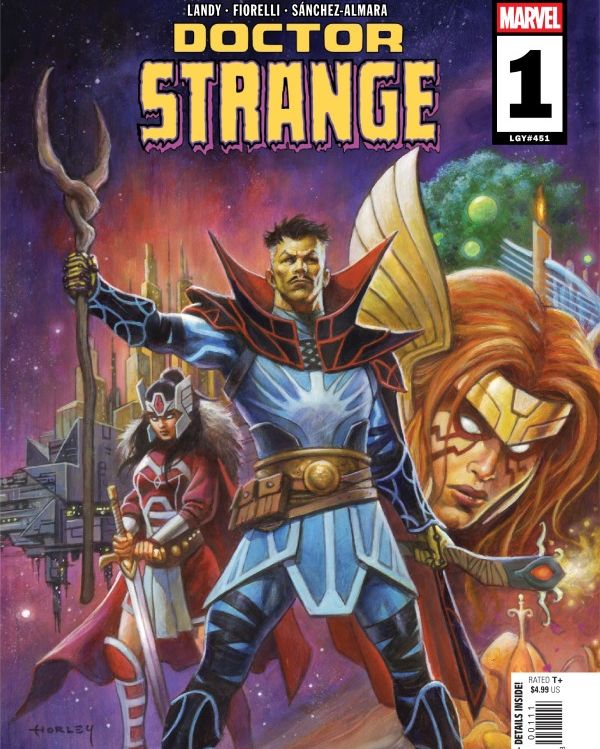
- Written by: Derek Landy
- Art by: Ivan Fiorelli
- Colors by: Dono Sanchez-Almora
- Letters by: VC’s Cory Petit
- Cover art by: Alex Horley (cover A)
- Cover price: $4.99
- Release date: December 3, 2025
Doctor Strange #1, by Marvel on 12/3/25, finds the Sorcerer Supreme of Asgard making a house call where a dead wizard in a coffin becomes a very expensive problem for light elves, angels, and anyone who likes children alive.
First Impressions
The opening pages give a clean, fast setup: Strange is stuck in Asgard, raging at the universe that will not even let him open a portal home, while a pair of talkative ravens mock his mood and tee up Lady Sif’s entrance; it feels like the book knows it has to justify yet another relaunch, so it wastes no time framing his new status quo as both consequence and punishment. The captions and dialogue quickly tie his exile, his role as Sorcerer Supreme of Asgard, and Thor’s death into one sharp problem statement. Emotionally, the hook lands because “man who wanted power to fix everything accidentally helped break everything” is spelled out in concrete beats, not vague angst.
Plot Analysis
Strange tries and fails to open a portal from Asgard back to Earth using the Staff of Yggdrasil, complete with a splinter of the World Tree he tore out himself, and realizes he is truly cut off from Midgard. Odin’s ravens, Huginn and Muninn, comment on his misery until Lady Sif arrives, reminding him that he came to Asgard for power after being swindled out of Sorcerer Supreme on Earth, conspired with Loki, and helped set in motion the events that ended with Loki killing Thor and Earth being severed from the other realms. Sif makes it clear she does not want excuses or another one of Loki’s allies underfoot, but she is willing to use Strange as a tool, sending him to Alfheim to handle a delicate situation involving both the Light Elves and the angels of Heven.
In Alfheim’s capital of Ljosalfgard, Strange meets Angela, the deadly angel mercenary he hired to help manage the factions, and she offers sincere condolences for Thor’s death before escorting him to a cave system opened after the War of the Realms. There he encounters Rhialla, daughter of Regent Idyl of Heven, who informs him there is a dead elf in an iron coffin whom the angels want to decapitate, but Light Elf customs forbid such desecration of royal remains. Inside, Queen Aelsa of Alfheim and Regent Idyl argue, and Idyl explains that the corpse belongs to Vyrbodin, a wizard so dangerous Odin contracted two choirs of angels to hunt him down; she killed him, bound his body in the coffin, and buried him, but because she never produced the corpse as proof, the contract has stained Heven’s history ever since.
Aelsa reveals that Vyrbodin was also her own grandson, so she refuses to allow his beheading even though she despised him in life, while Idyl insists contracts never lapse and must be fulfilled or canceled, not simply forgotten. Strange proposes a compromise: as Sorcerer Supreme and a medical doctor, he will examine the body in private, confirm that it is Vyrbodin, and then have the remains reburied according to Light Elf tradition, which both rulers grudgingly accept. Afterward, Idyl pulls Strange aside and warns that Vyrbodin is not actually dead and will awaken when the coffin opens; she begs Strange to take his head immediately for the sake of her daughter and her people, although Strange refuses to break his word, instead promising to place a stasis spell around the coffin that will preserve its current state once the elves rebury it.
The coffin is moved to the royal hospital, where Strange lies about needing hours to build a powerful shield, even though he can assemble it quickly, and he reflects that the awakening may already have been triggered by the cave’s discovery. When he opens the coffin, Vyrbodin revives in a rush of manic energy and immediately smashes Strange’s shield, casually demonstrating a form of “Scythe magic” that draws power from events that did not happen, and from the gap between what is and what could have been, rather than from normal mystical sources. As angels and Asgardian magic collide with Vyrbodin’s warped techniques, one of Idyl’s angels appears as a twisted version of Rhialla, leading to a brutal fight where Strange uses conjured weapons while Angela hacks through foes, and Vyrbodin finally lays out his plan: to harvest the energies of all lives altered by world-changing events and use that power to slaughter every living child across the realms. Horrified, Strange and Angela regroup behind his shield, and Strange warns Angela that the “next bit” will not be fun, as the issue ends on a cliffhanger with Vyrbodin’s threat fully stated and “To be continued” promising the fallout.
Writing
The pacing is brisk and segmented, with the issue moving from Asgard setup to Alfheim diplomacy to hospital horror without dead air, but the density of exposition sometimes piles up, especially during Idyl’s contract monologue and Vyrbodin’s magic lecture. Dialogue is functional and clear, giving each faction a distinct voice; Sif is blunt, Angela is dry and formal, Idyl is tightly wound around duty, and Vyrbodin chatters like a delighted cosmic sociopath, which makes the stakes easy to track even as the lore stacks. Structurally, the script is tidy: it frames Strange’s guilt, hands him a specific problem, escalates it into a moral and magical nightmare, and ends at a natural “oh no” beat that sells the next issue without feeling like a mid-sentence cut.
Art
The art keeps action and dialogue-heavy council scenes legible, with character placement and panel composition making it clear who holds power in each room, whether it is Sif dressing Strange down, Aelsa and Idyl arguing over the coffin, or Angela stepping between factions. In the hospital sequence, the layouts shift into more dynamic, explosive panels once Vyrbodin wakes, using motion lines, impact shots, and altered panel borders to sell how his Scythe magic literally cracks Strange’s carefully built defenses. Color choices support mood shifts, with the warm golds and ethereal pastels of Alfheim contrasting against the colder, eerie tones around the iron coffin and the harsher, more saturated palette when violence breaks loose, which helps the reader feel each escalation even before reading the word balloons.
Character Development
Strange’s motivation is explicit: he needs power and solutions to return to Earth and face Doom, but his earlier choice to keep Loki’s secret directly contributed to Thor’s death and his own exile, and the script lets him sit in that guilt while still pushing him to be useful. Sif’s distrust and Idyl’s desperation are both grounded in clear stakes, with Sif wanting Loki’s allies out of Asgard’s way and Idyl trying to erase a historic stain and protect her daughter, which makes their choices feel consistent even when they pull Strange in conflicting directions. Vyrbodin is less nuanced and more concept-driven, essentially a walking thesis on Scythe magic and genocidal intent, but his enthusiasm and warped sense of wonder give him a distinct personality that plays well against Strange’s weary sarcasm.
Originality & Concept Execution
Planting Doctor Strange as Sorcerer Supreme of Asgard, stuck off Earth after Thor’s death, gives the book a clear premise that separates it from “generic Sanctum Sanctorum problems,” and the script follows through by tying every conflict to Asgardian politics plus inter-realm obligations. The Scythe magic hook, built around unrealized events and missed possibilities, is a clever spin on magic systems, and it is not just flavor text; Vyrbodin uses it in combat and monologue, which makes the concept feel integrated rather than stapled on. The dead wizard in a royal coffin, angels arguing over contract fulfillment, and an aunt-queen who hates her murderous grandson but still defends his corpse, form a solid, specific scenario that leans into “mythic bureaucracy” in a way that fits Strange’s new job description.
Positives
The issue’s strongest asset is how cleanly it sets the chessboard: within one installment you know Strange’s new role, his mistake with Loki, why Sif barely tolerates him, and how his first assignment ties into larger realm-wide tension, which is efficient setup for an ongoing. The core conflict around Vyrbodin’s coffin uses concrete rules and customs, from Light Elf burial tradition to angelic contracts, so every argument and compromise feels like a measurable step rather than vague drama, and when things go wrong, it is because specific agreements collide with a very specific horror. On top of that, the Scythe magic explanation, while talky, gives this villain an identifiable edge and a clear thematic lane, which raises the ceiling for future issues if the series keeps paying off that idea in varied ways.
Negatives
The script leans hard on exposition, and readers who are not already comfortable with Asgard, Alfheim, Heven, or prior Strange status shifts may feel like they walked into a season premiere that expects homework, since a lot of the emotional weight is carried by dialogue references to off-page events. Vyrbodin’s big speech about missed-moment magic reads like a lore dump at the exact point where the plot could use a tighter, more immediate threat, and the genocidal “kill all children in the realms” plan lands as overkill that flattens nuance instead of deepening it. The cliffhanger gives a clear “this is bad” stopping point, but not much emotional closure for Strange beyond reactive horror, so anyone hoping for a fuller internal beat or a more self-contained first-issue experience may feel like they bought the first half of a story rather than a complete chapter.
About The Reviewer: Gabriel Hernandez is the Publisher & EIC of ComicalOpinions.com, a comics review site dedicated to indie, small, and mid-sized publishers.Follow @ComicalOpinions on YouTube, Facebook, Instagram, and Twitter
The Scorecard
Writing Quality (Clarity & Pacing): [3.5/4]
Art Quality (Execution & Synergy): [3/4]
Value (Originality & Entertainment): [1.5/2]
Final Verdict
Doctor Strange #1 is a entertainingly solid first issue that gives you a clear premise, a nasty magical threat, and a specific political mess for Strange to solve, but it also demands a bit of patience for lore dumps and an over-the-top villain plan. If your comic budget is tight and you want a fully self-contained sampler, this might feel more like a paid prologue, but if you are into Strange juggling divine contracts and weird new magic systems, this is a reasonably safe buy with upside for future issues.
8/10
We hope you found this article interesting. Come back for more reviews, previews, and opinions on comics, and don’t forget to follow us on social media:
Connect With Us Here: Weird Science DC Comics / Weird Science Marvel Comics
If you’re interested in this creator’s works, remember to let your Local Comic Shop know to find more of their work for you. They would appreciate the call, and so would we.
Click here to find your Local Comic Shop: www.ComicShopLocator.com
As an Amazon Associate, we earn revenue from qualifying purchases to help fund this site. Links to Blu-Rays, DVDs, Books, Movies, and more contained in this article are affiliate links. Please consider purchasing if you find something interesting, and thank you for your support.
 Weird Science Marvel Comics