
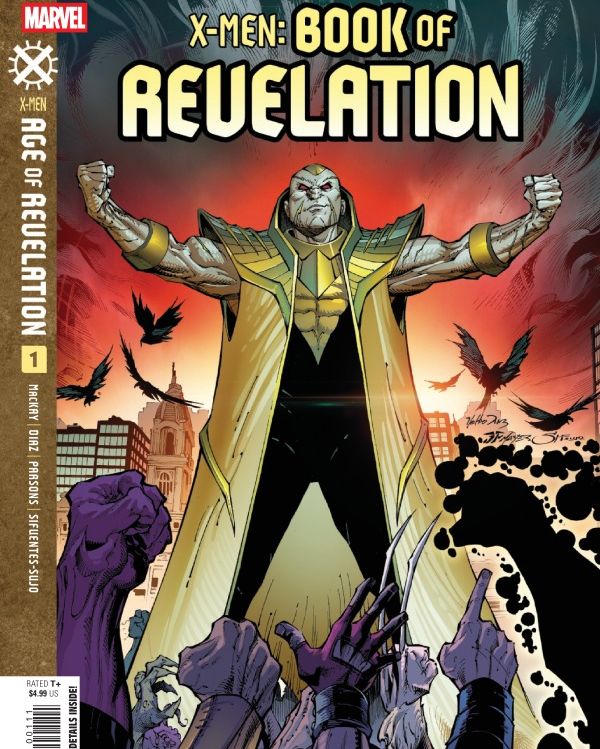
- Written by: Jed MacKay
- Art by: Netho Diaz, Sean Parsons
- Colors by: Fer Sifuentes-Sujo
- Letters by: VC’s Clayton Cowles
- Cover art by: Netho Diaz (Cover A))
- Cover price: $4.99
- Release date: October 22, 2025
X-Men: Book of Revelation #1, by Marvel on 10/22/25, follows Doug Ramsey (now calling himself Revelation), where words themselves are weapons. But as his newest recruit Elbecca Voss struggles with fear, doubt, and ghost stories, the comic takes its time revealing what’s truly haunting Philadelphia’s mutant utopia.
First Impressions
At first glance, this issue feels heavy on talk and light on thrill. The art pops with sharp detailing, yet the story crawls when it should sprint. It’s a political sermon in a superhero costume, saved only by one haunting twist that hits just when you start checking the page count.
Plot Analysis
The story begins with the world reshaped by the X-Virus after a Gene Bomb turned much of America into the mutant-ruled Revelation Territories. Doug Ramsey, once the soft-spoken Cypher, now rules over this land as the messianic “Revelation.” His subjects worship language itself, with mutant “Choristers” serving him by amplifying others’ powers through melody and command. Into this hierarchy steps Elbecca Voss, a new recruit terrified of the role thrust upon her.
Elbecca’s induction is marked by unease. Her mentor, Fabian Cortez, mocks her, while Revelation’s calm charisma masks authoritarian control. Strange whispers about a “Ghost of Philadelphia” fill the halls, hinting at unrest beneath the regime’s glossy façade. At night, Elbecca hears the ghostly voice herself, a chilling tremor that cuts the comic’s slow political rhythm with real dread.
Soon after, Revelation meets a delegation from Arakko led by Death, one of Apocalypse’s Horsemen. What should be diplomacy quickly explodes into tension when Death condemns Revelation for defying his father’s will. The exchange turns into a gripping standoff of words and wills, revealing Doug’s pride and grief over his dead wife, Bei the Blood Moon. His fury nearly costs them peace as he slays Death’s authority, if not the Horseman himself.
In the final pages, Cortez’s contempt turns violent as he attacks Elbecca out of jealousy. The ghostly voice returns to save her, urging her to use her powers, moments before Kitty Pryde, phasing out of the shadows, reveals herself as the “Ghost of Philadelphia.” It’s a stunning reveal that lands with surgical precision, reframing the horror elements as subterfuge and setting up a larger X-Men infiltration arc to come.
Writing
Jed MacKay’s script is cerebral, leaning into authoritarian theatrics and linguistic control. His dialogue for Revelation brims with charisma, though long stretches of exposition weigh it down. The pacing suffers from dense speeches that stall emotional momentum, with dramatic events – like Revelation’s confrontation with Death – playing second fiddle to political rhetoric.
Art
Netho Diaz’s art, aided by Sean Parsons’ inks and Fer Sifuentes-Sujo’s lush colors, carries the comic even when the script sags. Every panel feels meticulously constructed. The contrast between Revelation’s immaculate architecture and Elbecca’s expressive fear underscores the tension between control and vulnerability. The final page twist, rendered with haunting shadows and the spectral glow of Kitty’s arrival, is the visual knockout the story needed.
Characters
Elbecca emerges as the emotional anchor: a young mutant torn between reverence and rebellion. Revelation radiates menace dressed in civility, a dictator who believes in his own benevolence. Cortez is delightfully slimy, and though Death’s cameo feels brief, it injects long-awaited tension into an otherwise static issue. Kitty’s reveal rescues the pacing, promising the kind of conflict this series desperately needs.
Positives
The art is the unbroken spine of the issue. Diaz’s crisp linework and Sujo’s commanding color palette elevate every page. The last-page reveal of Kitty Pryde is not just clever but cathartic, turning a ghost story into an infiltration tale. Revelation’s concept about a ruler who governs language and communication is fascinating, rich with potential that outshines the execution.
Negatives
The problem isn’t the worldbuilding; it’s the yawning lull between moments of consequence. Pages upon pages of formal dialogue smother urgency. The promised “revelation” feels buried beneath politics, and the lack of direct X-Men involvement makes it hard to connect emotionally to the central conflict. Without Kitty’s dramatic appearance, this issue would drift like static.
About The Reviewer: Gabriel Hernandez is the Publisher & EIC of ComicalOpinions.com, a comics review site dedicated to indie, small, and mid-sized publishers.Follow @ComicalOpinions on YouTube, Facebook, Instagram, and Twitter
Final Thoughts
X-Men: Book of Revelation #1 is a slow-burning sermon that occasionally sparks into something greater. The pacing may nod off mid-monologue, but when it’s good (like that knockout final page) it’s really good. The art soars, the setup intrigues, and the ghost finally gives the story a pulse. If only the script trusted its own silence half as much as it trusts its speeches.
6.5/10
We hope you found this article interesting. Come back for more reviews, previews, and opinions on comics, and don’t forget to follow us on social media:
Connect With Us Here: Weird Science DC Comics / Weird Science Marvel Comics
If you’re interested in this creator’s works, remember to let your Local Comic Shop know to find more of their work for you. They would appreciate the call, and so would we.
Click here to find your Local Comic Shop: www.ComicShopLocator.com
As an Amazon Associate, we earn revenue from qualifying purchases to help fund this site. Links to Blu-Rays, DVDs, Books, Movies, and more contained in this article are affiliate links. Please consider purchasing if you find something interesting, and thank you for your support.
 Weird Science Marvel Comics