- Written by: Christopher Priest
- Art by: Joe Quesada
- Colors by: Richard Isanove
- Letters by: Richard Starkings, Tyler Smith
- Cover art by: Joe Quesada, Richard Isanove (cover A)
- Cover price: $4.99
- Release date: July 16, 2025
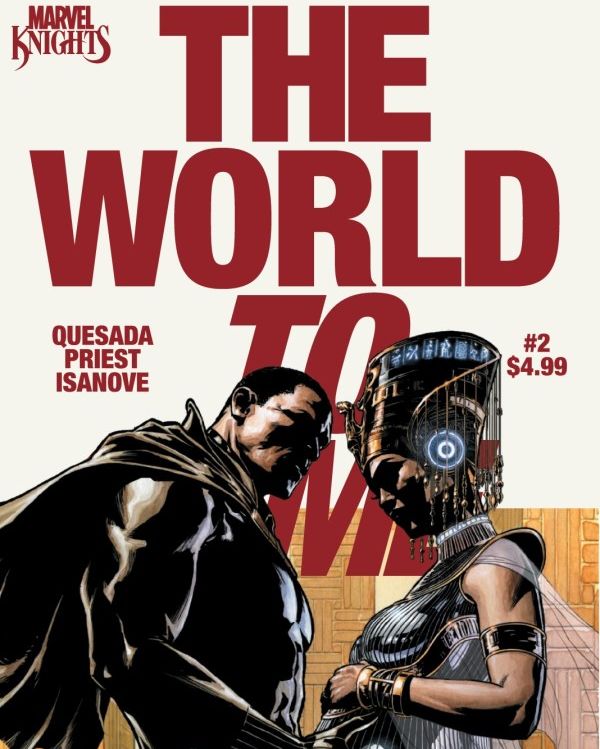
Marvel Knights: The World to Come #2, by Marvel on 7/16/25, thrusts readers into a fragmented narrative spanning multiple timelines, revealing a critical challenge for the Wakandan throne and a deep dive into the troubled past of Everett K. Ross.
First Impressions
This issue hits you with a jumbled sense of time and place, making for a disorienting, if somewhat intriguing, initial read. While the artwork immediately grabs your attention with its strong visuals, the story struggles to find its footing, leaving you more puzzled than captivated.
Recap
In Marvel Knights: The World to Come #1, set in a desolate future where water is scarce, the story plunges into a generational struggle for the Wakandan throne. The narrative unfolds in reverse, interspersing scenes of an aging King T’Challa fighting his biological son, Ketema, in a ritual combat for kingship. An old rebel from the Aquamarines resistance group narrates the history of Wakanda’s lineage to a young Dora Milaje member who brings news of the king’s death. The issue reveals T’Challa’s marriage to Monica Lynne and his repeated pleas for Ketema to yield, even after his son falls over a waterfall. The comic concludes with a shocking twist: Ketema, a zealot for ancient Wakandan ways, is revealed to be a white, blonde-haired man, a revelation sure to ignite conversation among readers.
Plot Analysis
The comic opens with an elderly Everett K. Ross narrating events eight years before “The World to Come,” describing a challenge for the Wakandan throne at Warrior Falls between King T’Challa and his son, Ketema. The narrative then abruptly jumps back 24 years before “The World to Come” to the J. Edgar Hoover Building, where a younger Ross reflects on his past as a diplomat and his current mundane job at Justice. He details the societal upheaval caused by a “Race War” and the mind-control drug “Z,” which ultimately led to him being offered a dangerous field assignment, a mission “no one talks about,” the kind you “don’t come BACK from”.
Ross’s past continues to unfold with the introduction of Noelle Adams, whom he is currently dating and who is later revealed to be Nikki’s twin sister—Nikki being a woman Ross loved but has since died. Their interactions are strained, filled with sarcastic jabs and a general sense of unease, particularly when Noelle insists on being taken to “Schnitzer’s for the Marble Rye” amidst heavy traffic. Ross’s increasing frustration is evident as he contemplates suffocating himself with a pack of cigarettes he was sent to buy.
The story shifts again, revealing a timeline in Mexico, Chihuahua, eight years before “The World to Come,” where Everett K. Ross, presumed dead, is actually infiltrating drug cartels with a partner known as “El Viejo General.” Meanwhile, (former Queen) Monica Lynne, concerned about King T’Challa’s errors regarding the succession, tracks down Ross. She reveals Ketema’s true biological father is Ross, bought by T’Challa after his biological son with Moinica Lynne died during child birth, and she urges him to return to Wakanda to prevent a disastrous tribal challenge.
The issue culminates as Queen Monica liberates three panther cubs from the sacred High Temple in Wakanda and leads Ross to Warrior Falls, where Ketema’s tribal challenge is underway. This pivotal event, as narrated by the future Everett Ross, is presented as the direct catalyst for “the end of the Old World… and emergence of the World to Come.” The various timelines and character introductions contribute to a complex, albeit fragmented, portrayal of events leading up to this significant turning point in Wakandan history.
Detailed Review
Story
The writing in Marvel Knights: The World to Come #2 is a mess. The dialogue often feels clunky and unnatural, with characters speaking in riddles or making seemingly random observations that do little to advance the plot. The flow of the narrative is awkward, constantly jumping between timelines without clear transitions, leaving the reader confused rather than intrigued. The plot itself is muddy, with key details about the “Race War” and the “Z” drug hinted at but never fully explained, making it difficult to grasp the stakes or motivations of the characters. While the idea of a fragmented narrative can be effective, here it just feels disjointed and poorly executed.
Art
On the flip side, the art is genuinely a standout. The visuals are sharp and dynamic, particularly in the action sequences and the detailed depictions of Wakandan landscapes and architecture. The character designs are distinctive, and the artists do an excellent job of conveying emotion, even when the script falls flat. The coloring is rich and vibrant, adding depth and atmosphere to each scene. Despite the narrative’s shortcomings, the artwork provides a compelling visual experience that keeps you turning the pages.
Characters
Everett K. Ross is clearly the central figure, and his sardonic narration provides a unique, if at times exasperating, perspective. However, the other characters, like Noelle and Queen Monica, feel underdeveloped. Their motivations are unclear, and their interactions with Ross often come across as forced or overly cryptic. It’s hard to connect with anyone when the dialogue is so stilted and the plot so opaque.
Positives
The artistic team truly shines in this issue, delivering stunning visuals that elevate the reading experience despite the convoluted narrative. The dynamic panel layouts and expressive character art create a vivid world, making the action sequences particularly impactful. Every page is a testament to the artists’ skill, showcasing intricate details and atmospheric coloring that draw the eye and maintain visual interest throughout the comic. The commitment to crafting such a strong visual identity provides a compelling reason to engage with the comic, even when the story struggles to keep pace.
Negatives
Unfortunately, the writing is the comic’s Achilles’ heel, burdened by clunky dialogue that feels forced and unnatural, leading to awkward exchanges that pull you right out of the story. The narrative’s flow is a choppy mess, bouncing erratically between timelines without clear purpose, making it nearly impossible to follow a coherent plot or understand the characters’ journey. This disjointed approach creates a muddy, confusing storyline where critical plot points are obscured by unnecessary tangents and an overall lack of clarity, ultimately undermining any potential for emotional connection or narrative impact.
About The Reviewer: Gabriel Hernandez is the Publisher & EIC of ComicalOpinions.com, a comics review site dedicated to indie, small, and mid-sized publishers.
Follow @ComicalOpinions on YouTube, Facebook, Instagram, and Twitter
Final Thoughts
Marvel Knights: The World to Come #2 is a visually impressive comic dragged down by its own narrative ambition. While the art is undeniably top-tier, the muddled plot, clunky dialogue, and awkward pacing make for a frustrating read. It’s clear there are interesting ideas at play, but they get lost in translation. This issue ultimately feels like a missed opportunity to deliver a compelling story.
5/10
We hope you found this article interesting. Come back for more reviews, previews, and opinions on comics, and don’t forget to follow us on social media:
Connect With Us Here: Weird Science DC Comics / Weird Science Marvel Comics
If you’re interested in this creator’s works, remember to let your Local Comic Shop know to find more of their work for you. They would appreciate the call, and so would we.
Click here to find your Local Comic Shop: www.ComicShopLocator.com
As an Amazon Associate, we earn revenue from qualifying purchases to help fund this site. Links to Blu-Rays, DVDs, Books, Movies, and more contained in this article are affiliate links. Please consider purchasing if you find something interesting, and thank you for your support.
 Weird Science Marvel Comics